Wind Turbine Technician Course in Belfast
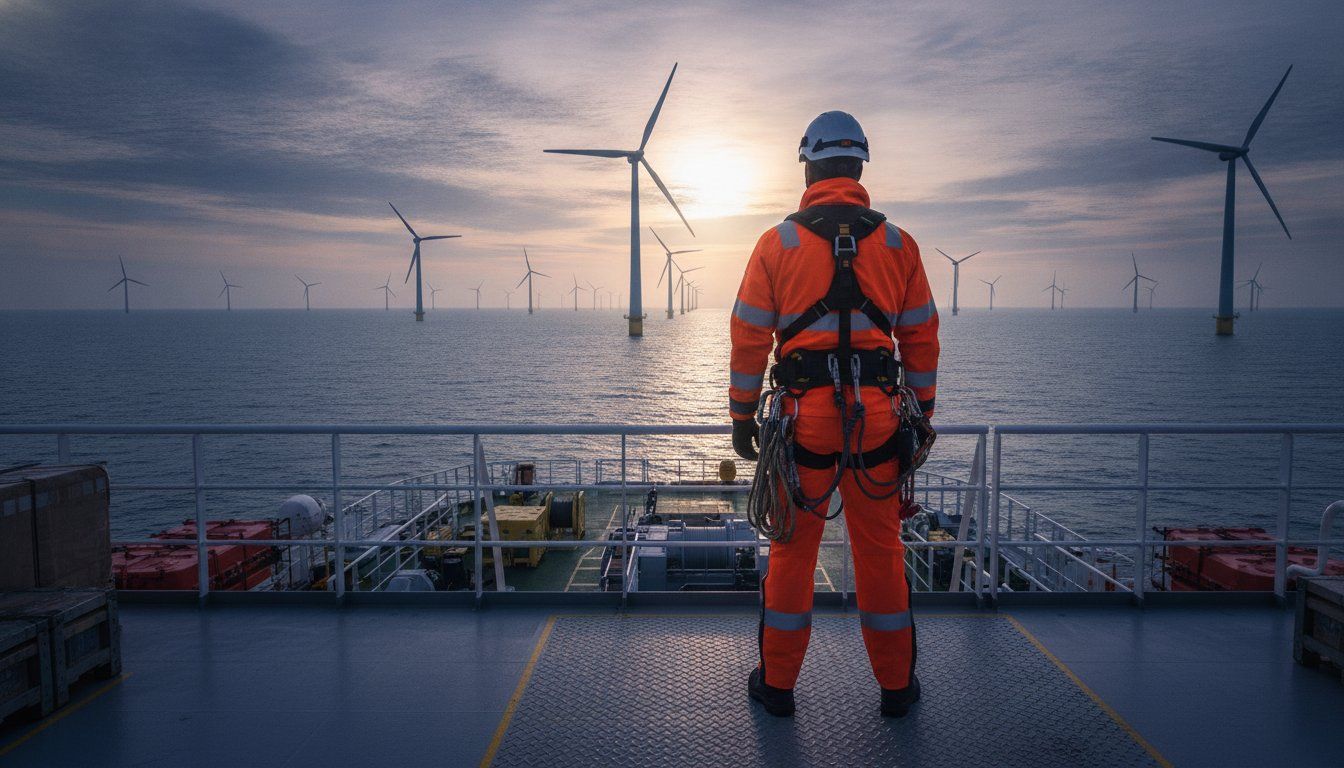
By 2030, the UK offshore wind sector will require over 104,000 workers, yet many aspiring technicians are stalled by a "certification trap" where they hold the wrong papers for the right jobs. It's frustrating to face a wall of technical jargon when you're simply trying to find a legitimate wind turbine technician course that guarantees site-readiness. You might feel anxious about the physical demands of working at height or confused by the conflicting advice regarding mandatory OEUK medical standards.
We believe that entering this high-growth industry should be a structured, transparent process. This article clarifies the exact training pathway you need, from the latest GWO Basic Safety Training modules to the advanced IRATA rope access skills that set top-tier candidates apart. You'll learn about the unique Belfast advantage, where training is led by active industrial experts rather than classroom theorists. We'll break down the essential certifications and medical requirements to ensure your career transition is both safe and successful.
Key Takeaways
- Gain insight into the UK's offshore wind expansion and the technical requirements of daily life on a turbine.
- Clarify the mandatory GWO certification modules required for site access amongst major energy developers.
- Understand how an IRATA-accredited wind turbine technician course provides a commercial advantage for high-risk maintenance and blade repair.
- Follow a structured pathway to qualification, from securing OEUK medical clearance to completing the GWO Basic Safety Training package.
- Discover the "Belfast Advantage" of learning from active industrial service providers who bring real-world turbine experience into the training centre.
Table of Contents
- The Reality of a Career as a Wind Turbine Technician in 2026
- Essential GWO Training: The Global Standard for Wind Safety
- The Rope Access Advantage: Why IRATA Complements GWO
- Your Step-by-Step Pathway to Becoming a Qualified Technician
- Why Train at Dangle Academy: The Belfast Industrial Advantage
The Reality of a Career as a Wind Turbine Technician in 2026
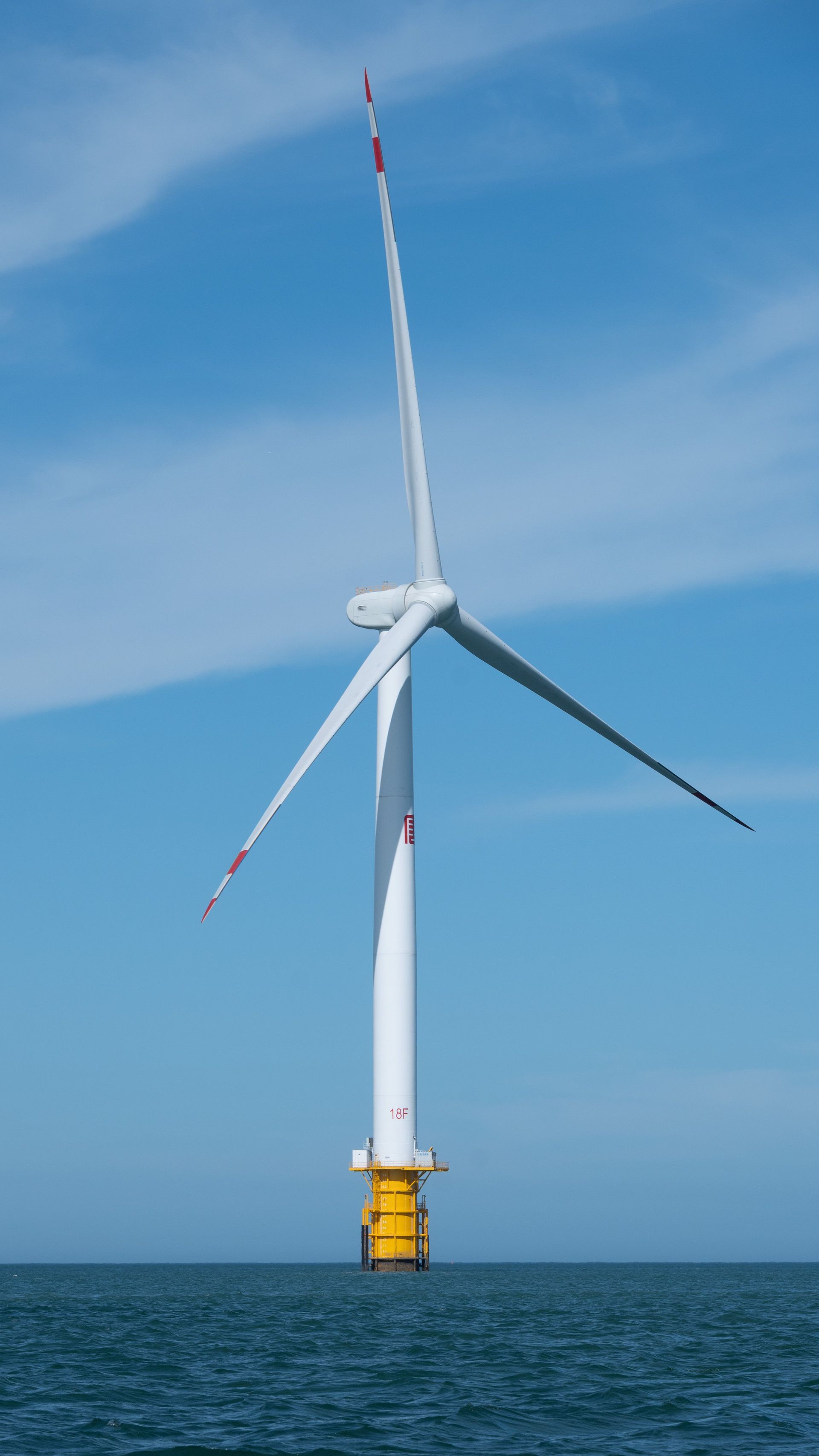
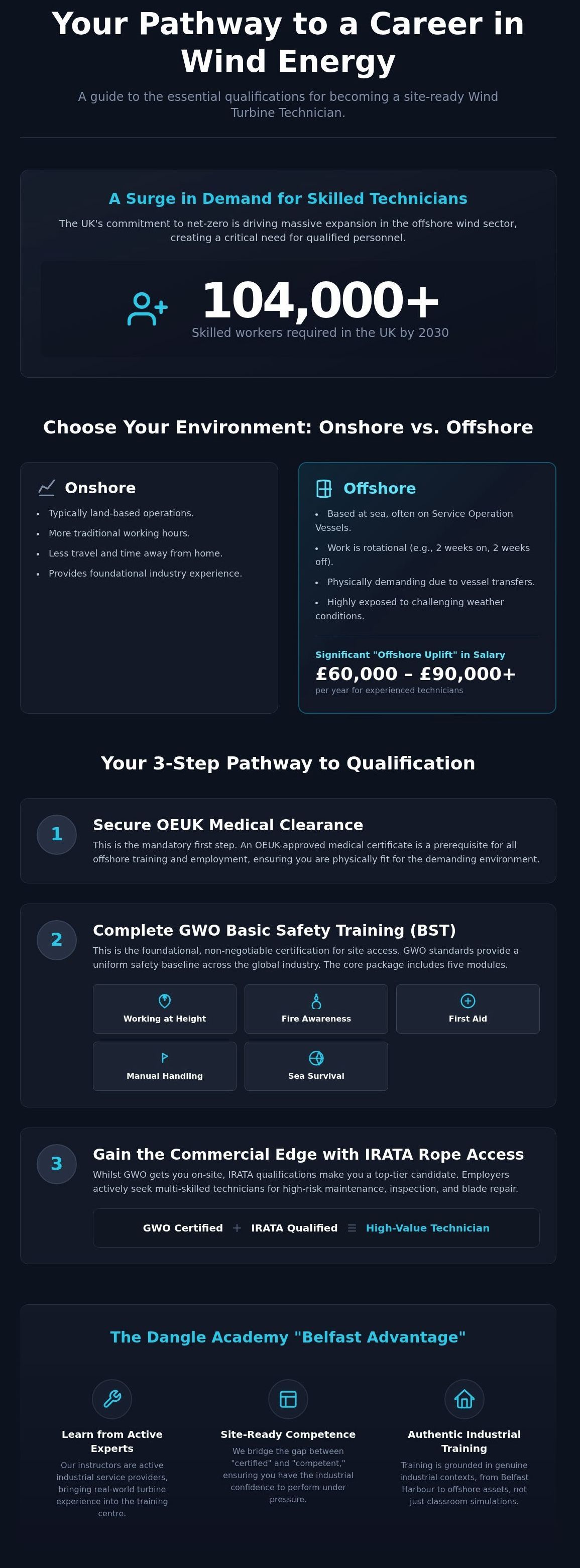
The UK’s commitment to net-zero has triggered a massive expansion in offshore wind capacity. Projections from the Offshore Wind Industry Council suggest the workforce will need to exceed 104,000 by 2030 to meet current development targets. This surge creates a lucrative environment for new entrants, but the role requires more than just mechanical aptitude. Completing a wind turbine technician course provides the entry-level credentials, yet the daily reality is a demanding blend of technical troubleshooting and high-risk environmental management.
Technicians are responsible for the health of assets worth millions of pounds. When a turbine goes offline, the commercial impact is immediate; lost generation revenue can reach thousands of pounds per day. Consequently, the industry has shifted its focus. We no longer just need general engineers. We need specialists who can manage "access-led" maintenance, combining technical repairs with the proficiency to work safely at height. This is where the Global Wind Organisation (GWO) standards become critical, ensuring every person on-site operates from a unified safety baseline.
Onshore vs Offshore: Choosing Your Environment
Your choice of environment dictates your lifestyle and your pay cheque. Onshore wind farms are typically land-based and offer more traditional working hours with less travel. In contrast, offshore arrays in the North Sea or Irish Sea require technicians to work on rotations, often spending two weeks at sea on a Service Operation Vessel. Whilst offshore work is more physically demanding due to vessel transfers and weather windows, it commands a significant "offshore uplift" in salary. Experienced offshore technicians can earn between £60,000 and £90,000 per year, depending on their specific technical specialisms and access qualifications.
The Skills Gap: Why Employers Struggle to Find Competent Staff
There is a distinct difference between being "certified" and being "competent." Many candidates finish a wind turbine technician course with the correct papers but lack the industrial confidence to perform under pressure. Employers are actively seeking multi-skilled technicians who possess both mechanical knowledge and IRATA rope access proficiency. At Dangle Academy, we see this gap daily. A safety-first mindset isn't something you read in a manual; it’s a behaviour developed through practical, hands-on exposure. Companies prioritise staff who can prove they have handled real-world industrial challenges rather than just classroom simulations. You can view our full range of training programmes to see how we bridge this gap between theory and site-ready competence.
Essential GWO Training: The Global Standard for Wind Safety
Entering a turbine without a valid Global Wind Organisation (GWO) certificate is impossible. These standards provide a uniform safety baseline across the global industry, ensuring that every technician, regardless of their employer, speaks the same safety language. Whether you are working in the North Sea or on a land-based farm in County Antrim, the safety protocols remain identical. This standardisation is why a GWO Basic Safety Training (BST) is the foundational requirement of any wind turbine technician course. Major developers and asset owners won't permit site access without these credentials verified on the WINDA database.
Safety in this sector isn't just about personal protection; it's about commercial reliability. A single safety incident can halt operations across an entire site. Consequently, GWO certificates are valid for 24 months, requiring technicians to complete refresher training before their "ticket" expires. According to the Occupational Outlook Handbook, the technical complexity of these roles continues to evolve, making regular safety updates essential for maintaining operational standards in high-stakes environments.
The GWO BST Modules
The GWO Basic Safety Training standard comprises five modules. For onshore wind work, the core training covers Working at Height, Fire Awareness, First Aid and Manual Handling. Anyone progressing into offshore wind will also require the Sea Survival module.
- Working at Height: GWO Working at Height is the most critical module. You'll master fall arrest systems, vertical ladders, and emergency rescue equipment used for self-evacuation.
- Fire Awareness: Turbines are high-value assets with complex electrical systems. In GWO Fire Awareness you'll learn practical firefighting and evacuation protocols specifically for confined nacelle environments.
- First Aid: Remote environments require self-sufficiency. This GWO First Aid module focuses on managing life-threatening injuries whilst awaiting professional medical evacuation.
- Manual Handling: GWO Manual Handling is all about protecting your musculoskeletal health, it's vital when moving heavy components and tools in restricted spaces like Wind Turbine Generators (WTGS).
- Sea Survival: Mandatory for anyone heading offshore. It covers vessel transfer techniques, survival at sea, and the correct use of life rafts and immersion suits. Not a requirement for onshore (land-based) wind turbine environments.
Advanced GWO Modules for Career Progression
Once you've secured your BST, advanced modules like GWO Advanced Rescue Training (ART) and GWO Enhanced First Aid (EFA) become your next steps. ART moves beyond basic self-evacuation, teaching you how to rescue an incapacitated casualty from the hub, nacelle, or basement. EFA is particularly critical for remote offshore medical response where professional help may be hours away. These qualifications don't just improve safety; they significantly increase your employability and potential day rate. If you're ready to begin your journey, you can enrol in our GWO BST package to gain your initial certifications in our Belfast centre.
The Rope Access Advantage: Why IRATA Complements GWO
GWO certification is the industry baseline, but it primarily covers safety and internal turbine access. To perform external inspections or composite repairs, you must master industrial rope access. Traditional access methods like scaffolding or mechanical platforms are often commercially unviable for wind assets. They are slow to deploy, expensive to maintain, and logistically complex in offshore environments. Rope access is the preferred solution amongst asset owners because it offers rapid deployment and a superior safety record with minimal equipment footprint.
By integrating an IRATA Level 1 qualification into your wind turbine technician course, you become significantly more employable. You transition from being a technician who can merely climb a ladder to a specialist capable of abseiling into position to resolve critical faults. This dual-certification is what separates standard applicants from those who secure high-earning contracts. As detailed in the National Careers Service profile, technical proficiency at height is a core requirement for career progression in this sector.
Blade Repair and Composite Skills
There is currently a high demand for technicians who can address leading-edge erosion on turbine blades. This erosion reduces aerodynamic efficiency and can lead to structural failure if left untreated. Performing these repairs requires you to be comfortable on ropes whilst handling composite materials. We often recommend Industrial Painter Training as a valuable secondary skill, as it teaches the surface preparation and coating techniques essential for blade maintenance. At Dangle, our training is led by active instructors who spend their time performing these exact repairs on-site, providing you with practical insights that classroom-only providers cannot offer.
The IRATA Progression: Level 1 to Level 3
Your journey begins at Level 1, where you master basic manoeuvres and equipment safety. However, rope access is a career-long progression. To move to an IRATA Rope Access Level 2 and eventually IRATA Level 3, you must log a minimum of 1,000 hours of work experience and have at least 12 months of experience at your current level before moving up a level. A Level 3 Supervisor is responsible for the entire site safety and rescue plan, commanding a much higher day rate. To ensure our trainees are fully prepared for these high-stakes assessments, Dangle Academy utilises a unique 5-day training model followed by a dedicated day 6 assessment. This extra time allows for deeper technical consolidation and significantly improves pass rates for our Belfast-based students.
Your Step-by-Step Pathway to Becoming a Qualified Technician
Transitioning into the renewables sector requires a methodical approach to ensure you don't waste time or capital on redundant qualifications. The most efficient pathway begins with physical verification followed by technical accreditation. Whilst many newcomers look straight at a wind turbine technician course, the industry's gatekeepers are actually found in health and safety compliance. Following a structured five-step plan ensures you're field-ready and compliant with UK offshore standards from day one.
Medical Fitness and Compliance
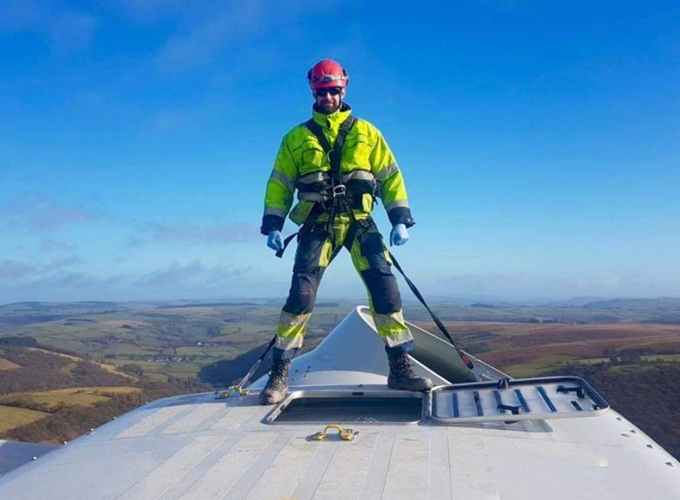
Before you step onto a turbine, you must clear the OEUK Medical and site requirements. This specialised health screening is the standard for the offshore energy sector. It assesses your vision, hearing, and lung function to ensure you can handle the rigours of the environment. You also need to pass the Chester Step Test. This aerobic assessment proves you have the physical capacity to climb towers that often exceed 100 metres in height. Industry developers maintain a zero-tolerance policy regarding drug and alcohol use. You'll likely face regular testing and health screening throughout your career. Ensuring these clearances are in place before you book your industrial services or training is essential for avoiding project delays.
Building Your CV for the Renewables Sector
Completing your training is only one part of becoming work-ready for the renewable energy sector. Employers and recruitment agencies will usually want to see clear evidence of your certificates, practical training, safety awareness and any previous site or industrial experience. After completing your GWO courses in Belfast, you should update your CV with your current qualifications, certificate dates and any relevant experience linked to working at height, rescue, first aid, manual handling, rope access, mechanical work, electrical work, telecoms or offshore environments.
For new entrants, a well-structured CV can help demonstrate that you are serious about moving into the wind industry. At Dangle Academy, we can offer general guidance on how to present your training, highlight transferable skills and understand the types of roles commonly advertised across the renewable sector.
Why Train at Dangle Academy: The Belfast Industrial Advantage
Many training centres operate in a technical vacuum, detached from the physical and commercial realities of modern wind farms. At Dangle Academy, we eliminate this disconnect. Our instructors aren't just educators; they are active technicians who regularly perform wind turbine maintenance and blade repairs on live assets across the UK and Ireland. This means when you enrol in any of our wind turbine technician courses, you receive instruction rooted in current site behaviours and real-world problem-solving rather than outdated theoretical manuals.
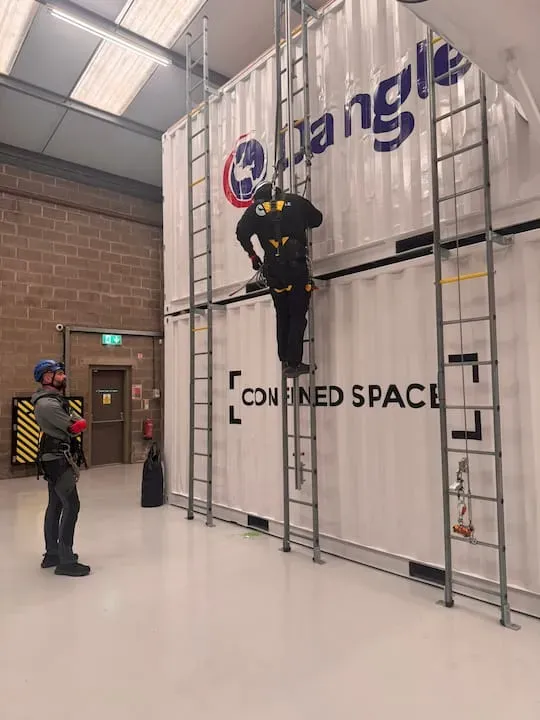
Our Belfast facility is specifically engineered to replicate high-risk industrial scenarios. We don't just use classroom simulations; we provide access to the same nacelle environments, vertical ladders, and fall arrest systems you'll encounter offshore. This "Service-to-Training" feedback loop ensures our curriculum evolves as fast as the technology on the turbines themselves. We understand the commercial pressure of turbine downtime, and we train our students to work with the precision and speed that Tier 1 contractors demand.
The Dangle Difference: Beyond the Classroom
Our dual role as both a service provider and an accredited academy gives our trainees a distinct career advantage. We know exactly what skills are currently in short supply because we are active in the field every day. This insight allows us to guide you toward the most valuable module combinations, such as pairing GWO safety with IRATA Rope Access. You'll train on the latest safety technology and equipment, ensuring your first day on a North Sea array feels like a familiar environment rather than a daunting challenge. We maintain strict adherence to international benchmarks whilst ensuring every trainee understands the specific compliance requirements of the UK renewables sector.
Starting Your Journey Today
We provide a comprehensive support structure designed to manage every detail of your career transition. Instead of navigating multiple providers, you can book your training modules, OEUK medicals, and Chester Step tests in a single, coordinated package at our Belfast centre. We offer flexible training dates to suit career changers and busy professionals working on rotations, ensuring you can qualify without disrupting your current commitments. Our goal is to move you from the classroom to the turbine as efficiently as possible, backed by the confidence of industrial-grade competence.
Explore our full range of Wind Turbine Technician courses to secure your place in our next intake and begin your career in the renewable energy sector.
Securing Your Future in the Wind Sector
The UK's transition to renewable energy is creating thousands of roles for technicians who possess the right blend of safety and technical proficiency. We've explored how mandatory GWO standards provide the safety baseline, whilst IRATA rope access skills offer the competitive advantage needed for high-value blade repair and maintenance contracts. By following a structured pathway from medical clearance to advanced rescue modules, you ensure your career is built on a foundation of industrial compliance and practical competence.
Choosing the right wind turbine technician course is about more than just getting a certificate; it's about learning from those who operate in the field every day. As a combined industrial service and training provider, Dangle Academy offers a unique perspective that classroom-only centres cannot match. Our Belfast-based expert trainers bring real-world site experience into our IRATA and GWO accredited facility, ensuring you're fully prepared for the physical and technical demands of the North Sea and beyond.
Take the first step toward a high-earning, sustainable career today.
Book Your GWO Basic Safety Training at Dangle Academy today and join the next generation of wind energy professionals in Northern Ireland. We look forward to supporting your professional progression into this vital industry.
Frequently Asked Questions
What qualifications do I need for a wind turbine technician course?
You must be at least 18 years old and hold a valid medical certificate to enrol in a wind turbine technician course. Whilst formal engineering degrees aren't always mandatory for entry-level safety training, most employers prioritise candidates with a background in mechanical, electrical, or hydraulic systems. This technical foundation ensures you can apply safety protocols to complex maintenance tasks on-site.
How long does it take to become a certified wind turbine technician?
You can complete the foundational GWO Basic Safety Training (BST) in five days. If you choose to add IRATA Level 1 rope access certification, you should expect another six days of training and assessment. Whilst the initial "tickets" are earned quickly, becoming a fully competent technician involves several months of supervised on-site experience to master the industrial realities of the role.
Do I need an engineering degree to work on wind turbines?
An engineering degree is not a mandatory requirement for working as a technician, as the industry values vocational proficiency and practical competence. Many successful technicians enter the field through apprenticeships or by transitioning from related trades such as automotive engineering or industrial electrical work. Practical experience with hand tools and diagnostic equipment is often more relevant than academic theory.
What is the difference between GWO and IRATA training?
GWO training provides the mandatory safety standard for entering and working inside a wind turbine, covering risks like fire and ladder falls. IRATA training focuses specifically on industrial rope access, which is required for external work such as blade repair. GWO gets you into the turbine; IRATA allows you to abseil outside it to perform specialist maintenance.
Is the wind turbine technician role physically demanding?
The role is physically rigorous and requires a high level of fitness for climbing vertical ladders that can exceed 100 metres. You must be comfortable working at height and capable of performing technical repairs in confined nacelle environments or whilst suspended on ropes. Stamina and physical coordination are essential for maintaining safety standards throughout a standard shift.
How much does a wind turbine technician course cost in the UK?
The investment for a wind turbine technician course varies depending on the module combination and whether medical screenings are included in the package. Most candidates choose to bundle their GWO BST modules to reduce costs and ensure they are site-ready in a single week. It's best to view these costs as a necessary professional investment for accessing high-earning offshore contracts.
Can I work offshore immediately after completing my GWO BST?
You are eligible for offshore work once you complete the GWO BST including the Sea Survival module, but many employers require additional credentials for North Sea roles. Gaining your IRATA Level 1 or completing Advanced Rescue Training (ART) significantly improves your chances of immediate offshore placement. Most Tier 1 contractors look for a multi-skilled profile that goes beyond basic entry-level safety.
What medical certificates are required for wind turbine work?
You must hold a valid OEUK Medical certificate and pass the Chester Step Test to work on UK wind farms. These assessments verify that you are fit for remote offshore environments and have the aerobic capacity to handle the physical strain of tower climbing. Employers also require a zero-tolerance drug and alcohol screening as part of their standard health and safety compliance.
Contact Us
We'd Love a Share...
Recent Blog Post's