Launching an International Industrial Training Franchise Opportunity

Dangle® Turns One: Launching an International Industrial Training Franchise Opportunity
What makes an industrial training franchise opportunity credible: the qualification on the certificate, or the judgement learners can apply when conditions change on site? In safety-critical industries, accredited training matters, but learners also need practical skills grounded in real working environments.
That’s the distinction prospective franchisees need to understand. Running an industrial training business involves more than delivering a course: it calls for sector knowledge, sound operational judgement and a clear understanding of how competence is developed and assessed. As Dangle® marks its first year, it’s launching an international franchise opportunity built around that connection between training and industrial work.
This article explains what industrial training franchise opportunities involve and how to assess whether the sector fits your experience and ambitions. It also explores how Dangle®’s operational work in rope access, inspection, coatings and wind turbine maintenance informs Dangle® Academy’s accredited and specialist training from Belfast. You’ll find a practical framework for considering the commercial and delivery demands, and for understanding why accreditation is an important foundation, not a substitute for applied competence.
Key Takeaways
- Learn what sets industrial training franchise opportunities apart from general training businesses, particularly the need to connect learning with site competence.
- Assess how accreditation, practical exercises and assessment can support meaningful learner outcomes without implying a job-placement guarantee.
- Compare franchise opportunities against clear factors, including sector focus, relevant accreditation, delivery requirements and intended audience.
- Use a practical self-assessment to consider whether your industry experience, communication skills, safety mindset and business readiness suit this work.
- Explore how Dangle® Academy’s Belfast training division draws on Dangle®’s industrial services to inform relevant, practical learning.
Table of Contents
- Why industrial training franchise opportunities differ from general training businesses
- How accredited industrial training connects learning to site competence
- How to compare industrial training franchise opportunities realistically
- Are you ready to run an industrial training business?
- Explore industrial training franchise opportunities with Dangle® Academy
Why industrial training franchise opportunities differ from general training businesses
A learner may be able to explain a procedure in a classroom and still struggle to apply it when working at height, handling equipment or responding to changing site conditions. That gap matters in industrial settings, where training needs to develop practical competence as well as knowledge.
An industrial training franchise is a business centred on industry-specific learning and competence. Its courses relate to defined work activities, equipment, processes or safety practices in sectors such as rope access, wind energy, telecommunications and workplace safety. This differs from tutoring, coaching or general business education, where learning may focus on academic progress, personal development or management skills rather than practical tasks in industrial environments.
The distinction affects both delivery and day-to-day operations. A franchise focused on industrial training needs to make its intended learners, subject areas and delivery requirements clear. Its commercial planning also depends on understanding the audiences it serves and the resources needed to deliver the relevant programmes. No single model or outcome should be assumed across every franchise offer.
What counts as industrial training?
Industrial training connects learning to work in a specific sector. Examples include rope access training, wind-industry safety, telecoms training and workplace safety courses. The course scope, assessment and accreditation depend on the programme. IRATA, GWO and EUSR are examples of recognised sector frameworks, each associated with particular areas of industrial training. Their relevance depends on what the course is designed to teach.
Vocational education takes different forms internationally. For example, the Industrial Training Institute model provides a wider reference point for industry-related skills training, but it should not be treated as equivalent to a UK franchise or accreditation model. In Belfast, Dangle® Academy delivers training across areas including IRATA rope access, GWO wind safety and EUSR telecoms. Its industrial training programmes illustrate how the subject area shapes the learning offer.
Why practical context matters to learners
Procedures make more sense when learners can connect them to conditions they may encounter at work. A classroom-only explanation might describe the need to follow a sequence during a task. A grounded example can explore how the work area, access method, equipment checks and communication between team members affect that sequence. The aim is not to replace formal course content, but to help learners understand how it applies.
Training quality shouldn’t be reduced to course volume or promotional claims. Consider whether learning objectives, practice and assessment relate to the competence the course is intended to develop. In a rope access context, for example, learners need to connect taught techniques with controlled practice and sound decision-making, not simply remember terminology. The same principle applies to wind, telecoms and safety training: relevant context helps make the learning meaningful, while the programme’s scope remains clear.
For anyone assessing industrial training franchise opportunities, the key question is therefore not only what courses are offered. It’s whether the business model can support credible, sector-specific delivery, with training grounded in the work learners are preparing to undertake.
How accredited industrial training connects learning to site competence
A course certificate records an outcome, but the training behind it must still prepare learners to apply relevant skills. A sound programme links its objectives, practical exercises and assessment to the competence it is intended to develop. If these elements drift apart, learners may complete the content without being able to demonstrate the required task in a controlled training setting.
Accreditation provides a framework for defined training standards and course outcomes. It helps give structure to what is taught and assessed. It isn’t a guarantee of employment, a job placement service or proof that someone has experience across every site condition. Those distinctions matter to learners and to anyone assessing industrial training franchise opportunities.
A useful way to examine course design is to follow the learning sequence:
- Objective: What knowledge or skill should the learner develop?
- Practice: What relevant exercise allows them to apply it?
- Assessment: How is their understanding or performance evaluated against the programme’s requirements?
Course completion shows that a learner has completed a programme; demonstrated practical competence shows how they perform the assessed tasks. The two are related, but they aren’t interchangeable.
Where IRATA, GWO and EUSR fit
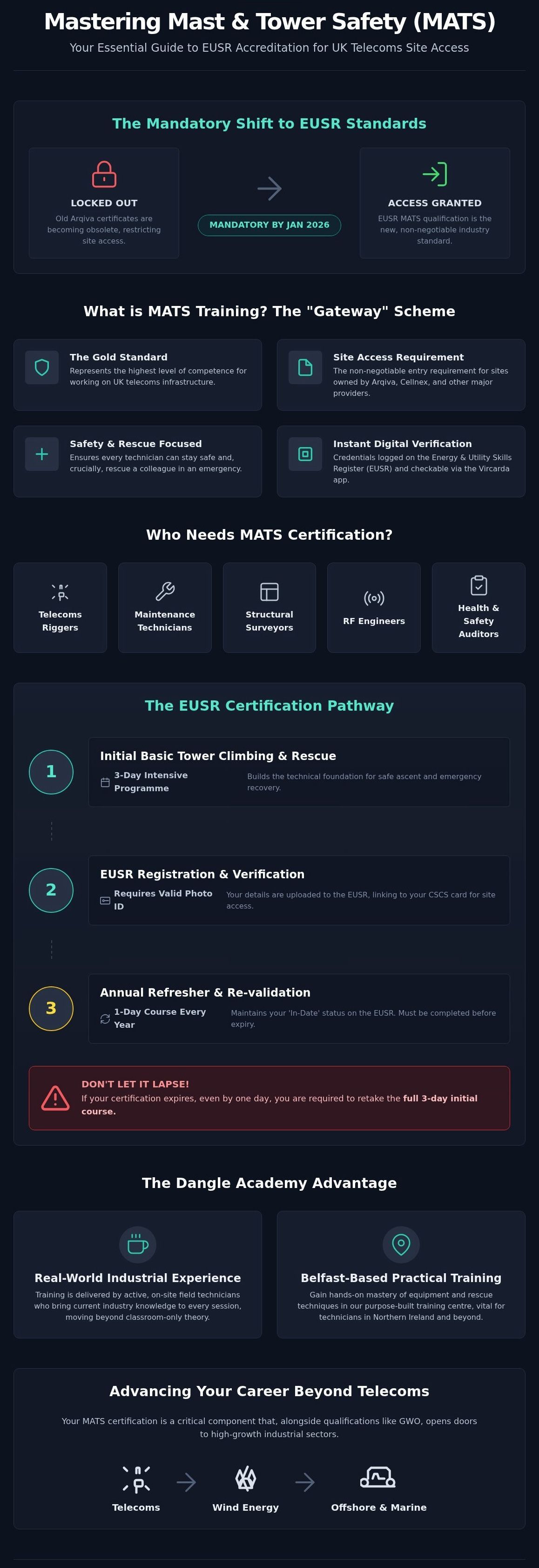
These frameworks serve distinct industrial training areas. IRATA relates to rope access training, GWO to wind-industry safety training, and EUSR to relevant utilities and telecoms training. The exact scope and assessment depend on the programme, so a course shouldn’t be described as covering more than its defined content. Dangle® Academy’s accredited industrial training courses include programmes connected to these sectors.
For example, a rope access exercise can focus on applying taught techniques in a controlled practical setting. Wind safety learning can use scenarios relevant to work around turbine environments. A telecoms course can relate instruction to tasks associated with telecommunications infrastructure. These examples illustrate how a programme can make learning relevant; they aren’t universal requirements or substitutes for the applicable course criteria.
What operational experience adds to training
Industrial work brings together more than a task in isolation. Depending on the job, technicians may need to consider access, equipment, communication with colleagues and the conditions around the work area. A trainer with relevant experience can draw on these considerations to make a scenario more grounded, while keeping instruction within the programme’s scope. Site examples should clarify learning, not be presented as rules that apply identically to every asset or workplace.
Dangle®’s industrial services include rope access, inspection, coatings and wind turbine work. Dangle® Academy is the training division, delivering accredited and specialist courses from Belfast. Together, this gives the brand operational and training perspectives: site work informs relevant examples, while structured training keeps learning tied to course objectives and assessment.
For prospective franchisees, this connection is a practical point to examine. Consider how trainers can explain not only what a procedure involves, but why access, equipment checks and communication may matter in a particular scenario. Explore the Dangle® Academy training portfolio to see how accredited programmes relate to industrial sectors and learner needs.
How to compare industrial training franchise opportunities realistically
A polished presentation can describe a training offer, but it won’t answer every operational or commercial question. Compare what the franchise opportunity specifically documents with what you’re assuming from franchise models in general. That distinction helps you assess the offer on evidence rather than treating common features as guaranteed terms.
Compare an industrial training franchise on its sector focus, relevant accreditation, practical delivery requirements and intended learners, then verify the commercial terms separately.
Assess the training model and sector fit
Start with the course portfolio. Identify the industrial sectors covered and the learners each programme is designed for. A portfolio spanning rope access, wind safety and telecoms has different subject matter from one focused on workplace safety alone. The range matters, but so does whether it fits your own knowledge and the audiences you understand.
Next, look at how the offer describes practical instruction and assessment. Are these clearly part of the delivery model, and do they relate to the skills the courses aim to develop? Accreditation should be considered against the relevant programme. It supports defined training standards, but it shouldn’t be treated as evidence of a guaranteed business outcome, learner job placement or success across every course. Dangle® Academy’s industrial training course portfolio shows the range of sector-specific training behind Dangle®’s approach.
Assess the practical operating requirements
Industrial delivery has practical considerations as well as curriculum. Depending on the programme, these may include trainer competence, suitable facilities, equipment and arrangements for safe practical learning. Avoid assuming that one set of requirements applies to every course. The relevant details need to be specific to the programme and the franchise offer.
The comparison below separates areas to investigate from conclusions that shouldn’t be assumed without evidence.
| Comparison area | What to examine | Don’t assume |
|---|---|---|
| Sector focus | Courses, industries served and intended learners | That a broad course list automatically suits your experience |
| Accreditation | Which framework applies to each programme | That one accreditation covers every course or guarantees employment |
| Practical delivery | How exercises, facilities, equipment and assessment fit the course | That delivery requirements are identical across subjects |
| Commercial terms | Documented fees, territories, support and financial projections | That typical franchise features or projected results form part of this offer |
Fees, territory arrangements, support and financial projections should be based on specific, verified information for the opportunity you’re evaluating.
Don’t substitute general franchise expectations for documented terms, and don’t treat a forecast as a guaranteed result. Likewise, separate evidence of a training framework from claims about wider business performance.
Finally, consider whether your own experience supports credible delivery and whether the practical operating requirements align with your plans. This comparison won’t decide for you, but it will make the next assessment more grounded: you’ll know which parts of the offer are evidenced, which depend on programme details and which require careful commercial scrutiny.
Are you ready to run an industrial training business?
Industry experience gives you a useful starting point, but training others calls for more than knowing how a task is done. You’ll need to explain procedures clearly, support practical learning and keep safety central, while also managing the responsibilities of running a business. This self-assessment isn’t a set of formal eligibility criteria. It’s a way to identify your strengths and the areas you’ll need to think through.
A practical readiness self-assessment
Work through these five questions against the courses and learners you hope to serve. Be specific. If your experience is in wind operations, for example, consider how it relates to training learners in relevant safety practices, rather than assuming experience in one role covers every course.
- Map your industry experience. Which sectors, tasks and working environments do you understand first-hand? Can you connect that experience to the learners and programmes you’re considering?
- Explain procedures clearly. Could you break a technical task into understandable stages, check learners’ understanding and answer questions without losing sight of the purpose?
- Support practical learning. Think about how you would brief an exercise, observe performance and give useful feedback. In a rope access setting, that means helping learners focus on the task and the relevant course requirements, not just describing a technique.
- Keep a safety-led mindset. Are you comfortable reinforcing safe decisions, recognising when an exercise needs to pause and treating questions or uncertainty seriously?
- Consider business ownership realistically. Training delivery is only one part of operating a business. Reflect on the time, organisation and commercial decisions involved, without relying on assumptions about returns or outcomes.
Your answers can reveal where hands-on experience is strong and where you may need to develop your teaching approach or operational plan. Readiness is about understanding the work involved, not meeting a checklist that promises success.
Why Belfast and Northern Ireland experience is relevant
Dangle® Academy is based in Belfast and delivers accredited and specialist training for industrial sectors that include renewable energy and utilities. Those sectors connect with practical work across the UK and are relevant to the wider industrial context of Ireland, too. Telecoms provides another example of a field where training needs to relate to specific work and learner requirements.
For prospective franchisees, location is one part of the picture. The more useful question is whether your experience, audience and intended course portfolio align. Reviewing the Dangle® Academy training catalogue can help you consider how programmes in rope access, wind safety and telecoms relate to the sectors you know.
It can also help to connect training with the practical controls technicians rely on before work begins. The previous article on PPE inspection services offers relevant context, alongside Dangle®’s industrial inspection and technical site services.
If you’re considering whether your experience could support an industrial training business, explore the Dangle® approach as a next step.
Explore industrial training franchise opportunities with Dangle® Academy
For professionals considering industrial training franchise opportunities, the value of a model depends on how well its learning offer connects with the industries it serves. Dangle® Academy is Dangle®’s dedicated training division, based in Belfast. It delivers accredited and specialist training, whilst Dangle® carries out industrial rope access, inspection, coatings and wind turbine work.
That combination brings training and operational perspectives together. Course delivery has defined objectives and assessment; site work gives the business direct experience of the tasks, access challenges and working environments that learners may be preparing for. The two inform one another, but they remain distinct activities: Dangle® provides industrial services, and Dangle® Academy delivers training.
What distinguishes Dangle® Academy’s industrial perspective
The Academy’s training includes IRATA rope access, GWO wind safety and EUSR telecoms. These areas relate to different work environments and learner needs, so relevant examples should be shaped by the programme rather than treated as interchangeable. A rope access exercise, for instance, can focus on applying taught techniques in a controlled setting. Wind safety instruction can draw on relevant turbine-work scenarios, whilst telecoms training can reflect tasks associated with telecommunications infrastructure.
Operational experience can help trainers explain why procedures matter in context. A technician’s perspective may bring attention to access, equipment, communication and the conditions surrounding a task. Used carefully, those examples can make instruction practical and safety-focused without suggesting that one site scenario applies everywhere.
Dangle® Academy’s IRATA format is a five-day course followed by assessment on day six. It provides a specific example of how training and assessment can be structured. Any franchise discussion should distinguish this course detail from other programmes, whose delivery and requirements depend on their own scope.
For prospective franchisees, the connection is worth examining closely. Consider whether your own industry knowledge could help learners relate course content to work, and whether you understand the difference between delivering an accredited programme and undertaking industrial operations. The operational side of Dangle®’s business includes rope access, inspection and wind turbine services, alongside coatings and other technical site work.
Take the next step with a clear understanding
A useful conversation should focus on fit and specifics. Bring your relevant sector experience, the learners and industries you hope to serve, and the questions you have about course scope, practical delivery and the franchise opportunity. Fees, territories, support arrangements and financial projections should be understood from the specific information provided for the opportunity, rather than assumed from general franchise models.
If you’re an industry professional considering a move into training, contact Dangle® Academy to discuss your experience, the opportunity and its specific details. A clear, practical discussion is the right next step before deciding whether this direction suits your ambitions.
Make your next step a considered one
Before moving forward, turn your interest into a clear decision brief. Set out the industrial sectors you know, the learners you could serve and the practical demands you’re prepared to take on. Then separate what you understand from what you still need to establish about the franchise’s specific structure and commercial terms. This gives any discussion a useful focus and helps you judge whether the opportunity fits your experience and business plans.
Industrial training franchise opportunities call for a deliberate approach. The right next step isn’t to assume that industry knowledge alone makes the decision, but to explore how your experience could translate into credible training delivery and a sustainable business commitment. Take the time to examine the details and consider the responsibilities alongside the opportunity.
Explore industrial training franchise opportunities with Dangle® Academy and take the next step towards assessing whether this direction is right for you. A clear-eyed decision can be the start of a purposeful new chapter in your professional life.
Frequently Asked Questions
What is an industrial training franchise?
An industrial training franchise is a business that delivers learning for specific industrial roles, processes or working environments under a franchise arrangement. Its courses might relate to activities such as rope access, wind energy or telecoms. The day-to-day work can include organising course delivery, communicating with learners and maintaining a clear link between the training offered and the work it addresses.
Can someone without a teaching background run an industrial training franchise?
A teaching background isn’t automatically the deciding factor, but the ability to explain technical information clearly is important. A prospective operator should consider how they would support learners, give clear instructions and respond to questions. Experience in an industrial sector can provide valuable subject knowledge, but it doesn’t replace the need to develop effective communication and understand the delivery requirements of each course.
Do industrial training franchises need accredited courses?
Accreditation depends on the course and the framework relevant to its subject. Some industrial programmes are delivered against recognised frameworks such as IRATA, GWO or EUSR; other workplace learning may have a different scope. A franchise candidate should understand which programmes are accredited and what that accreditation covers. It shouldn’t be presented as a guarantee of employment or as proof of every learner’s wider work experience.
What industries can an industrial training business serve?
An industrial training business may serve sectors such as renewable energy, utilities, telecommunications and industrial access. Its focus depends on the courses it delivers and the learners they are designed for. For example, training connected with wind safety serves a different work context from telecoms training. A defined sector focus helps an operator understand the subject matter, learner needs and practical setting relevant to each programme.
How does practical industrial experience improve training delivery?
Practical experience can help a trainer explain how a task fits into a real work sequence. For instance, a technician may describe how a handover between team members affects preparation before work begins, then use that situation to prompt discussion. Such examples give learners a context for the course material. They should be relevant to the programme, rather than treated as universal instructions for every site.
Is an industrial training franchise suitable for an experienced technician?
It may suit a technician who wants to use their industry knowledge in a learning environment, provided they’re also prepared to develop the skills and routines involved in course delivery and business ownership. Technical experience alone doesn’t determine suitability. Consider whether you can communicate with learners, work within defined course requirements and manage the responsibilities involved in operating a business, as well as delivering instruction.
What should I compare before pursuing an industrial training franchise opportunity?
Compare the course portfolio, intended learners, relevant accreditation and the practical delivery requirements. Then examine the opportunity’s specific commercial information, including fees, territory arrangements, support and financial projections. Treat each as a matter for documented detail, not an assumed feature of franchise models. This helps separate what the offer actually sets out from expectations formed by general descriptions of franchising.
Where does Dangle Academy deliver industrial training from?
Dangle® Academy delivers industrial training from Belfast, Northern Ireland. Its programmes include IRATA rope access, GWO wind safety and EUSR telecoms training, alongside other specialist and workplace courses. Belfast provides the base for the Academy’s training activity, while Dangle®’s industrial services bring operational experience in areas such as inspection, coatings and wind turbine work. This connects the training division with practical industrial activity.
Contact Us
We'd Love a Share...
Recent Blog Posts