MATS Telecoms Training in Belfast
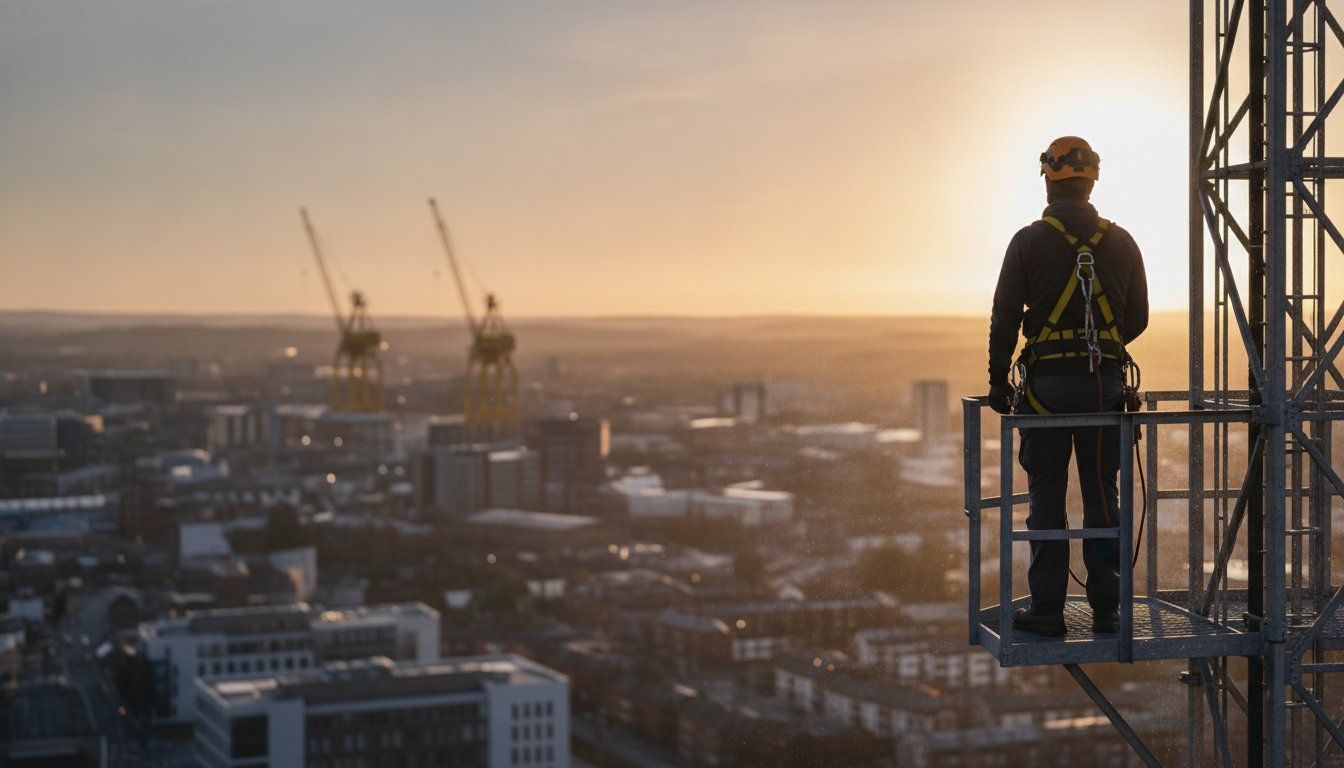
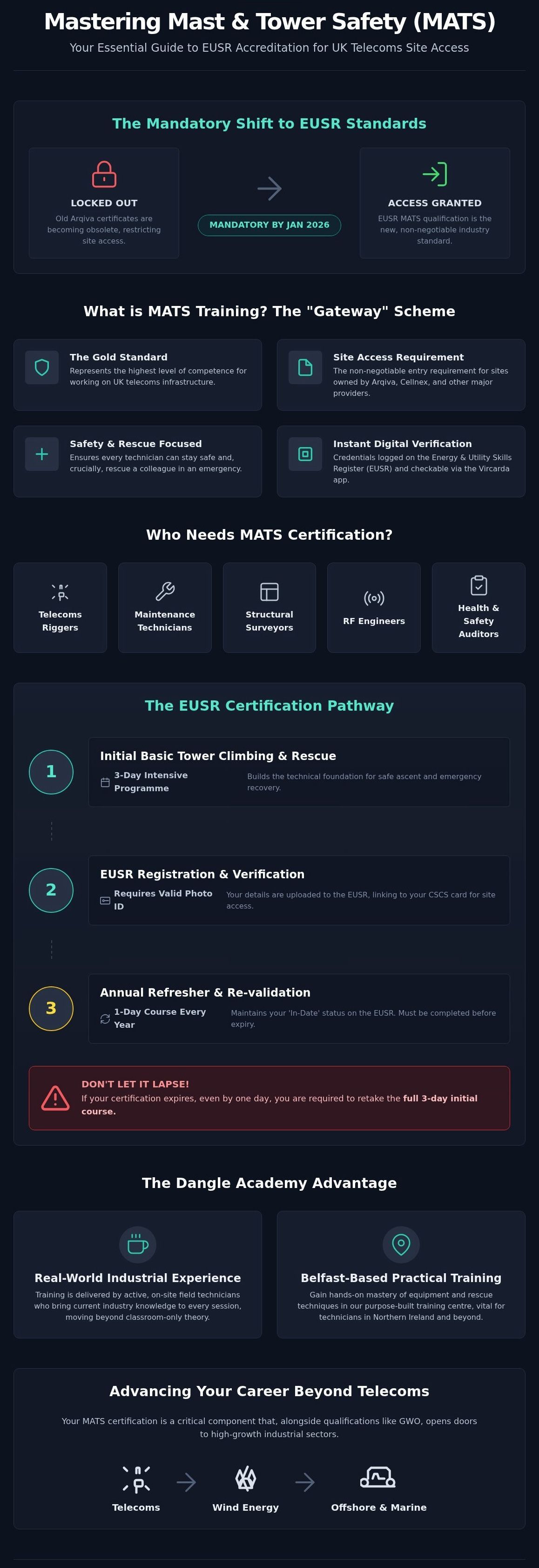
If you're still relying on an old Arqiva certificate for rooftop work, you're effectively locked out of UK telecoms sites following the mandatory transition to EUSR standards in January 2026. We understand that the overlap between various safety schemes often causes more confusion than clarity, especially when you're also managing the physical demands of high-altitude rescue scenarios. Securing the right MATS training shouldn't feel like a bureaucratic hurdle; it should be the foundation of your professional safety and site access.
This guide will show you exactly how to master the Mast and Tower Safety standards required for the modern industry and secure your EUSR accreditation. We'll examine the specific requirements for the three-day initial climbing course, the one-year validity of rescue certifications, and the practical advantages of training at our Belfast centre. Whether you're an entry-level climber or an experienced technician needing a refresher, this article provides the technical insight you need to stay compliant and gain access to restricted telecoms sites.
Key Takeaways
- Understand why MATS training is the essential gateway for accessing Arqiva-approved telecoms sites and how it integrates with the EUSR registration process.
- Identify the mandatory documentation and identity verification steps required to ensure your accreditation is recognised by major UK site providers.
- Gain insight into the practical exercises involved in tower climbing and rescue, moving beyond classroom theory to real-world equipment mastery.
- Discover the "Dangle Advantage" of training in Belfast with active field technicians who bring current industrial experience to every session.
- Learn how to leverage your telecoms certifications to access high-growth opportunities in the wind energy and offshore sectors.
Table of Contents
- What is MATS Training and Why is it Mandatory for Telecoms?
- The EUSR MATS Framework: Understanding the Standards
- MATS Initial Basic Tower Climbing and Rescue Course Breakdown
- Training in Belfast: Why Practical Experience Matters
- Advancing Your Career with Dangle Academy
What is MATS Training and Why is it Mandatory for Telecoms?
MATS training stands for Mast and Tower Safety. It represents the gold standard for anyone working on UK telecoms infrastructure. In the field, we call it the "Gateway" scheme because it's the non-negotiable entry requirement for accessing sites owned by major infrastructure providers like Arqiva or Cellnex. If your name isn't on the database, the site gate stays locked. This system ensures that every person on a mast possesses the same high level of competence, regardless of which company they work for.
The commercial reality is simple. Without a valid EUSR MATS Basic Tower Climbing and Rescue qualification, you cannot legally work on the vast majority of the UK's mobile network. This isn't just about ticking boxes; it's about ensuring every technician has the skills to stay safe and, crucially, to rescue a colleague in distress. The Energy & Utility Skills Register (EUSR) acts as the central verification point. It allows site managers to check your credentials instantly via the Vircarda app, providing a transparent record of your training history and current proficiency.
The Origins of the Mast and Tower Safety Group
The MATS Group didn't appear by accident. It grew from a collaboration between the UK's major network operators and broadcast owners who recognised a need to standardise safety across the board. Before this, different sites had different rules; this created dangerous inconsistencies for contractors moving between assets. By aligning climbing and rescue protocols, the group significantly reduced industry fatality rates. These standards aren't static. They evolve alongside advancements in equipment, such as the modern personal fall arrest system, ensuring that the training you receive reflects the latest technical safety developments.
Who Needs MATS Certification?
Certification is mandatory for a broad range of professionals. Telecoms riggers and maintenance technicians are the most common trainees, but the requirement extends much further. Structural surveyors, radio frequency (RF) engineers, and health and safety auditors must hold these credentials if their work requires them to climb towers or access rooftop monopoles. In the Northern Ireland context, where many technicians support cross-border infrastructure, having a recognised EUSR accreditation is vital. Many professionals find that MATS training is the essential link in their portfolio when bidding for large-scale network upgrades or maintenance contracts. It proves you've moved beyond basic height awareness into verified, industrial-level competence.
The EUSR MATS Framework: Understanding the Standards
The EUSR MATS framework isn't just a syllabus; it's a rigorous verification system that ensures every individual on a mast meets a baseline of professional competence. Once you complete your MATS training, your details are uploaded to the Energy & Utility Skills Register. This digital record links directly to your CSCS card, providing immediate proof to site owners that you comply with the Work at Height Regulations 2005. Without this registration, you simply cannot move past the site induction phase on major UK networks.
Identity verification is a non-negotiable part of the process. You must provide a valid, government-issued photo ID, such as a passport or driving licence, at the start of your course. This isn't just a formality; it ensures the integrity of the national database and prevents fraudulent certification in high-risk environments. For technicians working across different energy sectors, this accreditation often sits alongside GWO training, allowing for seamless movement between telecoms towers and wind turbine assets.
Initial vs. Annual Refresher Training
The entry point for new riggers is the three-day Initial Basic Tower Climbing and Rescue course. This intensive programme builds the technical foundation required for safe ascent and emergency recovery. However, competence is perishable. The EUSR registration for tower climbing is valid for exactly one year. To maintain your 'In-Date' status, you must complete a one-day refresher course before your current certificate expires. If you allow your certification to lapse even by a single day, the system requires you to retake the full three-day initial course, resulting in unnecessary costs and project downtime.
Physical and Medical Requirements
Climbing is physically demanding. You must be 'fit for climb', which involves more than just a lack of vertigo. Dangle Academy strongly recommends that trainees undergo an OEUK medical or a similar occupational health screening before attending. Whilst a self-declaration of fitness is the minimum requirement for the course, many site operators now demand professional medical certification to access their infrastructure. Ensuring you are medically cleared protects your health and your career longevity in this high-stakes industry. If you are ready to secure your spot on the next intake, you can view our upcoming MATS training dates in Belfast.
MATS Initial Basic Tower Climbing and Rescue Course Breakdown
The transition from a ground-based technician to a competent tower climber occurs over three intensive days. This syllabus is designed to replace hesitation with methodical, technical proficiency. We begin with the theoretical foundation, where we deconstruct the physics of a fall. Understanding fall factors and impact forces is essential; a harness alone cannot prevent injury if the technician doesn't understand the energy being managed. We then move immediately into equipment mastery. This involves more than just putting on gear. You'll learn the nuances of harness fitting, lanyard selection, and the specific operation of fixed fall arrest systems used across the UK network.
Practical climbing forms the core of the second day. Here, the MATS training focuses on the "100% hook-on" rule. Every movement on the steelwork must be protected; one connector is always anchored before the next is moved. Once climbing becomes second nature, we introduce rescue protocols. This is the most demanding part of the course. You'll learn "off-weighting" techniques, which involve transferring a casualty's weight from their own fall-arrest equipment onto a rescue device to facilitate a controlled descent. The course concludes with a formal assessment where you must demonstrate these skills under the scrutiny of an accredited assessor to prove you are safe to work on live assets.
Essential Practical Skills You Will Learn
Modern rigging requires more than just staying attached to the tower. You'll master the use of work positioning lanyards, which allow for hands-free maintenance whilst securely braced against the structure. We also focus on anchor point selection. Identifying a primary structural member versus a secondary bracing piece is a critical safety distinction. In rescue scenarios, you will gain hands-on experience with mechanical rope devices and the specific knots required to secure a casualty during a complex recovery from height.
Managing Risks: Suspension Syncope
Suspension syncope, often called the "silent killer," is a medical emergency that occurs when a person hangs motionless in a harness. Gravity causes blood to pool in the legs, which can lead to a rapid drop in blood pressure and eventual heart failure. Our rescue plans prioritise speed; we aim for casualty recovery within minutes, not hours. It is also vital to stay updated on medical guidance. For instance, the old "feet down" recovery position is no longer the standard advice. Modern protocols focus on horizontal recovery and immediate professional medical intervention. Training at Dangle Academy in Belfast ensures you are learning these latest life-saving protocols from technicians who manage these risks on-site every day.
Training in Belfast: Why Practical Experience Matters
For technicians based in Northern Ireland or the Republic, travelling to the mainland for MATS training is often an unnecessary expense that adds travel and accommodation costs to an already intensive week. We established Dangle Academy in Belfast to bridge this gap, providing a local hub for high-level accreditation. However, the location is only part of the advantage. The real value lies in our pedigree as a dual-provider; we don't just teach safety, we deliver industrial services on live assets every day. This field experience informs every module we deliver, ensuring our trainees learn the practical realities of the job alongside the theoretical requirements.
We reject the "tick-box" approach to safety. Our commitment to thoroughness is best reflected in our IRATA rope access model, where we provide a full five-day training period followed by a dedicated assessment on day six. We apply this same philosophy to our telecoms courses. Classroom-only training fails to prepare a technician for the physical and mental reality of a 50-metre mast in high winds. By training with active technicians who understand current site conditions across the UK and Ireland, you gain insights that a textbook simply cannot provide. If you are ready to advance your career, you can book your MATS training at our Belfast centre today.
Real-World Scenarios in a Controlled Environment
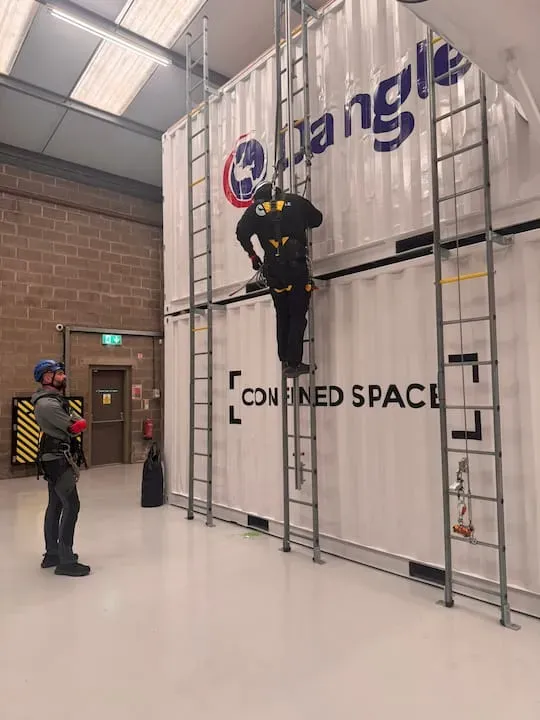
Our Belfast centre is designed to simulate actual tower conditions rather than just providing indoor scaffolding. We focus on the logistics of working at height, such as how to effectively organise your kit and tools whilst suspended. Our trainers share specific insights from recent telecoms maintenance projects, helping you anticipate the structural variations you'll encounter on different network sites. This practical approach ensures that when you step onto a live mast for the first time, the environment feels familiar and manageable.
The Dangle Academy Atmosphere
Safety training can be intimidating, especially for those new to high-risk environments. We maintain small class sizes to ensure every trainee receives personalised feedback during complex rescue drills. This supportive atmosphere is essential for building confidence in nervous climbers, allowing them to master technical skills at a steady pace. Trainees also have access to the latest professional-grade PPE from industry-leading manufacturers like Petzl and Heightec. Learning on the same high-specification gear used by our professional site teams ensures you are proficient with the equipment you'll actually use in the field.
Advancing Your Career with Dangle Academy
Achieving your MATS certification is more than a compliance exercise; it's a strategic career move. In the high-stakes world of industrial maintenance, the ability to work safely at height is a universal currency. Whilst your initial focus might be on mobile network infrastructure, the competencies gained during MATS training are highly transferable. Employers in the wind energy, utility, and offshore sectors actively seek technicians who have already proven their ability to manage complex rescue scenarios and maintain absolute safety in exposed environments. This accreditation marks you as a professional who understands the gravity of industrial risk.
The path from technician to supervisor requires a commitment to continuous professional development. As you gain experience on the steelwork, your role will naturally evolve from executing tasks to managing site safety and supervising junior climbers. Dangle Academy acts as a dedicated mentor throughout this journey, providing the advanced training needed to move up the professional ladder. By maintaining your EUSR registration and building a portfolio of diverse industrial skills, you position yourself as a steady, dependable leader capable of managing high-risk projects with precision and authority.
Cross-Sector Opportunities
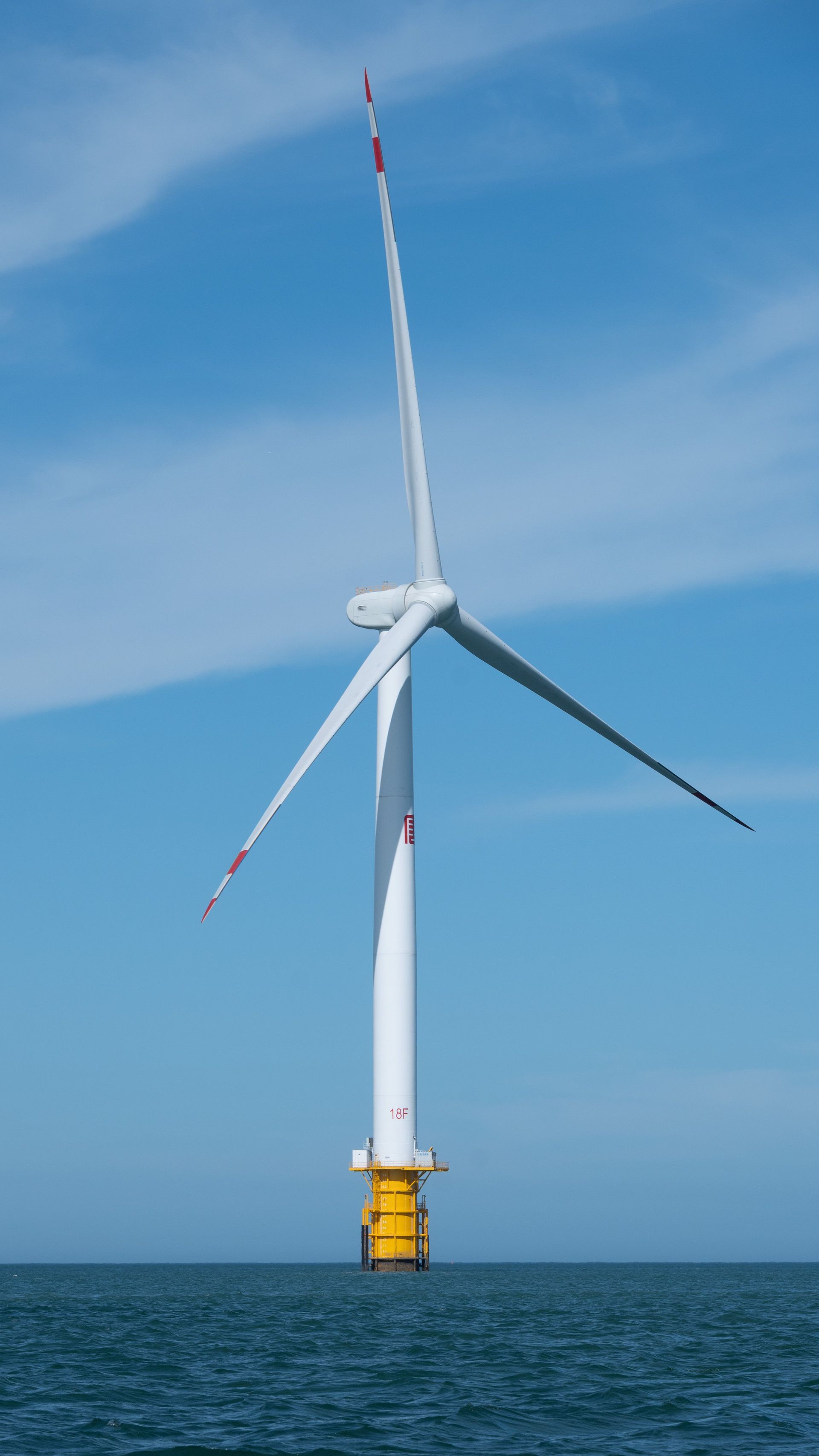
Telecoms technicians often find they are perfectly suited for wind turbine blade repair. The physical discipline and technical rigging skills required for mast work translate directly to the renewable sector. There is a significant overlap between MATS standards and GWO safety protocols; both prioritise rapid casualty recovery and rigorous equipment mastery. By adding certifications like Industrial Painter Training or inspection qualifications to your portfolio, you can transition between sectors as market demands shift. This versatility is essential for long-term job security in the evolving energy landscape of the UK and Ireland.
Booking Your MATS Training
For those looking to maximise their employability, combining your telecoms experience with an IRATA Rope Access Level 1 qualification is the most effective way to open new doors. Rope access techniques provide efficient solutions for accessing difficult structures where traditional climbing methods might be restricted. You can check our EUSR MATS course page for current availability and upcoming dates at our Belfast centre. We also offer flexible group booking options for companies needing to certify entire teams, ensuring your workforce remains compliant and ready for immediate site deployment. Contact our Belfast office directly for bespoke advice on your technical training requirements.
Secure Your Future on UK Telecoms Infrastructure
Mastering the standards of the Mast and Tower Safety Group is the only way to guarantee access to the UK’s restricted telecoms sites. Site access depends on it. By choosing a provider that combines EUSR accreditation with active field experience for your MATS training, you ensure your instruction is grounded in the technical realities of the industry. We've explored how maintaining your annual refreshers prevents costly project downtime and how these skills serve as a gateway to broader opportunities in wind energy and industrial maintenance.
At our Belfast training centre, we prioritise practical competence over simple classroom theory. Our instructors bring years of real-world industrial experience to every drill; they ensure you leave with the confidence to manage complex rescue scenarios under pressure. Whether you're a new entrant or an experienced rigger, we're here to support your professional progression with meticulous attention to safety and compliance. It's about more than just a certificate; it's about coming home safe every day.
Book Your EUSR MATS Training at Dangle Academy Today and take the next step in your high-stakes career with a partner you can trust.
We look forward to seeing you on the tower.
Frequently Asked Questions
How long does MATS training last?
The Initial Basic Tower Climbing and Rescue course takes exactly three days to complete. This timeframe allows for a comprehensive blend of classroom-based theory and intensive practical exercises on the tower. If you are attending a refresher course to maintain an existing qualification, the training is typically condensed into a single day of assessment and practice.
Is the MATS certificate valid internationally?
No, the MATS certificate is a UK-specific industry standard designed to meet the requirements of British network operators. Whilst the technical climbing and rescue skills you acquire are transferable to masts anywhere in the world, the EUSR registration is specifically recognised by UK infrastructure owners. Technicians planning to work abroad may require additional certifications such as IRATA or GWO.
What happens if I fail the practical rescue assessment?
You will receive detailed feedback from your assessor and, where possible, an opportunity to practice the specific manoeuvre before a re-assessment. We prioritise safety above all else; we cannot certify a trainee who cannot demonstrate a safe and effective rescue. If a trainee is unable to meet the standard within the course duration, they may be required to book additional training days.
Do I need a medical certificate before attending the course?
We strongly recommend obtaining an OEUK or similar "fit-for-climb" medical certificate before your course begins. Although the minimum requirement for the training is a self-declaration of fitness, most UK site owners will not allow you to access their masts without professional medical clearance. Having this documentation in place ensures your MATS training leads directly to active site work.
Can I work on any UK mast once I have my EUSR MATS card?
Yes, the EUSR MATS card is recognised as the standard entry requirement for the majority of the UK's mobile and broadcast infrastructure. It serves as your primary proof of competence for operators like Arqiva and Cellnex. However, you must still comply with individual site induction rules and hold any other site-specific permits or additional safety certifications required by the network provider.
Is there a difference between MATS and Arqiva training?
MATS is the modern, standardised framework that has replaced the older Arqiva-specific training schemes. As of January 2026, the EUSR MATS schemes are the mandatory requirement for accessing Arqiva sites. This transition was designed to create a single, consistent safety standard across all UK telecoms infrastructure, removing the confusion caused by multiple overlapping company-specific certifications.
How often do I need to refresh my MATS training?
You must complete a refresher course every 12 months to maintain your EUSR registration for tower climbing and rescue. Because rescue skills are perishable and technology evolves, annual practice is essential for safety. It is vital to book your refresher before your current certificate expires; if it lapses by even one day, the system requires you to retake the full three-day initial course.
Can I combine MATS training with IRATA rope access courses?
Yes, combining these qualifications is a strategic way to enhance your career prospects in the industrial sector. Whilst MATS training is essential for telecoms-specific structures, IRATA rope access provides the technical versatility needed for complex structural inspections and maintenance. Many technicians at our Belfast centre choose to hold both to ensure they can work across telecoms, wind energy, and oil and gas assets.
Contact Us
We'd Love a Share...
Recent Blog Post's