Offshore Wind Turbine Maintenance
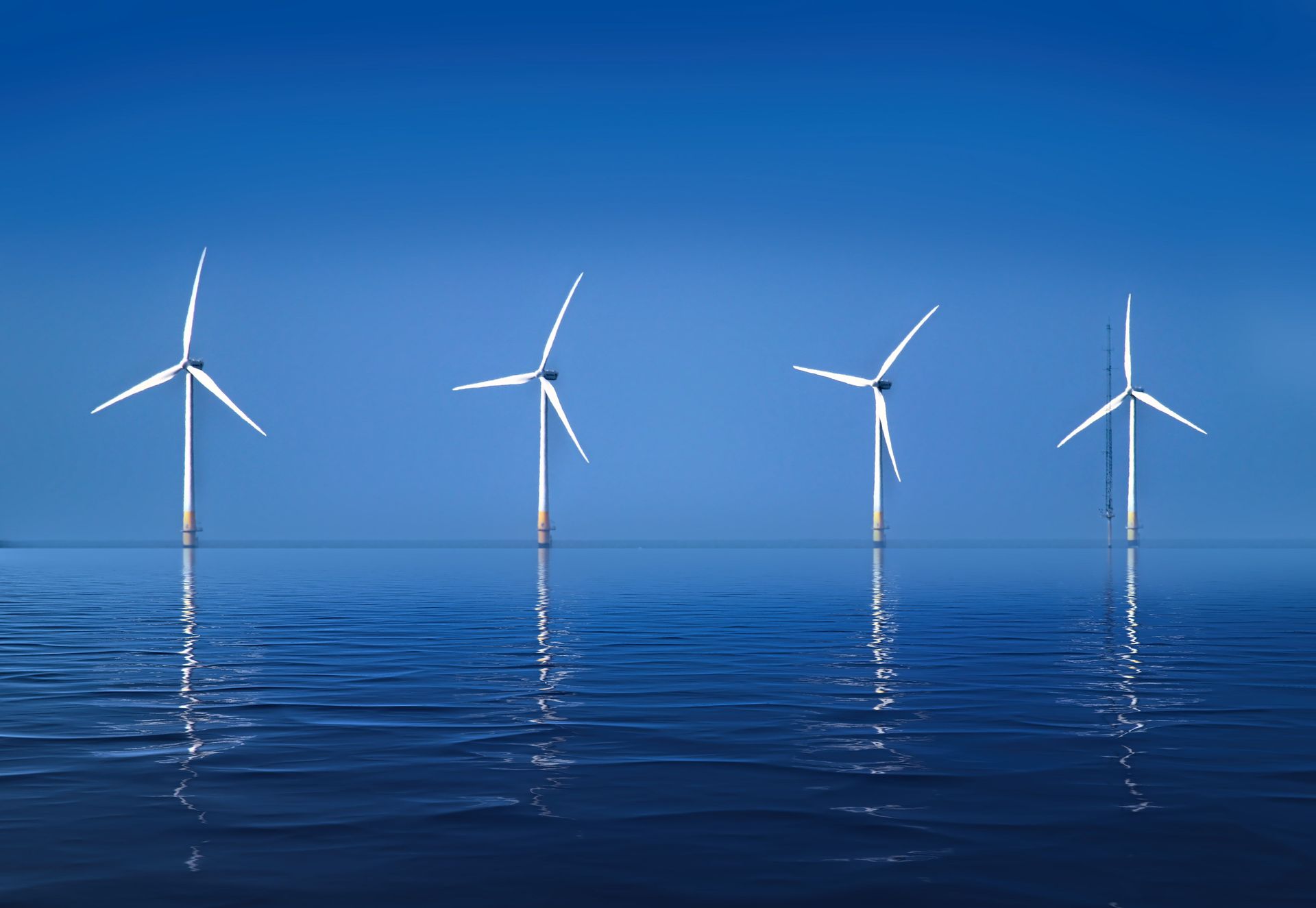
Offshore Wind Turbine Maintenance: A Guide to Safety and Efficiency
While the industry focuses on expanding capacity, the safety reality on the ground is shifting. In 2025, the UK Total Recordable Injury Rate for operational wind farms rose to 6.00, with nacelle-related incidents increasing by 140% as more assets moved into the maintenance phase. Managing offshore wind turbine maintenance in these high-risk environments is a logistical and safety challenge that often feels like a race against the weather and rising downtime costs.
You're right to be concerned about balancing efficiency with stringent compliance. This guide will help you master the complexities of offshore asset care, from specialist rope access techniques to GWO safety compliance. We'll explore the synergy between IRATA and GWO standards, identify the most cost-effective access methods, and examine the latest blade repair and inspection innovations.
At Dangle, we bring field-proven expertise from our Belfast hub directly to the offshore environment. By combining our role as a service provider with our unique 5-day IRATA training plus a 6th-day assessment, we ensure technicians aren't just passing a test; they're prepared for the physical and technical realities of the industry. Practical industrial experience is always superior to classroom-only knowledge when managing high-stakes assets.
Key Takeaways
- Learn how rope access provides a faster, more cost-effective alternative to traditional heavy scaffolding for offshore wind turbine maintenance.
- Understand the technical importance of Leading Edge Protection (LEP) and composite repair techniques in preserving turbine aerodynamic efficiency and structural integrity.
- Master the GWO safety framework and the essential requirements for Advanced Rescue Training when working in high-risk nacelle environments.
- Discover how to build a hybrid maintenance strategy that integrates drone inspections with field-proven rope access expertise to minimise downtime.
- Recognise the logistical benefits of utilising local hubs like Belfast to reduce mobilisation times and improve safety compliance for UK and Irish offshore projects.
Table of Contents
- The Critical Challenges of Offshore Wind Turbine Maintenance
- Advanced Access Methods: Rope Access vs Traditional Solutions
- Core Maintenance Tasks: Blade Repair and Coatings
- Safety Standards and Accreditation for Offshore Personnel
- Optimising Your Offshore Maintenance Strategy
The Critical Challenges of Offshore Wind Turbine Maintenance
The North Sea and Irish Sea environments are relentless. High salinity, heavy rain, and constant gale-force winds create a corrosive cocktail that accelerates material degradation. For operators, offshore wind turbine maintenance isn't just a technical necessity; it's a financial imperative. When a turbine stops spinning, the loss of revenue is compounded by the staggering cost of mobilising specialist vessels and technicians on short notice.
Reactive "fire-fighting" repairs are rarely sustainable in this sector. If you wait for a component to fail, you're at the mercy of unpredictable weather windows and long lead times for parts. A proactive approach allows teams to capitalise on calm seas and planned outages, ensuring the asset remains productive during peak wind periods. Effective maintenance planning reduces the risk of catastrophic failure and ensures the long-term viability of the project.
Environmental Stressors and Material Fatigue
Saltwater corrosion is a constant threat to the structural integrity of the tower and nacelle. Without high-performance industrial coatings, the lifespan of these multi-million pound assets would be drastically shortened. Offshore wind power operations also face the unique challenge of leading edge erosion. High-velocity rain and grit strike turbine blades at speeds exceeding 200mph, stripping away protective layers and reducing aerodynamic efficiency. Structural vibrations add another layer of complexity, as constant oscillation can lead to micro-fractures in internal components that are difficult to detect without specialised inspection.
The Safety Stakes of High-Risk Offshore Work
The physical risks of this industry are significant. In 2025, turbine nacelles were identified as the primary source of injuries in the UK, with incidents rising by 140% as more assets moved into the operational phase. Working at height whilst suspended over open water or navigating the confined spaces of a hub requires more than just theoretical knowledge. All personnel must hold a valid GWO Basic Safety Training (GWO BST) certificate to even step onto a transition piece.
However, classroom-only knowledge often fails when a real emergency occurs 100 miles offshore. This is why Dangle technicians are active in the field, bringing real-world industrial insight back to our Belfast training centre. We understand that safety isn't just about compliance; it's about the practical ability to execute a rescue or repair when conditions are at their worst. This field-proven approach ensures that our trainees are prepared for the technical realities of the industry, not just the exam.
Advanced Access Methods: Rope Access vs Traditional Solutions
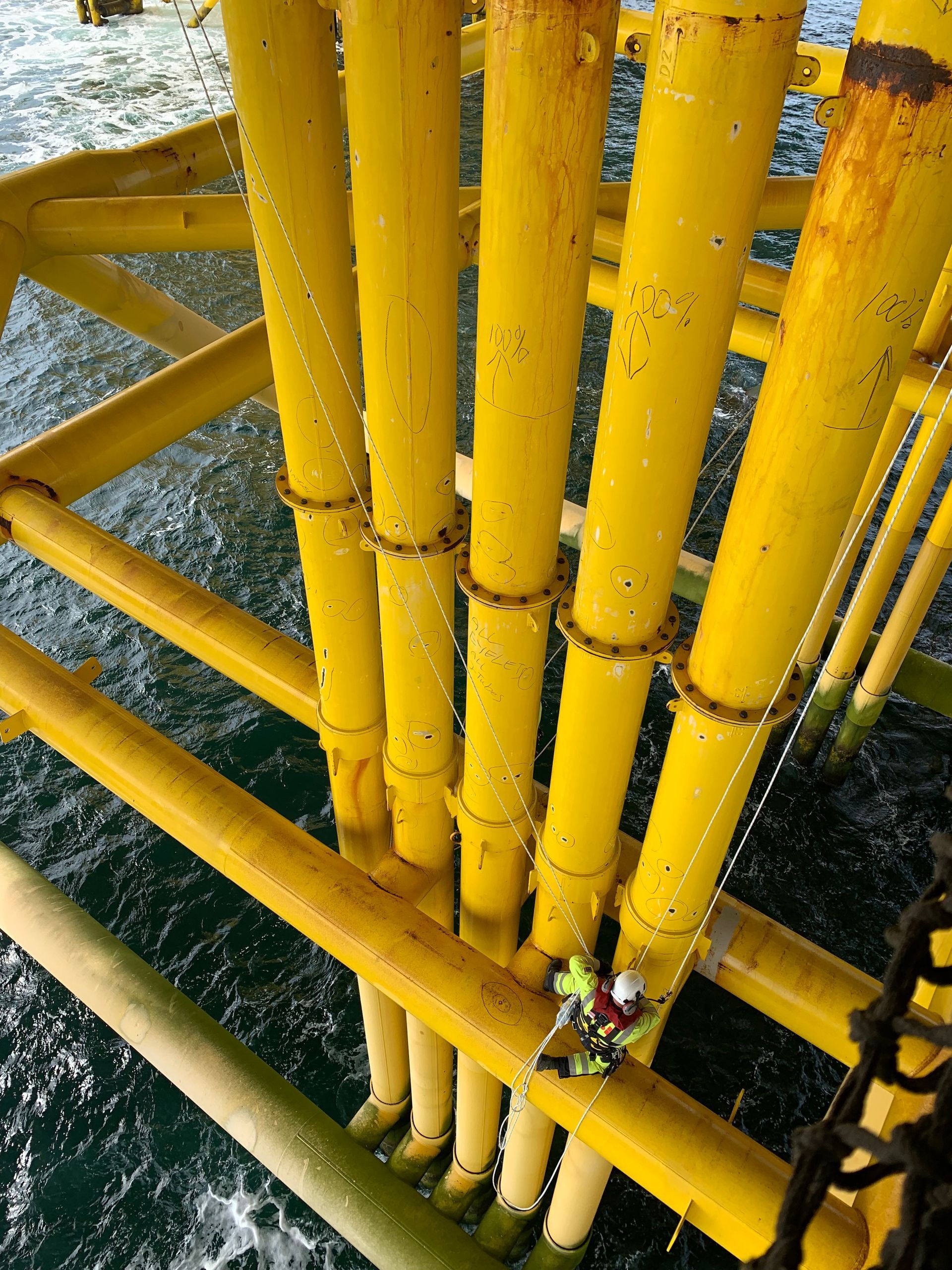
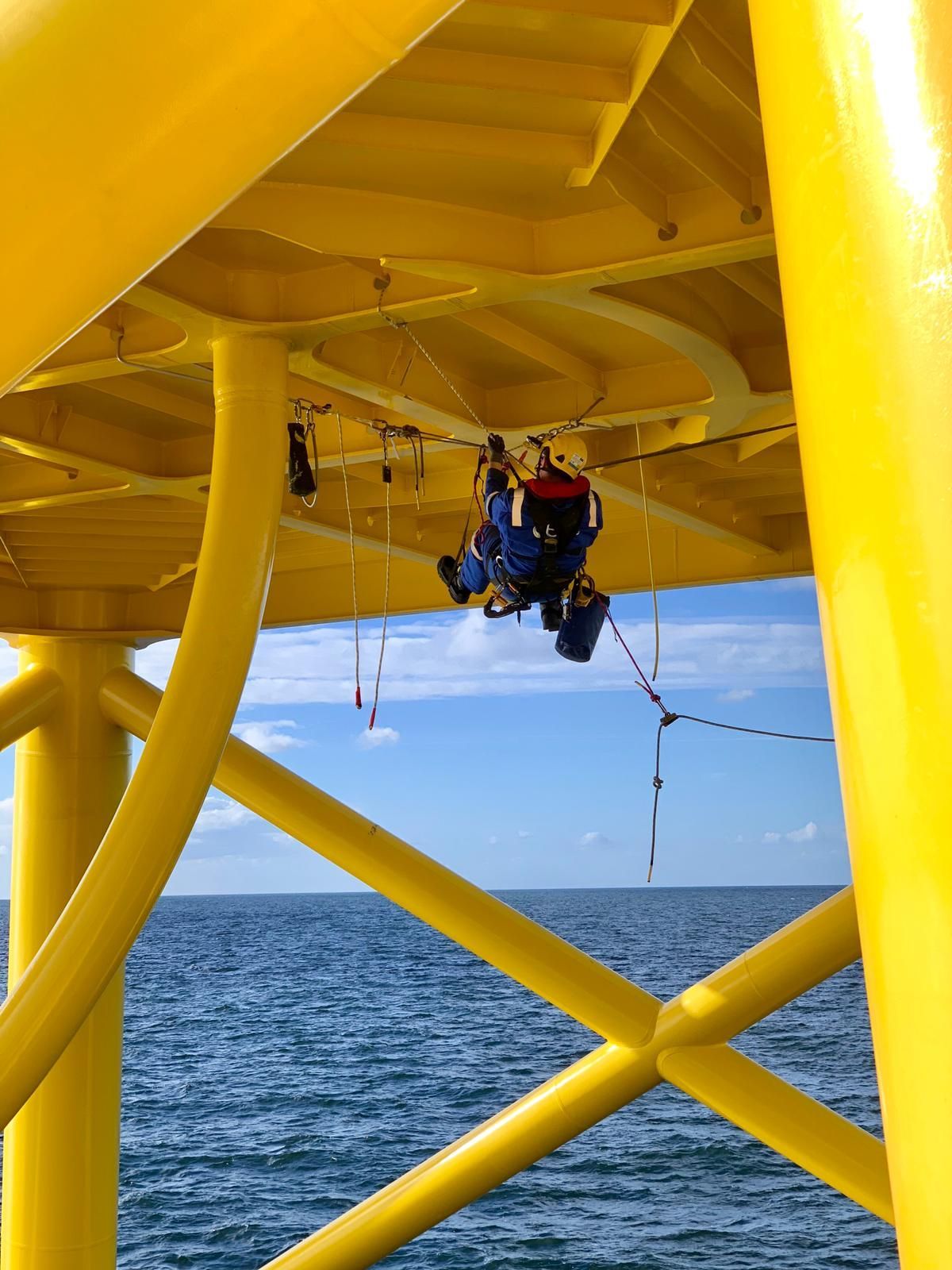
Heavy scaffolding is often a logistical dead end in the offshore sector. For a modern 15MW turbine, the time required to erect and strike traditional access structures can consume an entire weather window. Industrial rope access offers a leaner, more responsive alternative for offshore wind turbine maintenance. It requires minimal deck space and can be mobilised in a fraction of the time needed for mechanical platforms or jack-up vessels.
Technical reports like the U.S. Offshore Wind O&M Roadmap and RenewablesUK Offshore Wind Industry Skills report highlight that reducing vessel dependency and increasing technician agility are critical for lowering operational costs. By removing the need for heavy support machinery, rope access also significantly reduces the carbon footprint of each maintenance campaign. This methodology allows teams to react quickly to defects, ensuring that minor repairs don't escalate into major component failures during peak production months.
IRATA Rope Access: The Industry Gold Standard
The IRATA framework is the backbone of safe vertical work. For those starting their career, Rope Access Level 1 provides the fundamental skills needed for basic maintenance and inspections. As technicians progress to IRATA Level 2 and finally an IRATA Level 3, their responsibilities expand to include complex rigging and the management of detailed offshore rescue plans. These supervisors ensure that every task, from bolt tensioning to non-destructive testing (NDT) and blade repair, is executed within a strict safety envelope. At Dangle Academy in Belfast, our 5-day courses include a unique 6th-day assessment to ensure our trainees are field-ready and capable of handling real-world pressures.
Technological Integration in Asset Inspection
Innovation isn't just about better ropes; it's about smarter data. Drones are now used for rapid initial blade inspections to identify composite failures or lightning damage without putting a technician on the line prematurely. However, data alone doesn't fix a turbine. The real efficiency lies in the transition from drone-led discovery to physical wind turbine blade repair. Once a defect is mapped, rope access technicians can be deployed to the exact coordinate for precision repair. This hybrid model ensures real-time asset health monitoring and reduces unnecessary exposure to risk. If you're looking to advance your career in this sector, you can explore our full range of training courses to gain the necessary accreditations.
This seamless move from digital reporting to physical intervention is what defines modern asset management. By combining drone data with the tactile expertise of a qualified technician, operators can maintain a higher level of oversight with fewer personnel on-site.
Core Maintenance Tasks: Blade Repair and Coatings
A single millimetre of erosion on a turbine blade can disrupt airflow enough to cause a measurable drop in annual energy production. For offshore wind turbine maintenance, preserving aerodynamic efficiency is a constant battle against the elements. Technicians must address everything from minor surface pitting to severe structural damage caused by lightning strikes. These tasks require a deep understanding of composite materials and the specialised coatings that protect them. When a lightning strike hits, it can vaporise the resin within the laminate, leaving a charred hole that compromises the blade's structural integrity. Repairing this requires the removal of all damaged material before rebuilding the laminate layers with glass-fibre fabric and resin.
Turbine Blade Composite and Leading Edge Repair
Repairing composite materials 100 metres above the sea is a technical challenge that demands precision. The process involves sanding back damaged laminate, applying resin-rich fillers, and curing the repair to a smooth finish. Humidity and temperature control are vital; epoxy resins won't cure correctly if the environment is too damp or cold. Technicians often use heating blankets or specialised habitats to maintain the necessary conditions whilst suspended. Achieving a high-quality finish is essential for performance, which is why Industrial Painter Training is a critical certificate for those performing finishing works on offshore assets.
Corrosion Protection and Inspection Protocols
Steel towers face aggressive oxidation, particularly in the splash zone where constant wetting and drying occur. Identifying early signs of steelwork degradation through specialist paint inspection services is the only way to prevent costly structural repairs later. Technicians apply high-performance industrial coatings to internal tower sections and external surfaces to create a barrier against the salt-rich atmosphere. In the UK and Ireland, standardised inspection cycles ensure these assets meet regulatory benchmarks and remain safe for personnel. Beyond the structure, maintenance also extends to the nacelle. This area houses complex mechanical systems and high-voltage electrical components that require routine lubrication, bolt tensioning, and thermal imaging to detect overheating before a failure occurs. This proactive approach ensures the turbine remains operational throughout its designed lifespan.
Safety Standards and Accreditation for Offshore Personnel
An offshore wind technician is often the furthest person from a hospital when a medical emergency occurs. For offshore wind turbine maintenance, safety isn't just about wearing a harness; it's about holding the correct accreditations to work in high-risk environments. The industry recognises a "dual passport" system: IRATA for vertical movement and Global Wind Organisation (GWO) standards for sector-specific safety. Navigating this framework is essential for anyone looking to enter or progress within the renewables sector.
Medical compliance is the first gatekeeper. Personnel must pass an OEUK medical and a Chester Step test to prove they're physically capable of the demanding climbs involved. Once fit, the focus shifts to technical safety. GWO Advanced Rescue Training (ART) is now a critical requirement for those working in turbine nacelles, where complex machinery and confined spaces make traditional evacuation impossible. These standards ensure that every technician on a transition piece possesses the same baseline of competence, regardless of their specific trade.
The Dangle® Academy Advantage: 5+1 Training
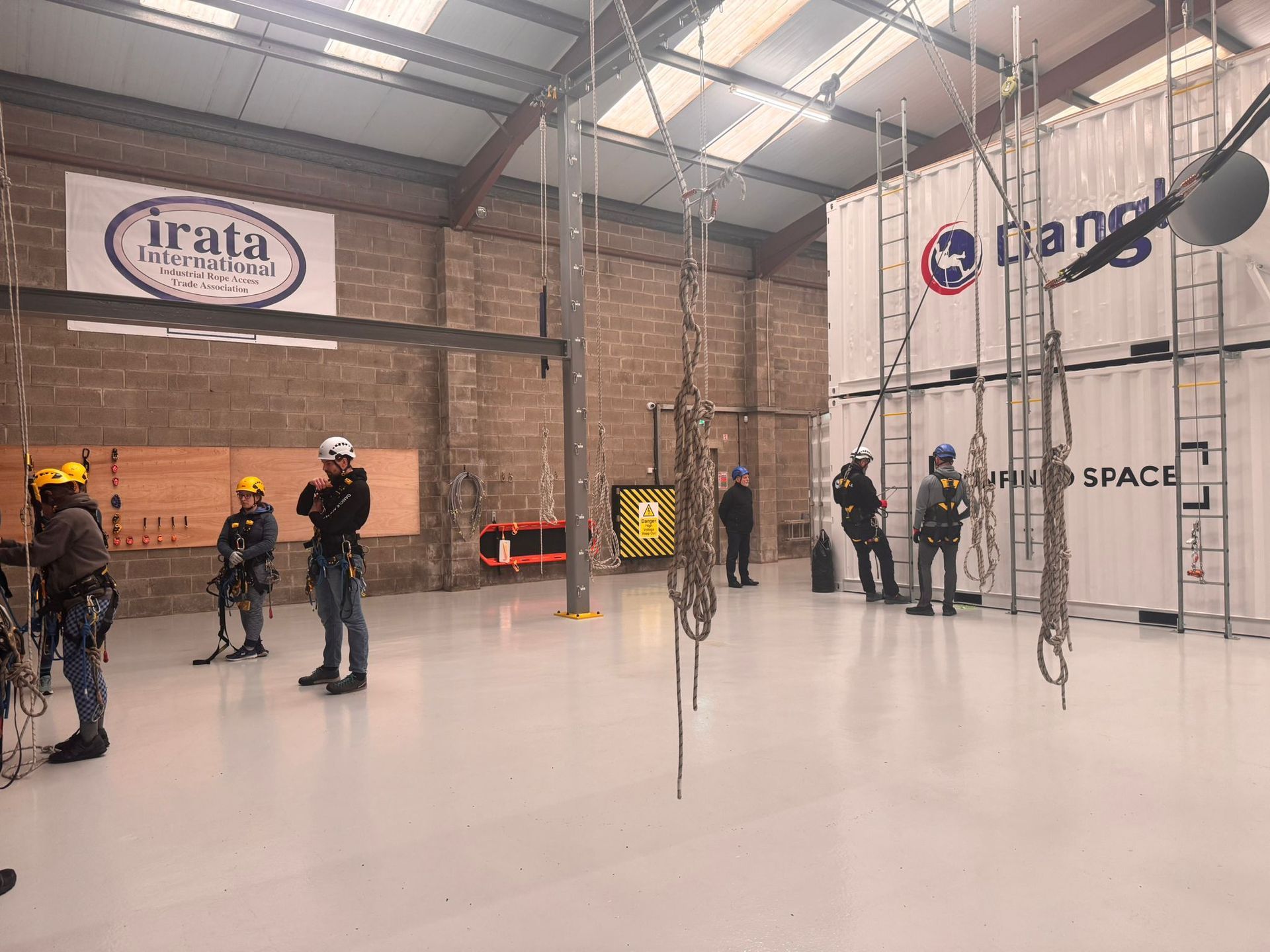
Our Belfast training centre serves as a vital gateway for UK and Irish offshore workers. We offer a unique 5-day IRATA course followed by a 6th-day assessment, a structure that significantly improves pass rates compared to standard 5-day programmes. This extra day allows for refinement and confidence-building under the guidance of instructors who are active industrial service providers. We don't just teach the syllabus; we share real-world insights gained from years of field-proven experience. This makes Dangle® the ideal partner for those transitioning from the oil and gas sector into renewables, where practical industrial experience is highly valued.
First Aid and Emergency Response Offshore
In remote environments, the standard of medical care must be higher. GWO Enhanced First Aid (EFA) provides technicians with the skills to stabilise a casualty for extended periods. Regular rescue drills are mandatory to maintain proficiency, as the psychological and physical demands of an offshore rescue are intense. Technicians must be able to execute complex lowering and hauling systems whilst managing their own safety in high-wind conditions. This builds on the standards we set during GWO Basic Safety Training, ensuring that rescue remains a practical skill rather than a theoretical concept. To ensure your team meets these rigorous benchmarks, you can book your GWO and IRATA training courses through our Belfast academy today.
Optimising Your Offshore Maintenance Strategy
Relying solely on sensor data to manage a multi-million pound asset is a high-stakes gamble. Whilst predictive analytics can flag a potential fault, the physical resolution still requires a technician on a rope. Effective offshore wind turbine maintenance requires a hybrid model that bridges the gap between digital oversight and manual intervention. By combining real-time data with drone-led inspections and rapid-response rope access, operators can move away from reactive repairs. This strategy reduces the need for expensive vessel mobilisations and ensures that minor issues are rectified before they cause significant downtime.
Local hubs like Belfast are critical to this operational efficiency. Having a central base for both rope access inspection services and specialist training reduces logistics overheads for UK and Irish offshore projects. It allows for faster mobilisation during narrow weather windows, ensuring that technicians are on-site exactly when the conditions permit. This geographic advantage is a key factor in maintaining high availability across the fleet.
Selecting the Right Industrial Partner
Vetting a contractor involves looking beyond their equipment list. You must evaluate their safety culture and technical competence through their specific IRATA and GWO accreditations. A key advantage of working with a provider like Dangle is our dual nature as an academy and a service provider. This "Training-to-Service" loop means our field technicians are constantly updated with the latest standards, and our trainees benefit from instructors with current offshore experience. When you choose a partner that trains its own staff, you're securing a higher baseline of proficiency. Long-term partnerships are always superior to transactional services, as they allow the contractor to develop a deep understanding of your specific asset's history and structural quirks.
Securing the Future of Wind Energy Assets
As the first generation of offshore farms approaches middle age, the industry's focus is shifting toward repowering and life-extension projects. Proactive asset management is the only way to maximise ROI and ensure these turbines continue to contribute to the UK’s net-zero targets. Well-maintained blades and towers don't just last longer; they perform better. If you're ready to improve your operational standards or need to upskill your workforce, your next step is simple. You can view our upcoming course dates or contact our Belfast centre to discuss a tailored maintenance package. Practical industrial experience is the foundation of energy security, and we're here to provide it.
Securing the Future of Offshore Wind Operations
Mastering offshore wind turbine maintenance requires a sophisticated balance of field-proven technique and rigorous safety compliance. We've explored how transitioning from traditional heavy access to agile rope access methods can significantly reduce downtime whilst maintaining the highest safety standards. By integrating drone-led data with the tactile expertise of qualified technicians, operators can protect their assets from the relentless environmental stressors of the North and Irish Seas.
At Dangle, we believe that practical industrial experience is the only true benchmark for competence. Our Belfast-based academy is led by active service providers who understand the physical and technical realities of the industry. With our unique 6th-day assessment for IRATA courses, we're able to ensure higher pass rates and a deeper level of field readiness for every trainee. Whether you're looking to upskill your workforce or enter the renewables sector, we provide the accredited training and consultancy services needed to excel in high-stakes environments.
Take the next step in your professional development and ensure your team is equipped for the challenges ahead. Book your GWO training and IRATA training at Dangle Academy today. We look forward to supporting your career progression and the long-term success of your offshore projects.
Frequently Asked Questions
How often do offshore wind turbines need maintenance?
Offshore turbines generally require a major scheduled service once a year and a smaller intermediate check six months later. These planned visits focus on lubrication, bolt tensioning, and gearbox inspections. However, offshore wind turbine maintenance also includes reactive repairs triggered by sensor data or storm damage. The frequency depends on the age of the asset and its location, with older turbines in the North Sea often requiring more frequent structural inspections
What is the most common cause of offshore turbine failure?
Leading edge erosion on blades and gearbox failures are the most frequent causes of downtime. The high-velocity impact of rain and salt spray strips the protective coatings, leading to a loss of aerodynamic efficiency. In 2025, turbine nacelles were identified as a primary source of technical incidents in the UK. Regular structural surveys and proactive composite repairs are essential to prevent these common issues from escalating into catastrophic mechanical failures or long-term structural degradation.
What is the difference between onshore and offshore wind turbine maintenance?
The primary differences are the aggressive marine environment and the logistical complexity. Offshore work requires specialised sea survival training and medical certifications like OEUK. Logistics are also far more challenging, as technicians must rely on crew transfer vessels or helicopters within specific weather windows. Whilst onshore maintenance is often accessible by road, offshore wind turbine maintenance demands a higher level of rescue proficiency due to the remote nature of the assets and the difficulty of emergency evacuation.
How long does a typical offshore wind turbine blade repair take?
A minor composite repair or Leading Edge Protection (LEP) application typically takes between one and three days per blade. This timeline is heavily dependent on ambient conditions like humidity and temperature, as resins require specific environments to cure correctly. More extensive structural repairs or lightning strike damage can take longer. Technicians often use specialised habitats or heating blankets to speed up the process and ensure the repair meets the manufacturer's technical specifications.
What medical certifications are required for offshore wind technicians?
All offshore personnel must hold a valid OEUK medical certificate to prove they're fit for the marine environment. This is typically accompanied by a Chester Step test, which measures aerobic capacity and suitability for the physically demanding climbs inside a turbine tower. These certifications ensure that technicians don't have underlying health conditions that could lead to an emergency in a remote location where medical support is several hours away.
Why is rope access preferred over scaffolding for wind turbines?
Rope access is the preferred method because it's faster to mobilise and requires far less deck space than heavy scaffolding. It allows technicians to reach any part of the blade or tower without the need for jack-up vessels or complex mechanical platforms. This speed is vital for capitalising on narrow weather windows. Additionally, rope access has a much lower carbon footprint and reduces the overall cost of maintenance campaigns by eliminating expensive equipment rentals.
How does weather affect offshore maintenance schedules?
Weather is the most significant factor in offshore scheduling, as high winds and wave heights can prevent safe transfers. Most crew transfer vessels have a significant wave height limit of around 1.5 to 2 metres. Wind speeds above 10 to 12 metres per second often halt work on the blades. These constraints create weather windows, making it essential to use agile access methods like rope access to complete tasks quickly when conditions are favourable.
Contact Us
We'd Love a Share...
Recent Blog Posts