GWO Basic Safety Training: The Technician’s Gateway to Wind Energy (2026)
GWO Basic Safety Training
A GWO Basic Safety Training certificate is the only document that stands between a qualified tradesperson and a high-growth career in the renewable energy sector. Without this specific accreditation, you simply cannot set foot on a turbine, regardless of your previous experience or technical skill set. It's understandable if you feel anxious about the physical demands of the modules or confused by the digital registration process in the WINDA database.
We'll help you navigate these requirements with clarity and confidence. This guide provides expert-led insights into the core modules, ensuring you understand exactly what's expected during your training at our Belfast centre. We'll examine the updated V20 standards effective from March 2026 and explain how learning from field-active instructors at Dangle Academy gives you a distinct advantage. By the end of this article, you'll have a clear path to obtaining a recognised certificate that serves as your immediate gateway to the wind industry.
Key Takeaways
- Understand why GWO Basic Safety Training is the non-negotiable entry requirement for anyone seeking employment in the global wind energy sector.
- Identify the five essential modules of the BST package and how the 2026 V20 updates ensure you meet the latest international safety standards.
- Master the WINDA registration process to ensure your training records are digitally verified and visible to prospective offshore and onshore employers.
- Prepare for the physical rigours of climbing and rescue drills by understanding the requirements for OEUK medicals or equivalent fitness certifications.
- Gain a competitive edge by choosing expert-led training in Belfast that prioritises real-world industrial experience over basic classroom theory.
Table of Contents
- What is GWO Basic Safety Training (BST)?
- The Core Modules of GWO Basic Safety Training
- Navigating WINDA and Certification Validity
- Preparing for Your GWO Training in Belfast
- Why Practical Industry Experience Trumps Classroom Theory
What is GWO Basic Safety Training (BST)?
Relying on general construction safety standards in a wind turbine environment is a significant risk. The unique geometry of a turbine tower, coupled with the remote nature of offshore and onshore sites, demands a specialised approach to risk management. GWO Basic Safety Training (BST) serves as the industry-mandated entry point. It's a comprehensive suite of safety protocols designed specifically for the wind sector. This standard is governed by the Global Wind Organisation (GWO), a non-profit body founded by leading turbine owners and manufacturers to ensure a safer work environment.
As of March 10, 2026, the industry transitioned to the V20 standard. This update reflects the latest technical advancements and safety data gathered from across the global fleet. Unlike generic safety cards, this accreditation proves you possess the specific skills to survive and assist others in a turbine nacelle or transition piece. At Dangle Academy, we deliver this training using instructors who are active in the field; they bring real-world context to every drill, moving beyond the theory found in a textbook.
The Commercial Importance of GWO Accreditation
From a commercial perspective, GWO accreditation is a prerequisite for site access. Wind farm operators and insurance providers view non-certified personnel as an unacceptable liability. By standardising safety training, the GWO has created a system where certificates are recognised globally. This portability allows a technician trained at our Belfast centre to work on projects in the United Kingdom, or Asia without needing to retake foundational courses. It streamlines recruitment for contractors and ensures that every person on-site speaks the same safety language. Without a valid record in the WINDA database, you're effectively locked out of the industry's supply chain.
Who Should Undertake GWO BST?
GWO BST is the essential first step for a wide range of roles within the wind energy sector. It is not just for hands-on technicians but for anyone who needs to access a turbine environment.
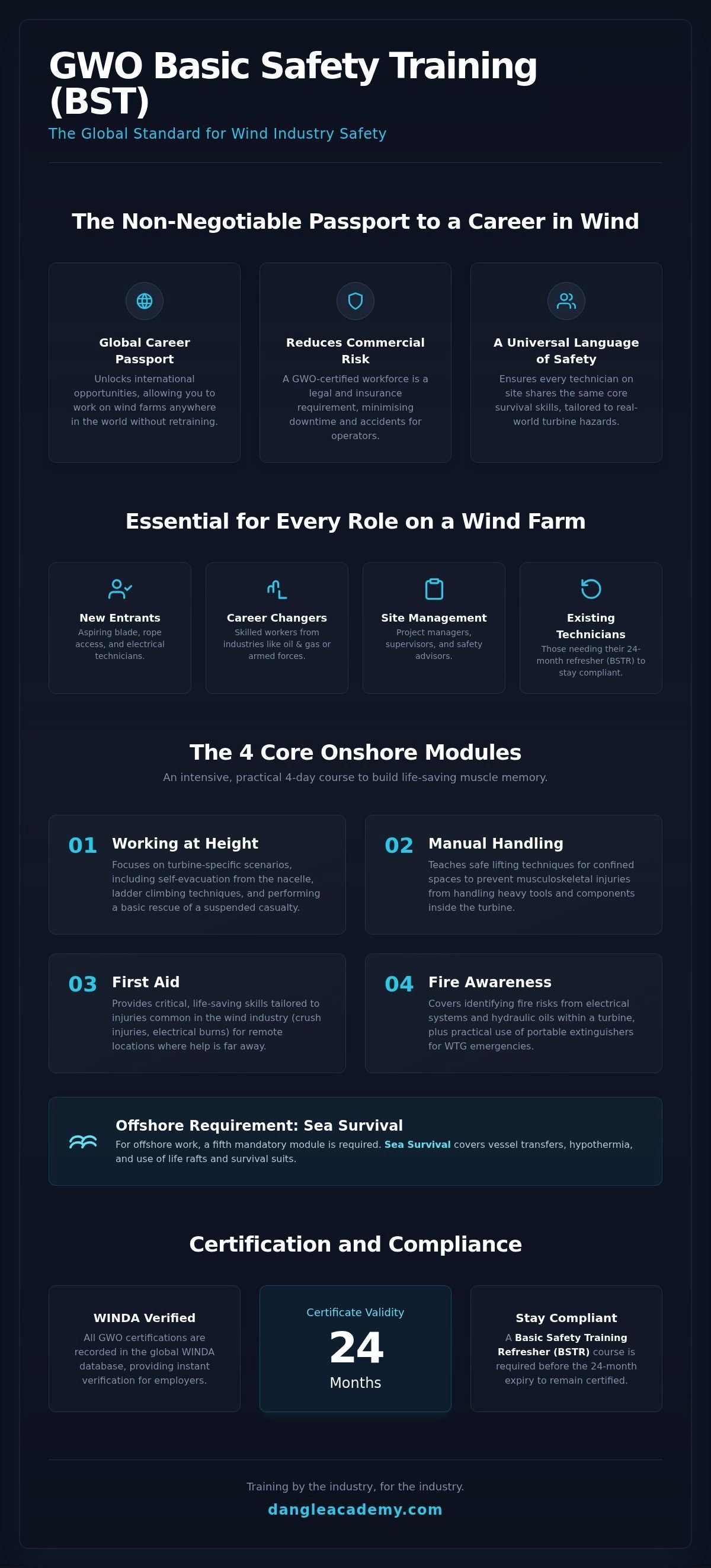
New Entrants: Aspiring blade technicians, rope access specialists, and electrical engineers looking to enter the renewables sector.
Career Changers: Skilled workers from adjacent industries like oil and gas, traditional utilities, or the armed forces who want to pivot into wind energy.
Site Management: Project managers, site supervisors, and health and safety advisors who need to understand the practical risks their teams face.
Existing Technicians: Any worker whose 24-month BST certificate is approaching its expiry date must undertake a Basic Safety Training Refresher (BSTR) course to remain compliant.
This training isn't just for those climbing the ladders. Whilst it's essential for blade technicians and electrical engineers, it's also required for site managers, inspectors, and even drone pilots who need to access the turbine structure. We've seen a steady increase in professionals pivoting from the oil and gas sector or traditional utilities. These candidates often possess high-level technical skills but lack the turbine-specific rescue training required for renewables. Whether you're a new entrant or an experienced hand needing a refresher, the GWO Basic Safety Training remains the non-negotiable first step in your professional development.
The Core Modules of the GWO BST Package
The GWO BST standard is designed to equip technicians with the practical skills to handle the most common emergencies in a turbine environment. The full GWO BST standard consists of five modules. At Dangle Academy, we focus on delivering the four core modules required for onshore work, providing the foundational skills every single wind turbine technician needs.
This training is intensely practical, balancing essential theoretical knowledge with hands-on drills. Our approach ensures that safety procedures are not just memorised but are built into a technician's muscle memory. The four modules are typically delivered over four days, allowing delegates to become fully immersed in a realistic safety culture.
Working at Height and Manual Handling
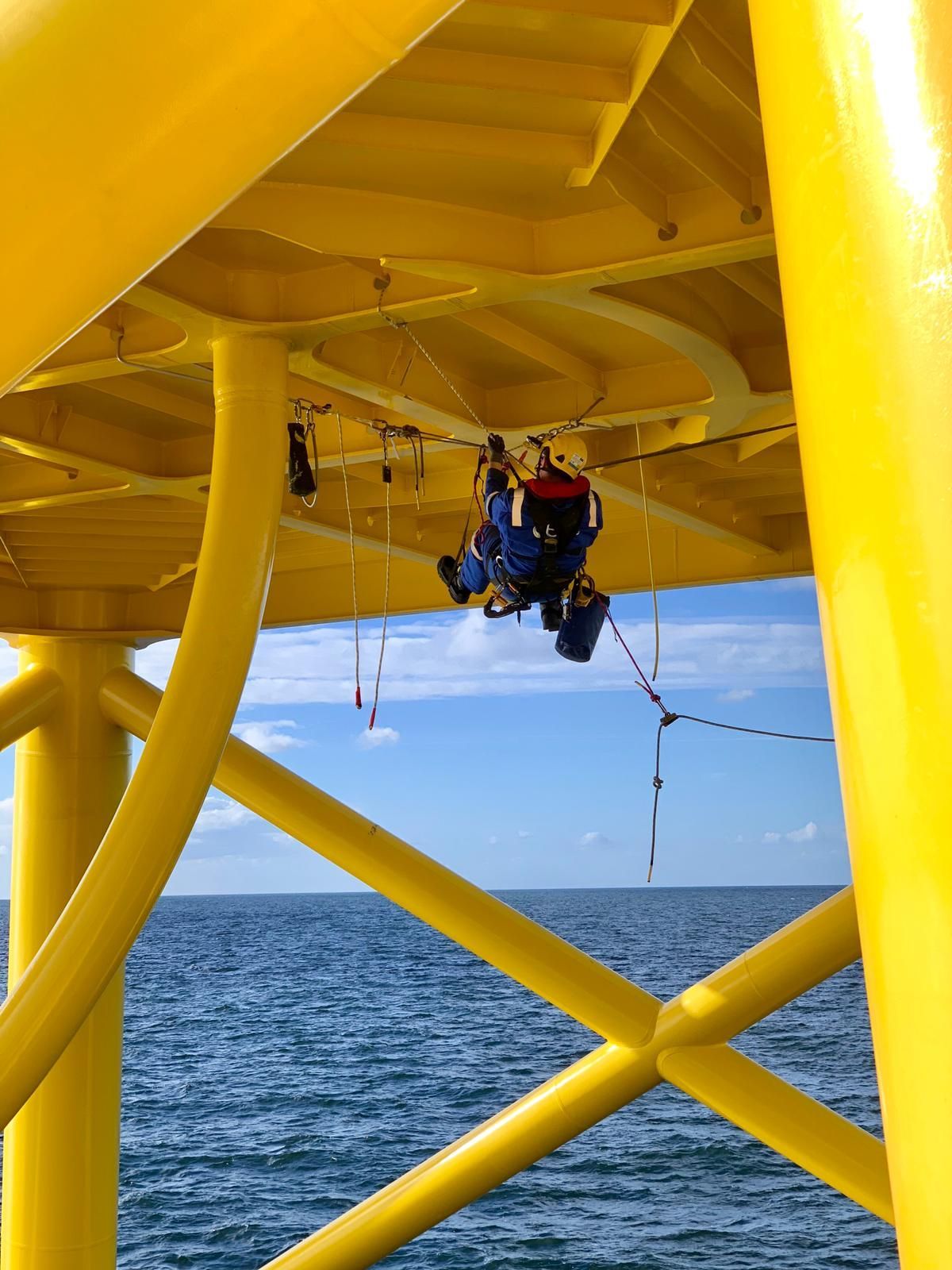
These two modules are the foundation of turbine safety. Following the March 2026 updates, they are delivered as distinct units but remain intrinsically linked during practical exercises. You'll learn the correct use of personal fall protection equipment (PFPE) and master safe evacuation procedures from a height. A significant focus is placed on basic rescue, ensuring you can lower a colleague to safety using industry-standard devices. We also integrate ergonomic techniques specifically for confined spaces to prevent musculoskeletal injuries. This training aligns directly with GWO Working at Height standards, preparing you for the physical reality of the tower.
First Aid and Fire Awareness
Wind turbines are remote workplaces where traditional emergency services cannot reach you quickly. Our First Aid module equips you with life-saving skills tailored to the industrial environment, focusing on trauma and incident management. For those looking to progress into more senior safety roles, this serves as the baseline before moving on to GWO Enhanced First Aid. Complementing this is Fire Awareness, where you'll practice fire mitigation and the correct use of portable extinguishers. Understanding how to manage a fire within the restricted space of a WTG nacelle is vital for preventing catastrophic equipment failure and ensuring crew safety.
Onshore Focus vs. Offshore Requirements (Sea Survival)
For a technician to work offshore, a fifth GWO module is required: Sea Survival. This specialised course covers the unique hazards of working over water, including vessel transfer procedures, hypothermia, and the use of life rafts and survival suits. It is a mandatory requirement for any role on an offshore installation.
Dangle Academy's GWO BST course is currently structured to provide the four essential modules—Working at Height, Manual Handling, First Aid, and Fire Awareness—that are fundamental for all wind technicians, particularly those starting their careers in the onshore sector.
This provides the most direct and efficient pathway to getting on-site. Technicians whose career path later takes them offshore can complete Sea Survival as a standalone module at a specialist marine training centre.If you're unsure which modules best suit your career path, you can view our full training calendar to see how these modules are scheduled at our Belfast centre.
Navigating WINDA and Certification Validity
Arriving at a training centre without a WINDA ID is a common mistake that can delay your certification. WINDA, the Wind Industry Database, is the global platform used by the industry to verify technician training records. It acts as a single source of truth for employers and site managers. Without a personal ID, your successful completion of GWO Basic Safety Training cannot be recorded. This digital system has replaced paper certificates, ensuring that your qualifications are instantly verifiable anywhere in the world.
All modules within the BST suite carry a 24-month validity period. This two-year cycle ensures that safety skills remain sharp and compliant with the latest industry revisions, such as the V20 standard. Managing this timeline is a professional responsibility. If you allow your certification to lapse by even a single day, you'll be barred from site access and forced to retake the full initial course rather than a shorter refresher.
How to Organise Your WINDA ID
Registering for your WINDA ID is a straightforward but essential task. You must visit the official GWO website and sign up as a "Delegate". This process generates a unique, lifelong identifier that stays with you throughout your career. It's vital to use a personal email address rather than a corporate one, as you'll need access to this account even if you change employers. Once you've registered, provide your ID to Dangle Academy before your course begins. After you pass your drills, we handle the digital upload of your results directly to the database. You can then view our professional services to see how these verified skills are applied in real-world turbine maintenance.
The Refresher Cycle: BST vs BSTR
The industry distinguishes between the initial
GWO Basic Safety Training (BST) and the Basic Safety Training Refresher (BSTR). Staying within your 24-month window allows you to take the BSTR, which is significantly shorter and more cost-effective. This refresher focuses on practical skill maintenance and updates on new safety protocols. However, if your certificate expires, the system won't allow a refresher upload. You'll have to invest more time and money into the full 5-day package again. We recommend booking your refresher at least three months before your expiry date to account for site schedules and weather delays. Maintaining your status ensures you remain eligible for high-stakes roles, such as those requiring
GWO Advanced Rescue Training.
Preparing for Your GWO Training in Belfast
Preparing for your GWO Basic Safety Training requires more than just reading a manual. It's a physically rigorous programme that tests your stamina and mental resolve. Candidates often underestimate the effort required for repeated vertical ladder climbs or the coordination needed during rescue drills. Success in the wind industry depends on your ability to perform under pressure whilst maintaining strict safety protocols.
Before you arrive at our Belfast centre, you may be asked to secure an OEUK medical or a suitable equivalent. This ensures your cardiovascular health and physical condition are compatible with the high-risk nature of turbine work. Mental preparation is equally vital. If you have concerns about working at height, our instructors will guide you through the equipment's reliability to build your confidence.
To ensure a smooth start, please bring the following items:
- Your unique WINDA ID (generated as a Delegate).
- Government-issued photo identification.
- A copy of your valid OEUK medical certificate or self declaration medical form.
- Comfortable work clothing and sturdy, lace-up footwear.
Physical Fitness and Weight Restrictions
Physical standards in the wind industry include a strict 136kg weight limit. This figure includes your body weight plus your personal protective equipment (PPE) and tools. It's a hard limit dictated by the certification of fall arrest and rescue devices. If you exceed this, you won't be able to complete the practical elements of the course safely. Many employers also demand the Chester Step Test as a benchmark for aerobic fitness. We advise focusing on cardiovascular conditioning and leg strength in the weeks leading up to your training. Being physically prepared allows you to focus on the technical skills rather than struggling with the climb.
What to Expect at Dangle Academy
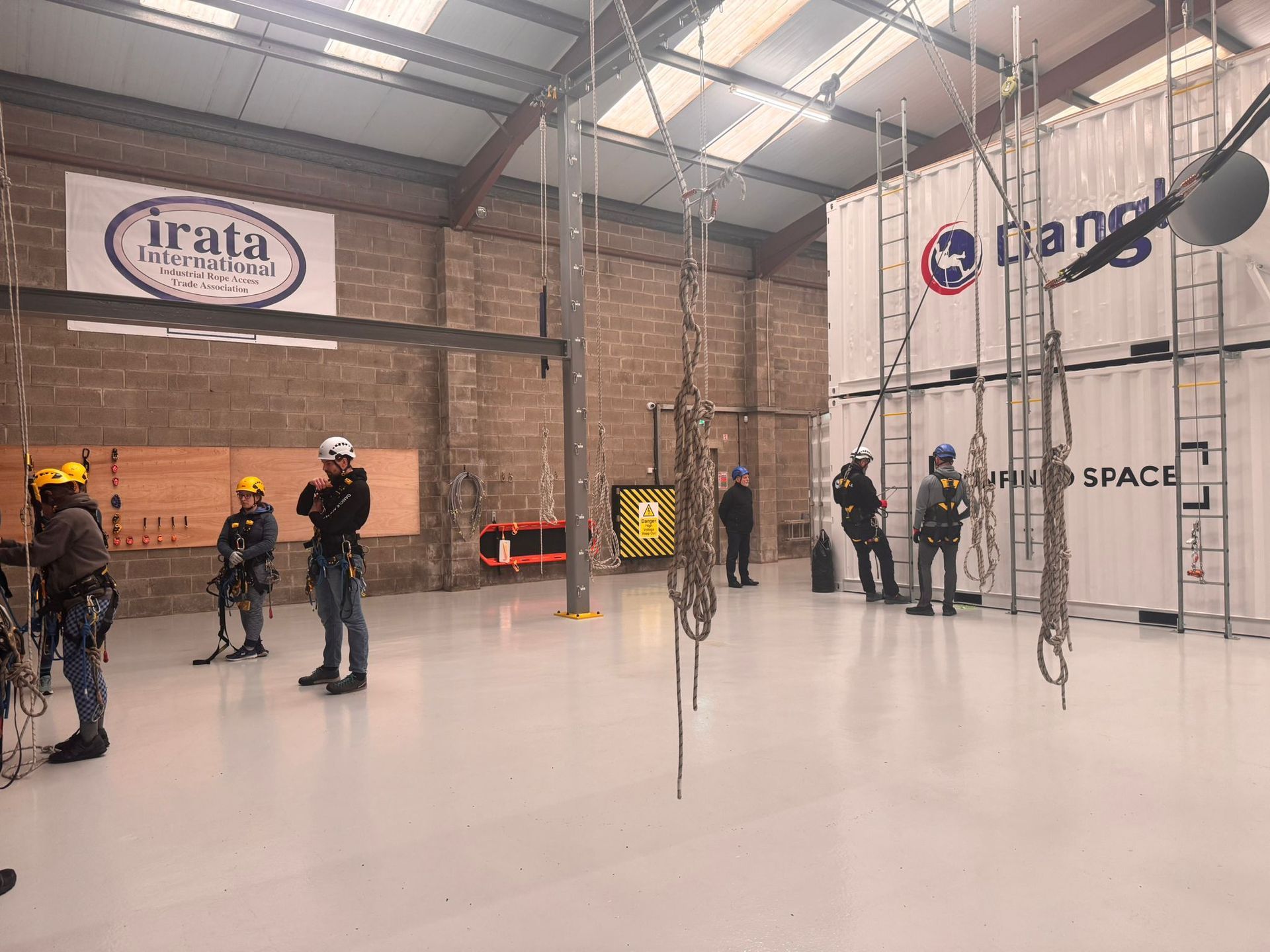
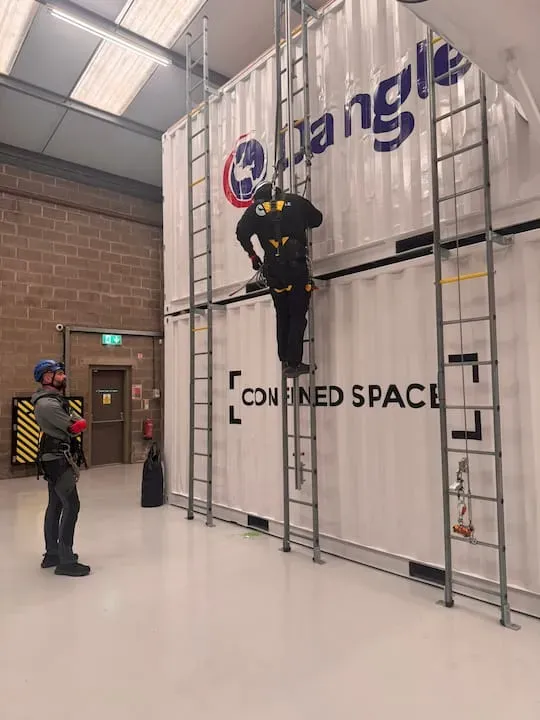
Our Belfast facility is designed to mirror the industrial realities of the wind sector. We utilise realistic training rigs that simulate the confined spaces and vertical challenges of a turbine tower, nacelle and blades. The atmosphere at Dangle Academy is one of disciplined professionalism. Our instructors are field-active technicians who bring current site experience over decades in the industry, into the classroom. They understand the anxiety new entrants may feel and provide a supportive environment to help you master the drills. For those travelling from outside Northern Ireland, our centre is conveniently located with easy access to transport and hotel accommodation in Belfast. You can book your GWO BST course online to secure your place in our next intake.
Why Practical Industry Experience Trumps Classroom Theory
Many training centres treat safety as a sterile, classroom-based box to be ticked. On a wind turbine, this disconnect between theory and reality can have catastrophic consequences for a new technician. Safety training is only as reliable as the experience behind it. At Dangle Academy, we don't just teach the GWO Basic Safety Training syllabus; we live it. Our instructors are active technicians who spend their weeks on turbines, not just in classrooms. This field-first approach means you're learning from people who understand the commercial pressures and physical realities of the job.
The Dangle Advantage: From Training to Site
Being both a training academy and an active provider of Industrial Rope Access Services and Wind Turbine maintenance services gives our trainees a distinct edge. We use our own service technicians who are also instructors to inform the training syllabus, ensuring the drills you practice are relevant to current site conditions. This practical mentorship often leads to higher pass rates because we focus on the "why" behind every safety protocol. Real-world "war stories" aren't just anecdotes; they're essential tools for helping you retain life-saving information when you're 100 metres above the ground. By prioritising muscle memory over memorising slides, we ensure you're site-ready from the moment you receive your certificate.
Booking Your GWO BST in Northern Ireland
Choosing a local provider in Belfast significantly reduces the logistical burden of launching your career. By training at Dangle Academy, candidates from across Northern Ireland and the Republic of Ireland can avoid the excessive travel and accommodation costs typically associated with GB-based centres. It's about more than just convenience; it's about training in a facility that understands the specific needs and operational nuances of the local wind sector. We act as a bridge between your initial qualification and your first day on-site, providing the technical confidence that only comes from expert-led instruction.
To maximise your employability in a competitive market, we recommend combining your initial GWO Basic Safety Training with GWO Advanced Rescue Training (ART). This advanced certification, coupled with your foundational safety knowledge, makes you a far more attractive prospect for major operators who require technicians capable of complex rescues. Staying ahead of the curve is essential, so it's also worth reviewing our previous guide on improving site safety through harness inspection to understand the broader industrial landscape you'll be entering. Select your preferred course date now to begin your journey with a partner that knows the industry inside out.
Secure Your Future in the Global Wind Sector
The transition to a career in renewables requires more than technical aptitude; it demands a commitment to the highest safety standards. Obtaining your GWO Basic Safety Training is the definitive step toward site access and professional legitimacy. By mastering the four core modules and maintaining your digital record in the WINDA database, you ensure your skills are recognised by operators across international borders. This foundational qualification is the bedrock upon which a successful career as a wind technician is built.
Choosing Dangle Academy means you aren't just attending a course; you're joining a community of industrial professionals. As an accredited training provider, our centrally located Belfast facility provides the realistic environment needed to build muscle memory under the guidance of field-active experts. Don't leave your career progression to chance by choosing classroom-only providers. Book your training at Dangle Academy Belfast to gain the practical competence required for the modern wind industry. We look forward to seeing you on the rigs.
Frequently Asked Questions
How long does the GWO Basic Safety Training take to complete?
The full GWO Basic Safety Training package typically takes four days to complete at our Belfast centre. This intensive week covers all four core modules: First Aid, Manual Handling, Fire Awareness and Working at Height. If you only require specific modules for onshore projects, the duration may be shorter. However, most technicians choose the full week to ensure they're fully qualified for onshore environments without any professional delay.
Is there a specific medical certificate required for GWO training?
Yes, you must hold a valid medical certificate to participate in the practical elements of the course. The industry standard is the OEUK medical, though a Fit 2 Train certificate or a suitable equivalent may be accepted depending on your employer's requirements. We provide occupational health screening and Chester Step testing at Dangle to ensure you meet the physical benchmarks required for high-risk industrial work and turbine climbing.
What happens if I fail one of the GWO BST modules?
If you don't meet the assessment criteria for a specific module, you'll need to retake that individual unit. Our instructors at Dangle Academy provide continuous feedback throughout the drills to help you succeed. Because we prioritise practical mentorship, we find that most candidates who engage fully with the hands-on drills pass successfully. You won't need to retake the entire five-day package; you only repeat the module where the standard wasn't met.
Can I work offshore with just the GWO BST onshore modules?
No, you cannot work offshore without the Sea Survival module. Whilst the four onshore modules allow you to work on land-based turbines, offshore sites carry unique risks that require specific survival training. This includes vessel transfers and life raft procedures. We recommend completing the full suite to maximise your employability. Most major contractors in the North Sea and Irish Sea demand the complete offshore-ready certification for all their technicians.
How much does the GWO BST course cost in the UK?
The cost of a GWO BST course varies across the UK depending on the training provider and the specific modules included in the package. At Dangle Academy, we focus on providing expert-led training that reflects real-world industrial conditions. Whilst we don't list fixed prices here, we encourage candidates to consider the value of learning from field-active instructors. Local training in Belfast also helps you save significantly on travel and accommodation costs compared to GB centres.
Do I need to be a strong swimmer for the Sea Survival module?
You don't need to be an Olympic-level swimmer, but you should be confident in the water whilst wearing a lifejacket and survival suit. The Sea Survival module focuses on survival techniques, life raft entry, and vessel transfers rather than distance swimming. If you have a significant phobia of water, it's best to discuss this with our instructors beforehand. They're experienced in supporting candidates through these controlled pool-based drills in a safe environment.
Is the GWO BST certificate recognised in the USA and Europe?
The GWO BST certificate is recognised globally, including across Europe and the USA. Because the Global Wind Organisation (GWO) was founded by international turbine manufacturers, the training standards are consistent worldwide. Your successful completion is recorded in the WINDA database, allowing employers in any country to verify your credentials instantly. This portability is a major advantage for technicians who want to follow the seasonal demand for wind energy projects across different continents.
Can I take the GWO refresher course if my certificate has already expired?
No, you cannot take a refresher course if your previous certificate has already expired. The GWO standards are very strict on this point. If your 24-month validity period has passed by even one day, the WINDA system will not allow a refresher upload. In this situation, you'll have to retake the full initial GWO Basic Safety Training package. We always advise booking your refresher well in advance of your expiry date to avoid this unnecessary expense.
Contact Us
We'd Love a Share...
Recent Blog Posts