Rope Access vs Scaffolding Cost
Rope Access vs Scaffolding Cost UK: 2026 Industrial Comparison Guide
If you're still budgeting for scaffolding as your default access method, you're likely paying for weeks of "dead time" where no actual work is being performed. When evaluating the rope access vs scaffolding cost UK landscape in 2026, it's clear that the traditional approach often carries hidden burdens, from the £140 monthly local authority permit fees for pavement hoarding to weekly hire rates that can exceed £1,100 for a standard semi-detached structure. You likely feel the frustration of watching project timelines slip whilst waiting for a complex rig to be erected, inspected, and eventually dismantled.
We'll show you why switching to industrial rope access typically reduces total project costs by 30% to 70% while maintaining superior safety standards. This guide provides a clear financial justification for your next asset maintenance programme, exploring the ROI of multi-skilled technicians and the latest IRATA regulatory updates. You'll gain a practical framework to decide which method delivers the best value for your specific industrial requirements, ensuring your budget is spent on results rather than rental equipment.
Key Takeaways
- Identify the primary financial drivers behind the rope access vs scaffolding cost UK debate, specifically how eliminating passive rental fees can reduce your total project expenditure by up to 70%.
- Learn how rapid deployment and minimal logistical footprints allow multi-skilled technicians to complete maintenance cycles in a fraction of the time required for traditional setups.
- Discover the specific breakeven point where the volume of materials or project duration makes traditional scaffolding a more viable investment than rope-based methods.
- Understand how IRATA-accredited systems and advanced rescue planning provide a higher degree of operational safety whilst removing the liability of heavy plant equipment on site.
- Master the criteria for vetting industrial contractors by distinguishing between individual technician proficiency and company-wide IRATA membership to protect your long-term assets.
Table of Contents
- Evaluating the True Cost of Industrial Access in the UK (2026)
- The Hidden Overheads of Traditional Scaffolding: Why Budgets Inflate
- Operational Efficiency: How IRATA Rope Access Reduces Total Expenditure
- Strategic Comparison: When to Deploy Rope Access vs Traditional Scaffolding
- Optimising Your Maintenance Budget with Accredited Industrial Solutions
Evaluating the True Cost of Industrial Access in the UK (2026)
The UK industrial landscape in 2026 is defined by a tightening of operational budgets and a critical shortage of traditional trades. For asset managers overseeing offshore platforms, wind farms, or manufacturing plants, the financial burden of maintenance is no longer just about the work itself. It is about the cost of getting there. Scaffolding firms currently face soaring transport overheads and a deficit in qualified erectors, leading to a sharp rise in "passive hire" fees. When you analyse the rope access vs scaffolding cost UK data, the baseline difference is stark. Industrial rope access frequently saves 40% or more on total project spend, primarily because it eliminates the need for expensive, long-term equipment rental.
Compliance with the Work at Height Regulations 2005 (WAHR) remains the primary driver for safety costs. Whilst these regulations are essential for protecting personnel, the method chosen to satisfy them dictates your profit margins. Traditional access methods often focus on hourly rates, but this is a narrow metric. To understand the true financial impact, you must evaluate Total Project Expenditure (TPE). This includes the permit fees, which average around £140 per month for public highway encroachment, and the hidden costs of project delays during the weeks it takes to erect and dismantle complex steel structures.
The Shifting Economics of Work at Height
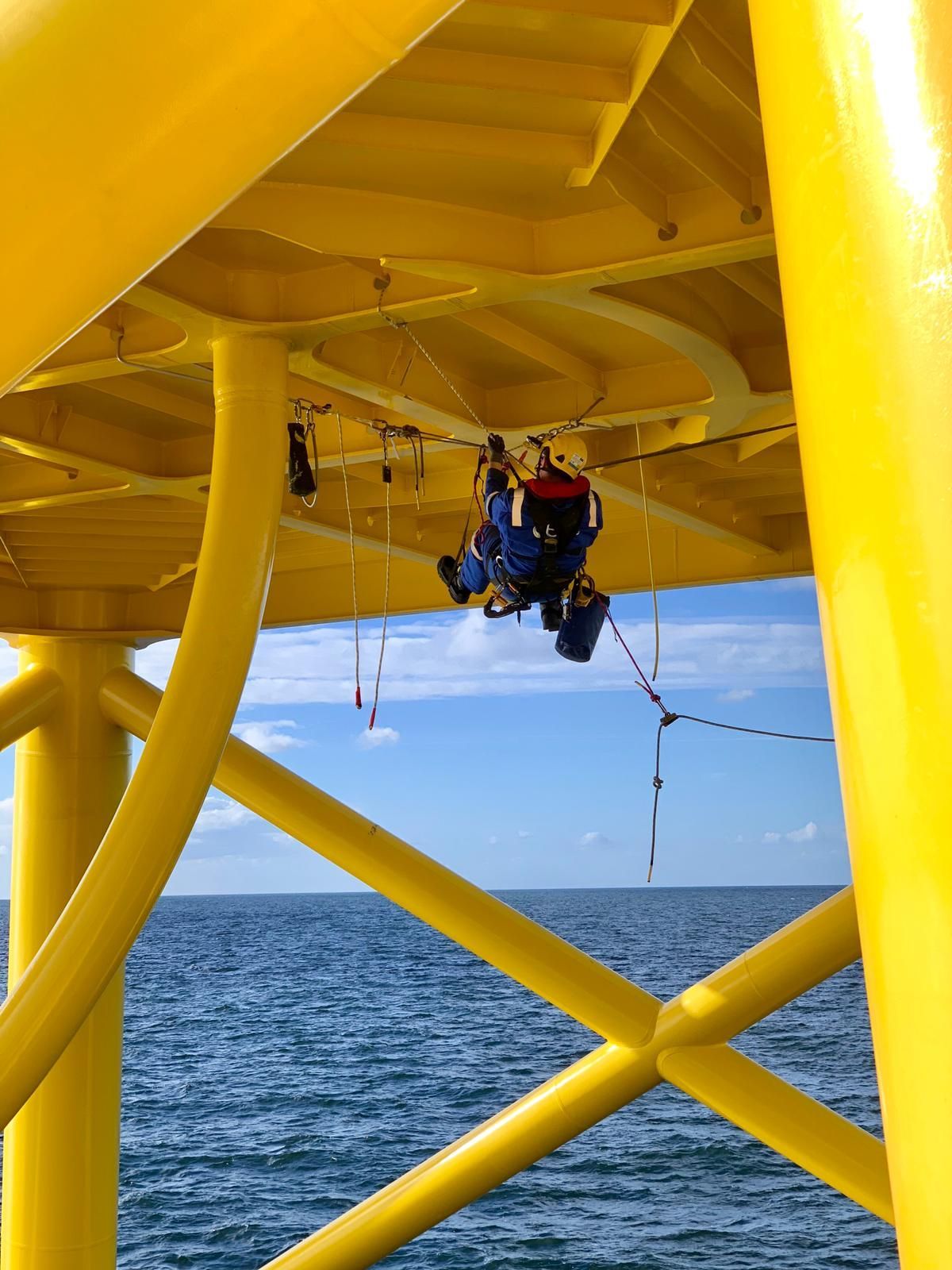
Modern asset managers are rapidly pivoting toward agile access solutions. In sectors like renewables or petrochemicals, high-frequency inspections require a footprint that traditional scaffolding cannot provide without causing significant operational downtime. By utilising rope access techniques, companies can bypass the logistical bottlenecks of heavy plant machinery and temporary works permits. The IRATA framework provides a predictable cost model where safety is integrated into the technician's proficiency rather than being a separate, bolted-on equipment charge. This shift is particularly evident in the North England and Scotland regions, where industrial heritage sites are being maintained through more nimble, labour-centric models.
Defining Rope Access and Scaffolding in Financial Terms
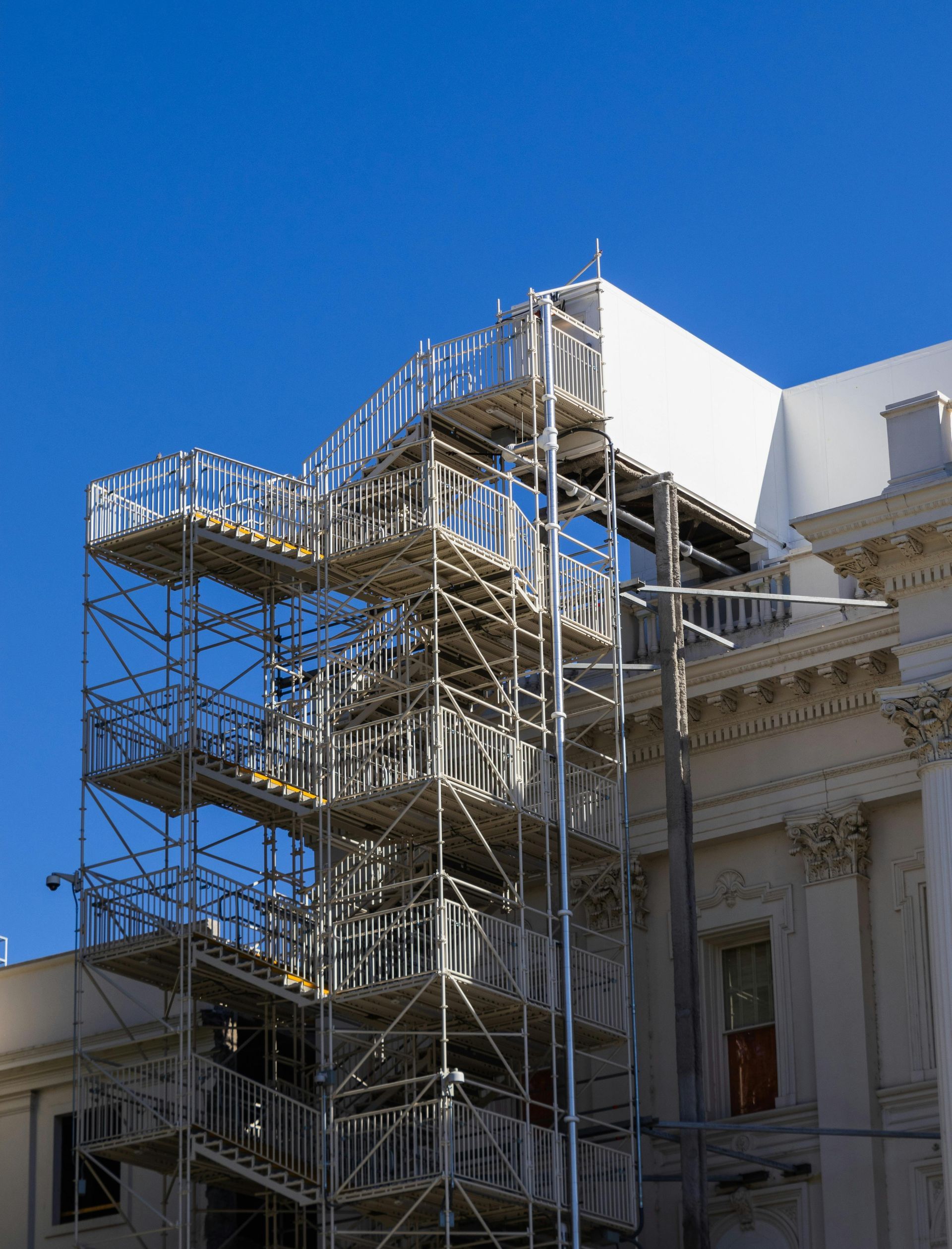
It is helpful to view these two methods through different accounting lenses. Scaffolding is a capital-intensive, hardware-heavy infrastructure investment. You are essentially paying for a temporary building to be constructed around your asset. Conversely, rope access is a highly mobile operational expenditure. For those overseeing complex assets, our Industrial Rope Access Services offer a direct route to these efficiencies. For a standard industrial unit, monthly scaffolding hire can easily reach £1,200 before a single technician has even stepped onto the site. A rope access team can often complete the entire scope of work in the time it takes a scaffolding crew just to deliver their materials to the yard. The rope access vs scaffolding cost UK comparison clearly favours the method that prioritises rapid deployment over stagnant hardware.
The Hidden Overheads of Traditional Scaffolding: Why Budgets Inflate
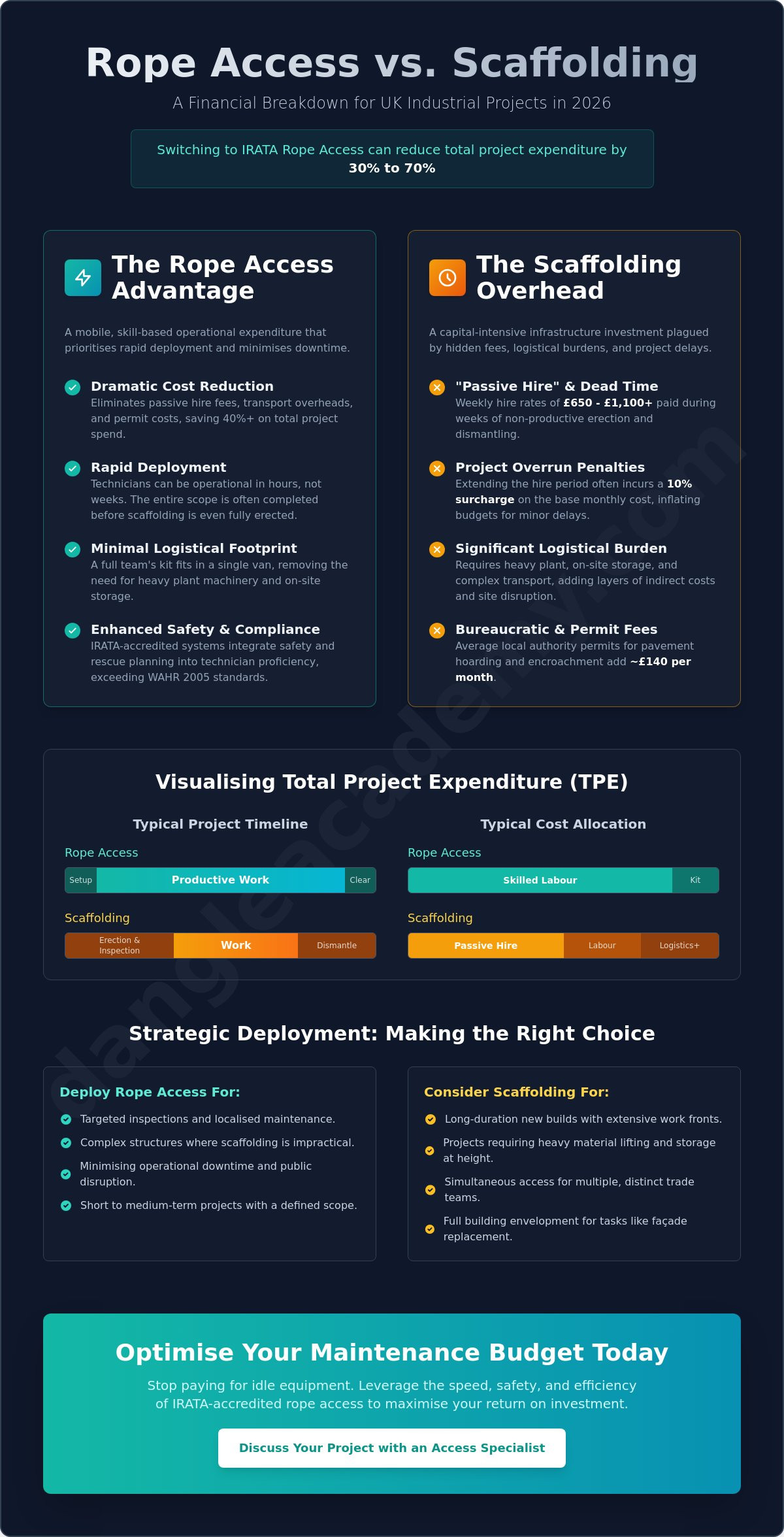
Traditional scaffolding quotes often represent a best-case scenario that rarely survives the realities of a UK industrial site. When comparing rope access vs scaffolding cost UK metrics, the most significant budget-killer is "Passive Hire". This refers to the ongoing rental fees paid for equipment that sits idle during weather delays, material shortages, or scheduling conflicts. For a standard industrial structure, weekly hire rates can range from £650 to £1,100. If a project overruns, extending the hire period typically adds a 10% surcharge to the base monthly cost, turning a minor delay into a major financial penalty.
The logistical footprint of scaffolding adds further layers of expense. Transporting tonnes of steel tubing and boards requires heavy plant machinery and significant on-site storage space. This contrasts sharply with rope access, where a full team's kit fits into a single transit van and is removed from the site every evening. Fixed structures also introduce security risks, effectively providing a ladder for unauthorised site access, which often necessitates additional lighting, hoarding, and security patrols.
The Cost of Passive Hire and Project Creep
Project creep is an inherent risk with fixed access. UK weather is notoriously unpredictable; high winds can halt work for days, yet the scaffolding remains in place, incurring costs. Because scaffolding takes days or weeks to erect, it isn't feasible to dismantle it during downtime. Rope access technicians simply coil their ropes and leave, meaning you only pay for the days they are actively working on your asset. This flexibility is a primary reason why our Industrial Rope Access Services are increasingly favoured for high-velocity maintenance tasks.
Administrative and Regulatory "Soft" Costs
The administrative burden of scaffolding is frequently underestimated. Beyond the physical hardware, you must account for local authority permits, which cost approximately £140 per month for any structure encroaching on a public highway. Compliance with UK scaffolding safety regulations also mandates weekly safety inspections by a competent person and formal structural engineering sign-offs for complex rigs. Additional safety features, such as debris netting at £5/m² per week and protective hoarding, further inflate the "soft" costs that rarely appear in the initial headline quote.
Operational Efficiency: How IRATA Rope Access Reduces Total Expenditure
The efficiency of rope access isn't just a marketing claim; it's a mathematical certainty rooted in the reduction of man-hours. Whilst scaffolding represents a construction project in itself, rope access is a surgical tool. When you analyse the rope access vs scaffolding cost UK data, the most immediate saving comes from the "Rapid Deployment" factor. A standard industrial rope system can be rigged and safety-checked in a matter of hours, whereas even a basic scaffolding rig often requires three days of labour just to reach the work face. This speed allows for a higher volume of work within the same window, effectively lowering the cost per square metre of maintenance.
Operating with a "Zero Footprint" is another critical financial advantage. Because technicians descend from above, there's no requirement for ground-level clearance or heavy plant machinery like MEWPs (Mobile Elevated Work Platforms) or cranes. This ensures that your site remains fully operational at ground level. In high-stakes environments like wind farms or utility plants, keeping the site clear of obstructions prevents the costly disruption of secondary workflows. Adhering to IRATA International standards ensures that this speed never compromises safety, providing a high safety-to-cost ratio by drastically reducing the total number of man-hours spent at height.
The Multi-Skilled Technician Advantage
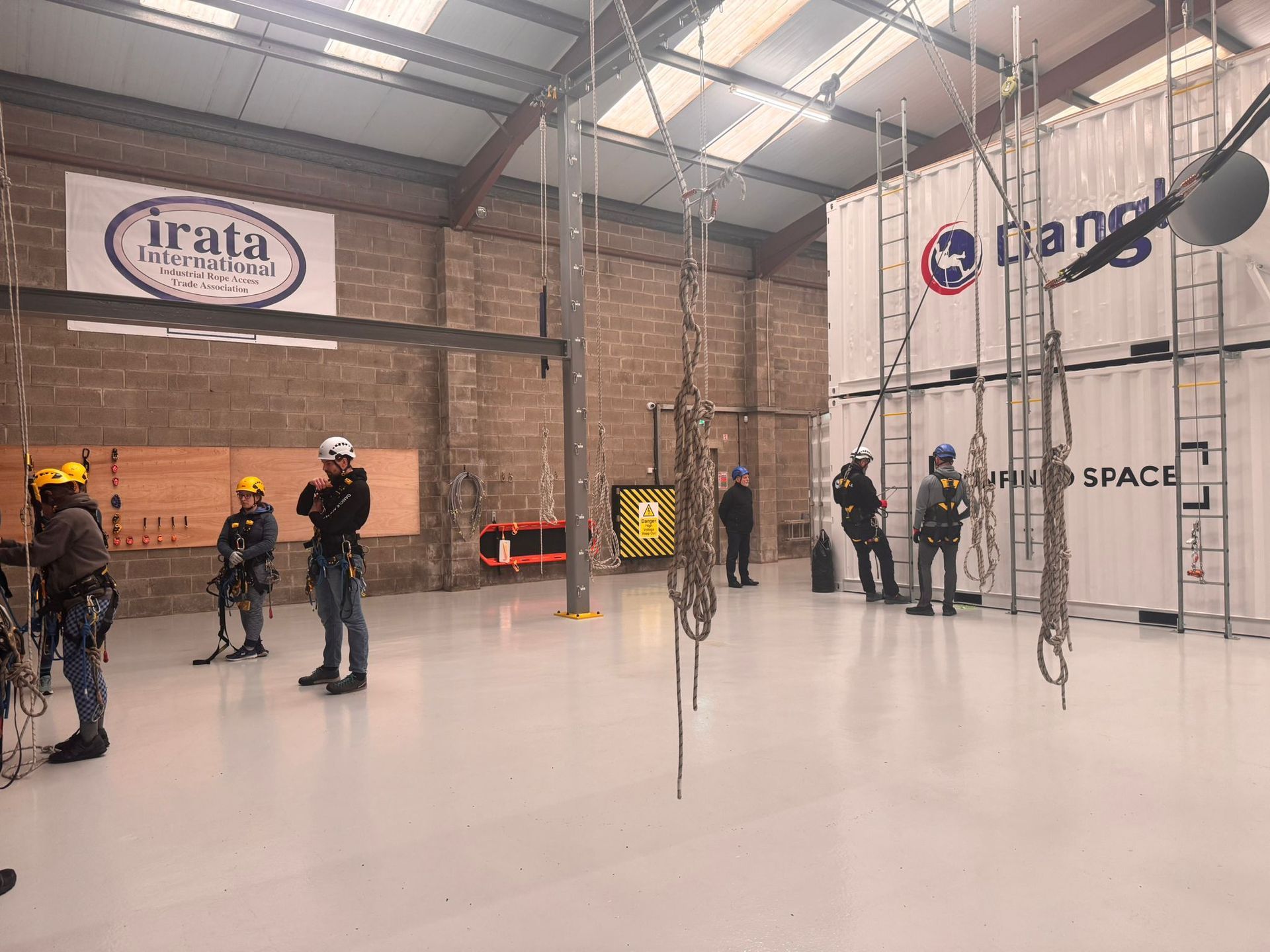
The real secret to reducing total expenditure lies in the versatility of the workforce. Traditional models require an access team to build the scaffold and a separate trade team to perform the work. By contrast, a technician with IRATA Level 1 certification is often already trained in a specific industrial trade. For example, integrating Industrial Painter Training into the access team's skill set eliminates the need for two separate crews. You aren't just paying for a climber; you're paying for a specialist who brings their own ladder. This consolidation of roles significantly slashes the "Total Man Hours" billed to the project, as one multi-skilled team handles both the access and the technical execution.
Speed of Access and Dismantling
Time is the most expensive variable in any industrial contract. A rope access team can often complete a minor inspection or repair and be off-site before a scaffolding crew has finished their first lift. This agility allows for dynamic movement; as a job progresses, technicians can re-rig and move their access points in minutes without additional equipment costs. Once the task is finished, dismantling takes a fraction of the time, allowing for an immediate site handover. In the UK utility and wind sectors, where downtime is measured in thousands of pounds per hour, this rapid turnaround is the primary driver for choosing rope-based solutions over fixed structures.
Strategic Comparison: When to Deploy Rope Access vs Traditional Scaffolding
Choosing the wrong access method is a strategic error. It extends far beyond simple hourly rates. Whilst previous sections highlighted the agility of rope work, scaffolding remains a necessary solution for specific industrial scenarios. The "Breakeven Point" in the rope access vs scaffolding cost UK debate typically occurs when a project exceeds a three-month duration or requires the constant movement of heavy masonry and bulk materials. If your scope involves thousands of tonnes of material that cannot be easily hauled via a pulley system, the stable platform of a fixed structure becomes a functional necessity.
Rope access is most efficient when performing targeted "drops" on specific asset areas. Conversely, scaffolding is designed for "decking out" large surface areas where multiple trades need simultaneous access over an extended period. For high-frequency, low-duration tasks such as NDT inspections or minor structural repairs, the logistical weight of scaffolding is almost never financially justifiable. The decision should be based on a matrix of duration, material weight, and the required footprint at ground level.
Project Duration and Material Volume
Projects lasting longer than 12 weeks with a high volume of material usage generally favour traditional scaffolding. In these cases, the high initial erection cost is eventually offset by the ability to have ten or twenty workers on a single lift. However, if the task is an inspection or a light repair, the speed of rope access wins every time. You must evaluate whether you are paying to build a temporary factory around your asset or simply paying for a skilled technician to reach a specific bolt. For complex projects requiring a technical evaluation, our Safety Consultancy Services provide the necessary framework to mitigate risk and optimise spend.
The Safety and Risk Management Matrix
Safety data from the Health and Safety Executive (HSE) consistently indicates that industrial rope access is statistically safer than traditional scaffolding. This is largely due to the rigorous training levels and the fact that rope systems are removed daily, eliminating the risk of unauthorised public access or structural tampering. The cost of rescue planning is also more streamlined in rope access. Technicians undergoing GWO Advanced Rescue Training are prepared for immediate, self-contained recovery, whereas scaffolding rescues often involve complex coordination with external emergency services. By reducing the total "Time at Risk" for personnel, you inherently lower the project's overall insurance and liability profile.
Optimising Your Maintenance Budget with Accredited Industrial Solutions
Integrating rope access into a national asset management strategy represents a shift from reactive spending to proactive preservation. The financial logic is clear. By removing the high monthly rental burdens of fixed structures, you reallocate capital toward actual repairs and detailed inspections. When evaluating the rope access vs scaffolding cost UK framework, the most successful organisations view access as a tool for high-velocity maintenance rather than a static infrastructure expense. This approach allows for a more agile response to asset degradation, ultimately extending the lifecycle of your industrial infrastructure whilst keeping operational budgets lean.
Transitioning your workforce or appointing a specialist provider requires a methodical approach to procurement. You aren't simply hiring climbers; you're engaging a technical solution designed to eliminate the logistical bottlenecks of traditional construction. The goal is to move away from the "passive hire" trap where you pay for equipment to sit idle. Instead, focus on a model that rewards technical proficiency and rapid turnaround times.
Vetting for Competence and Compliance
Your cost-saving strategy only works if the contractor maintains strict compliance. A robust Risk Assessment and Method Statement (RAMS) should be your first point of audit. It must detail specific anchor points, exclusion zones, and a site-specific rescue plan. Effective project management relies heavily on IRATA Level 3 supervision. These supervisors don't just ensure safety; they organise the workflow to prevent the dead time that plagues scaffolding projects. Hiring non-accredited or cheap access providers often results in higher long-term liability costs and potential HSE interventions that far outweigh any initial savings.
Building a Cost-Effective Maintenance Programme
Modern maintenance regimes often combine rope access with drone surveys to create a tiered inspection model. Drones identify high-priority areas, and Industrial Rope Access Services are then deployed for tactile testing or immediate repair. This synergy ensures you only pay for human access where it's strictly necessary. We recommend starting with a technical feasibility study to accurately compare access costs for your specific site. By identifying the breakeven points and logistical constraints early, you can build a maintenance programme that prioritises both fiscal responsibility and operational excellence. Your next step should be a thorough audit of your current access spend to identify exactly where passive hire fees are draining your project budget.
Future-Proofing Your Industrial Maintenance Strategy
Securing the long-term integrity of your assets requires a shift away from the expensive, static footprint of traditional access. By prioritising agility and multi-skilled labour, you can eliminate the "dead time" often associated with fixed structures and ensure your budget is invested in actual technical work. When you weigh the rope access vs scaffolding cost UK variables, it becomes clear that the true value lies in rapid deployment and a significantly reduced site footprint. This approach doesn't just save money; it creates a more responsive and resilient maintenance culture.
Organisations that adopt this agile model benefit from lower insurance risks and more frequent, safety-critical inspections. As an IRATA Accredited Provider specialising in wind energy and industrial maintenance, Dangle provides the technical expertise and safety consultancy needed to transition your operations. We offer a comprehensive suite of training and professional services designed to keep your personnel safe and your projects profitable. Consult with Dangle for a Cost-Effective Industrial Access Solution to begin refining your maintenance programme. Taking control of your access strategy today will yield measurable dividends for your asset's performance and your company's bottom line.
Frequently Asked Questions
Is rope access always cheaper than scaffolding for UK projects?
No, the cost-effectiveness depends on project duration and material volume. For long-term projects exceeding three months or those requiring the movement of heavy masonry, scaffolding often becomes the more economical choice. Scaffolding provides a stable platform for large crews and heavy equipment, whereas rope access excels in high-velocity tasks like inspections and minor repairs where rapid deployment is the priority.
How much can I expect to save by using rope access instead of scaffolding?
Savings typically range between 30% and 70% for short-to-medium duration industrial maintenance tasks. This reduction is primarily achieved by eliminating "passive hire" fees and the significant logistical overhead associated with heavy plant machinery. When comparing the rope access vs scaffolding cost UK landscape, the removal of weeks of assembly and dismantling time represents the most immediate financial gain for asset managers.
Do I need a special licence for rope access in a UK city centre?
Yes, you must secure local authority permits if the work encroaches on public highways or pavements. Whilst scaffolding requires a mandatory pavement licence costing approximately £140 per month, rope access often involves "oversail" permits or specific pedestrian management plans. You must always verify the specific requirements of the local council regarding exclusion zones and the protection of the public during overhead operations.
Is rope access safe for heavy industrial painting and coating jobs?
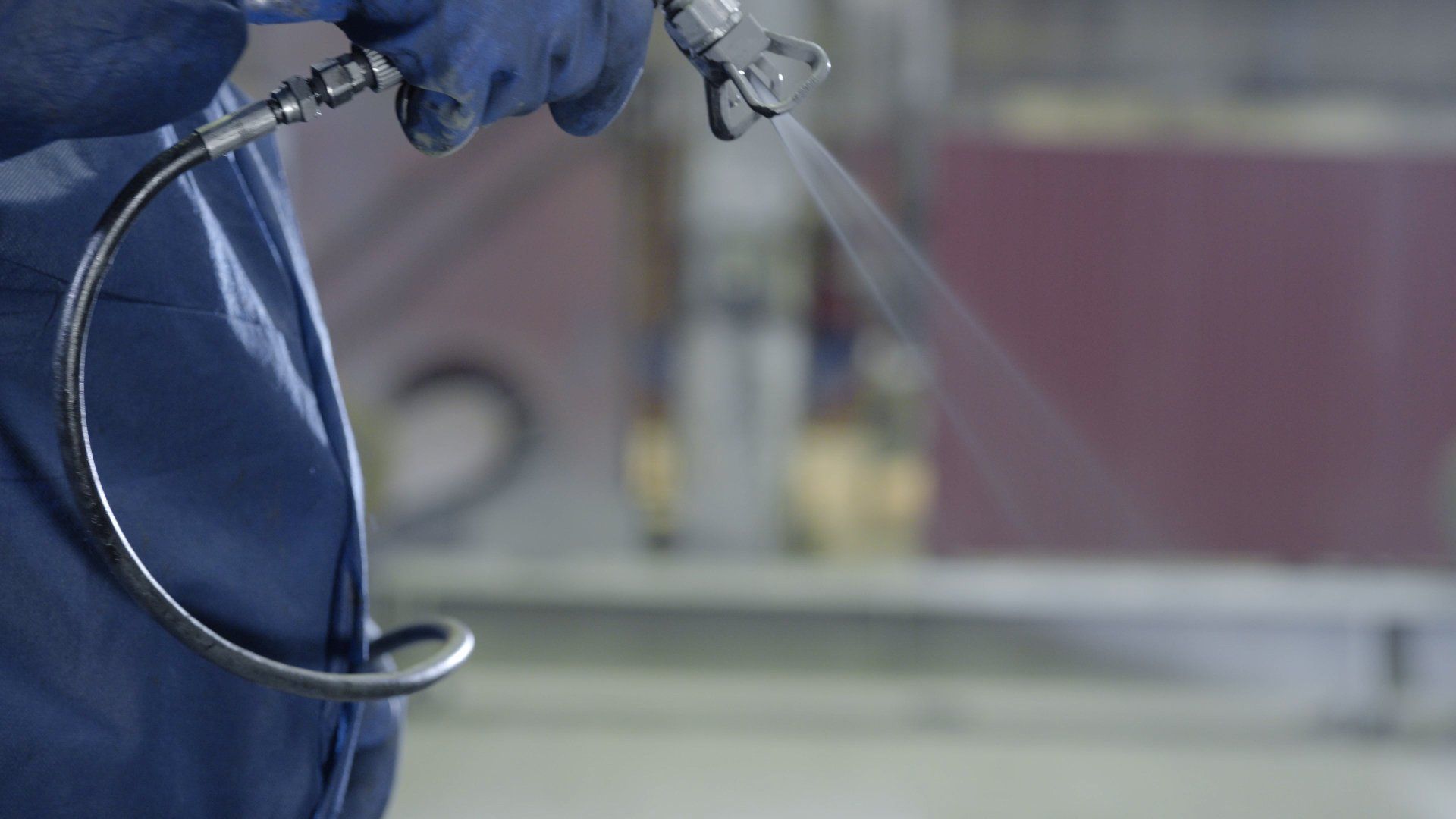
Rope access is a standard and exceptionally safe method for industrial coating applications when performed by qualified technicians. Technicians use specialised rigging and containment systems to manage material handling and prevent overspray. By employing workers with industrial painter training, you ensure that high-quality surface preparation and application are achieved without the need for the bulky, fixed infrastructure of a scaffold rig.
What are the main factors that make scaffolding more expensive?
The primary cost drivers are labour-intensive assembly, high transport overheads for tonnes of steel, and ongoing rental fees. Unlike rope systems, you pay for scaffolding every day it remains on-site, regardless of whether work is progressing. Administrative burdens, including weekly safety inspections by a competent person and formal structural engineering sign-offs for complex designs, further inflate the total project expenditure compared to more agile methods.
How long does it take to set up a rope access system compared to scaffolding?
Rope access systems are typically rigged in a matter of hours, whereas scaffolding can take days or even weeks to reach the work face. A standard industrial rig can be established and safety-checked by an IRATA Level 3 supervisor in a single morning shift. This rapid deployment allows your technical team to begin work immediately, bypassing the lengthy lead times and logistical bottlenecks inherent in fixed structures.
Can rope access technicians carry out the same quality of work as those on a scaffold?
The quality of technical work is identical, provided the technicians are suitably qualified in their specific trade. Rope access is merely the method used to reach the work site; the technical execution depends on the worker's proficiency. By utilising multi-skilled technicians who hold both IRATA and trade-specific certifications, you ensure that inspections, repairs, and maintenance are completed to the same rigorous industrial standards as any other method.
What insurance requirements are there for rope access contractors in the UK?
UK contractors must hold specialised Public Liability and Employer’s Liability insurance that explicitly covers industrial rope access activities. Standard construction or general maintenance insurance often excludes work at height using ropes. You should always verify that a provider’s policy is current, aligned with IRATA International standards, and specifically covers the unique risks of your site, such as offshore environments or high-voltage utility assets.
Contact Us
We'd Love a Share...
Recent Blog Posts