IRATA Level 2 Training Belfast: The Technician’s Guide
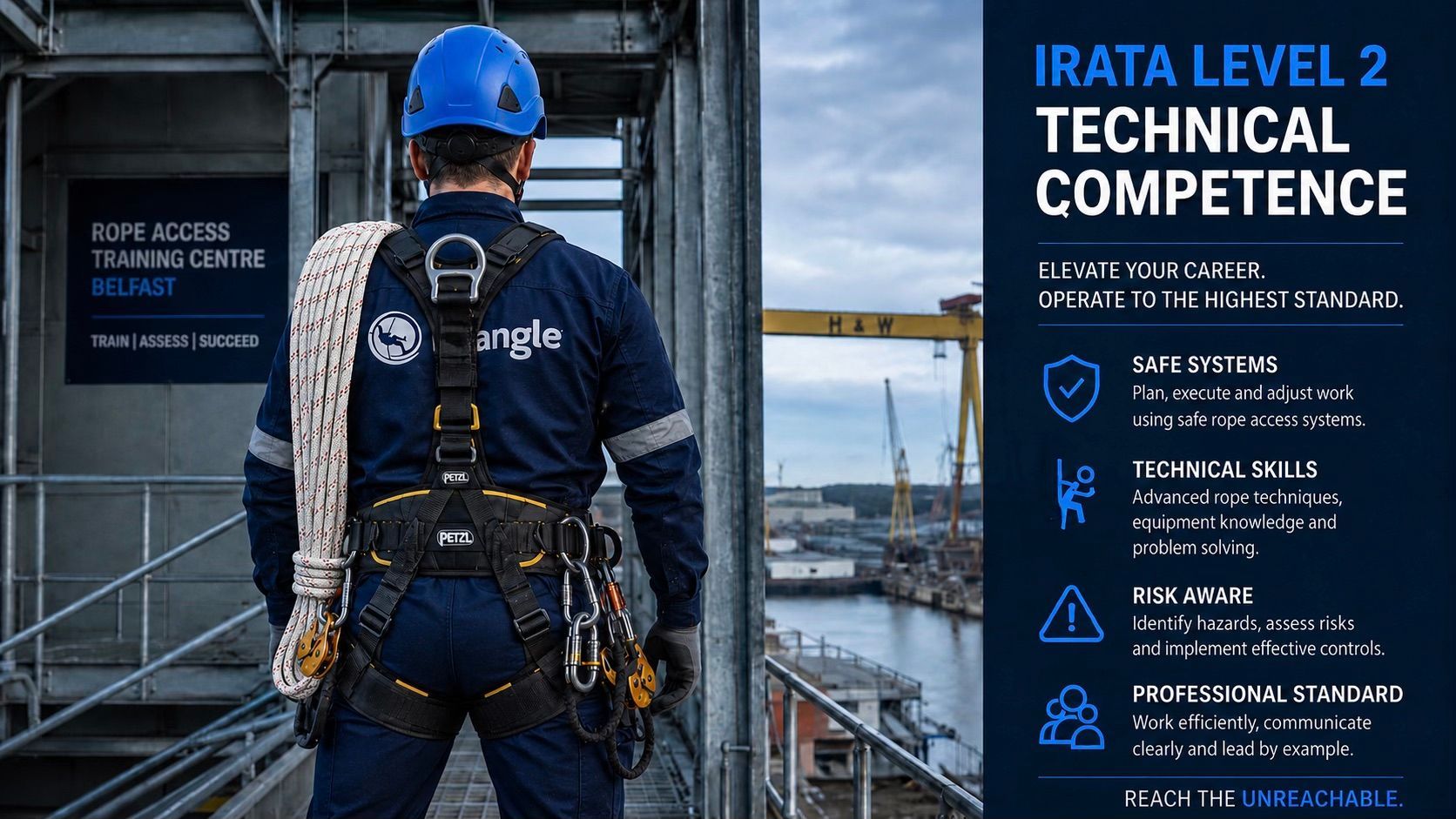
Reaching 1,000 hours in your logbook is a significant milestone, but it doesn't automatically mean you're prepared for the technical intensity of an IRATA Level 2 assessment. Many technicians feel a genuine sense of anxiety regarding the failure rates of advanced rescues or wonder if their site experience is sufficiently varied to satisfy a rigorous assessor. Securing your irata level 2 training Belfast is about more than just hitting a required number; it's about shifting your mindset from following instructions to mastering the physics of complex rigging.
We understand that the transition from Level 1 can feel daunting, especially with the 2026 IRATA regulatory updates introducing new layers of compliance. This guide provides expert insight into the L2 syllabus, helping you build the confidence needed to excel during the Day 6 assessment. We'll explore how to bridge the gap between basic rope work and the high-paying lead rigger roles available across Northern Ireland's industrial and film sectors. You'll gain a clear path to professional advancement, backed by the practical knowledge that only an experienced, industry-led training centre can provide.
Key Takeaways
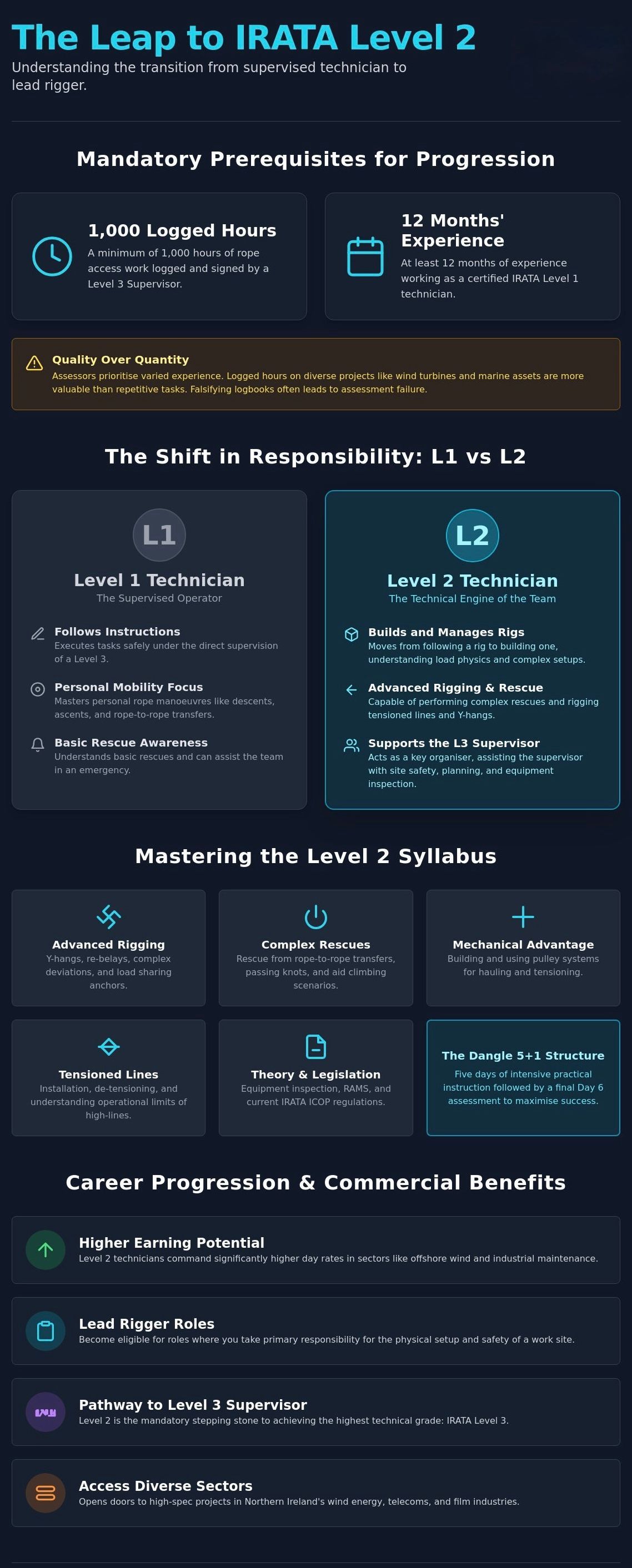
- Understand the mandatory IRATA prerequisites, including the 1,000 logged hours and 12-month experience threshold required for professional progression.
- Master the advanced rigging and mechanical advantage systems taught during irata level 2 training Belfast to handle complex site rescues with confidence.
- Transition your mindset from a supervised technician to a skilled organiser capable of supporting Level 3 Supervisors in high-stakes environments.
- Maximise your assessment success by utilising the Dangle Academy 5+1 training structure, which provides five days of intensive practical instruction before your evaluation.
- Explore the diverse career paths available in Northern Ireland’s wind energy and telecoms sectors for certified Level 2 technicians.
Table of Contents
- The Professional Leap: Why IRATA Level 2 Training in Belfast is a Career Milestone
- Mastering the Syllabus: Advanced Rigging, Rescues, and Mechanical Systems
- Level 1 vs Level 2: Understanding the Shift in Operational Responsibility
- Preparing for Success: How to Ace Your Level 2 Assessment in Belfast
- Beyond the Certification: Career Prospects for Level 2 Technicians
The Professional Leap: Why IRATA Level 2 Training in Belfast is a Career Milestone
Progression in the rope access industry is not merely a formality. It is a fundamental shift in technical competence. Whilst a Level 1 technician focuses on safely executing tasks under direct supervision, the Level 2 technician becomes the technical engine of the team. This transition marks the point where you move from following a rig to building one. It requires a deep understanding of Rope access techniques and the physics of load distribution. For many, irata level 2 training Belfast at Dangle Academy is the definitive step toward professional autonomy.
The prerequisites for this advancement are strict for a reason. Candidates must have completed a minimum of 12 months of experience as a Level 1 and logged at least 1,000 hours of work. These aren't just numbers to be ticked off. They represent the practical seasoning required to handle the pressure of advanced rescues. Additionally, ensuring you have a valid medical certificate, such as an OEUK medical, is essential before embarking on advanced training. Belfast has emerged as a premier hub for this high-spec industrial training, offering facilities that mirror the challenging environments found in offshore wind and marine engineering.
The 1,000-Hour Rule: Quality of Experience vs Quantity
The temptation to "pencil whip" a logbook is a dangerous mistake. Faking hours or repeating the same basic task for a year often leads to immediate failure during the Day 6 assessment. Assessors look for varied experience amongst different sectors. A rope access technician who has only worked on straight drops will struggle with the complex deviations and re-belays required as levels progress. Before booking your irata rope access training in Belfast, verify that your logbook entries are signed by a Level 3 Supervisor and reflect a range of rope access scenarios. Quality hours on wind turbines or oil platforms provide the technical intuition that classroom study cannot replicate.
Commercial Benefits of the Level 2 Certification
Attaining a irata rope access Level 2 certificate significantly alters your earning potential and career trajectory. In the UK offshore wind and industrial sectors, Level 2 technicians often command higher day rates due to their ability to perform complex rigging and rescues. This qualification makes you eligible for "Lead Rigger" roles, where you take responsibility for the physical setup of a job site. It is also the mandatory stepping stone toward becoming an IRATA Level 3 Supervisor. By investing in this training, you aren't just learning new knots; you're securing a position in the engine room of the rope access team, making you an indispensable asset on any complex project.
Mastering the Syllabus: Advanced Rigging, Rescues, and Mechanical Systems
Whilst Level 1 focuses on personal mobility, the Level 2 syllabus demands absolute mastery over the ropes themselves. During your irata level 2 training Belfast, you'll move beyond basic descents to manage complex rigging scenarios including Y-hangs, re-belays, and complex deviations. These techniques aren't just for show; they're the essential tools required to navigate the intricate steelwork of a wind turbine nacelle or the underside of a oil rigs moon pool. Every access system you build must adhere to the strict safety standards set by IRATA International, ensuring that safety factors are maintained even in the most challenging configurations.
The syllabus also introduces tensioned lines and high-lines, which are vital for transferring personnel or equipment across spans where vertical access is impossible. You'll learn the operational limits of these systems, focusing on how to safely install and de-tension them without compromising anchor integrity. Beyond the physical ropes, there is a significant theoretical component. You must demonstrate a working knowledge of equipment inspection, current legislation, and the creation of comprehensive Risk Assessments and Method Statements (RAMS). This ensures that as a Level 2, you aren't just a climber; you're a safety-conscious technician capable of planning the work you execute.
The Complexity of Level 2 Rescues
The jump in rescue difficulty is the most common cause of assessment anxiety. You'll be tested on rescues from tensioned lines and re-belays, where the primary pitfall is often poor rope management leading to "snagging" the casualty. The "broken rope" scenario is a core test of your ability to think on your feet, requiring you to demonstrate proficiency in both hauling and lowering techniques simultaneously. Managing casualty care whilst operating at height is paramount. You must maintain clear communication and ensure the casualty’s airway and harness position remain safe throughout the entire manoeuvre, all whilst working against the clock in a high-pressure assessment environment.
Mechanical Advantage and Rigging Physics
Understanding the difference between theoretical and actual mechanical advantage is what separates a technician from a rigger. You'll master 3:1 and 5:1 hauling setups, learning how friction in pulleys and carabiners can sap your efficiency. A solid grasp of vector forces is also required; you need to know exactly how much load you're placing on your anchor points when rigging at wide angles. Selecting the correct hardware for these complex configurations is critical to prevent equipment failure. Technicians looking to sharpen these technical skills should review the full rope access Level 2 course details to prepare for the rigours of the assessment.
- Advanced Rigging: Proficiency in Y-hangs, re-belays, and complex deviations for industrial environments.
- Mechanical Advantage: Practical application of 3:1 and 5:1 hauling systems for heavy lifting and rescue.
- Tensioned Lines: Safe installation, operation, and de-tensioning of horizontal rope systems.
- Rescue Proficiency: Executing complex rescues from re-belays and tensioned lines under assessment pressure.
- Theoretical Knowledge: Mastery of equipment inspection, RAMS, and UK work-at-height legislation.
Level 1 vs Level 2: Understanding the Shift in Operational Responsibility
The jump from Level 1 to Level 2 is often misunderstood as a simple increase in rope speed or physical strength. In reality, it's a fundamental change in your job description. Whilst a IRATA Level 1 technician is responsible for their own safety and the completion of assigned tasks, a Level 2 must begin to organise the work site. This mindset shift is a core focus of irata level 2 training Belfast, where we prepare you to step out of the "supervised" role and into one of operational influence.
You effectively become the engine room of the rope access team. A Level 3 Supervisor oversees the entire project’s safety and legal compliance, but they can't be everywhere at once. They rely on the Level 2 to execute the rigging plan, manage the advanced hauling systems, and ensure the ropes are protected from site-specific hazards. This level of trust is built on your ability to take ownership of the equipment. You'll move from merely using the kit to managing inspection logs and ensuring every carabiner and pulley is fit for purpose before the shift begins.
The Lead Rigger Role
On complex projects, site managers look to the Level 2 to be the "Lead Rigger." This means you're expected to troubleshoot rigging issues without needing the Level 3 to hold your hand through every knot. For example, during wind turbine blade repair, a Level 2 might be tasked with setting up the complex hauling systems required to position heavy materials or repair platforms. You're mentoring entry-level technicians on the ropes, correcting their positioning whilst ensuring the work remains on schedule and within the safety parameters of the site's RAMS.
Safety and Compliance Leadership
Leadership at this level is defined by an uncompromising eye for detail. You must be able to identify "at-risk" behaviour in your peers before it leads to a serious incident. This requires a solid grasp of the IRATA International Codes of Practice (ICOP) at an intermediate level. You aren't just following rules; you're interpreting them to keep the team safe in changing weather or structural conditions. The Level 2 technician serves as the primary safety buffer, providing the critical technical support that allows the Level 3 Supervisor to manage the broader scope of site operations.
Preparing for Success: How to Ace Your Level 2 Assessment in Belfast
Success in the IRATA Level 2 assessment isn't guaranteed by your logbook hours alone. It requires a specific peak in both physical stamina and technical precision. At Dangle Academy, we utilise a 5+1 structure for our irata level 2 training Belfast. This means you receive five full days of intensive instruction followed by a dedicated sixth day for the independent assessment. This extra day of training is critical; it allows you to move beyond the basics of the syllabus and refine your speed and rescue fluidity, which are often the deciding factors between a pass and a fail.
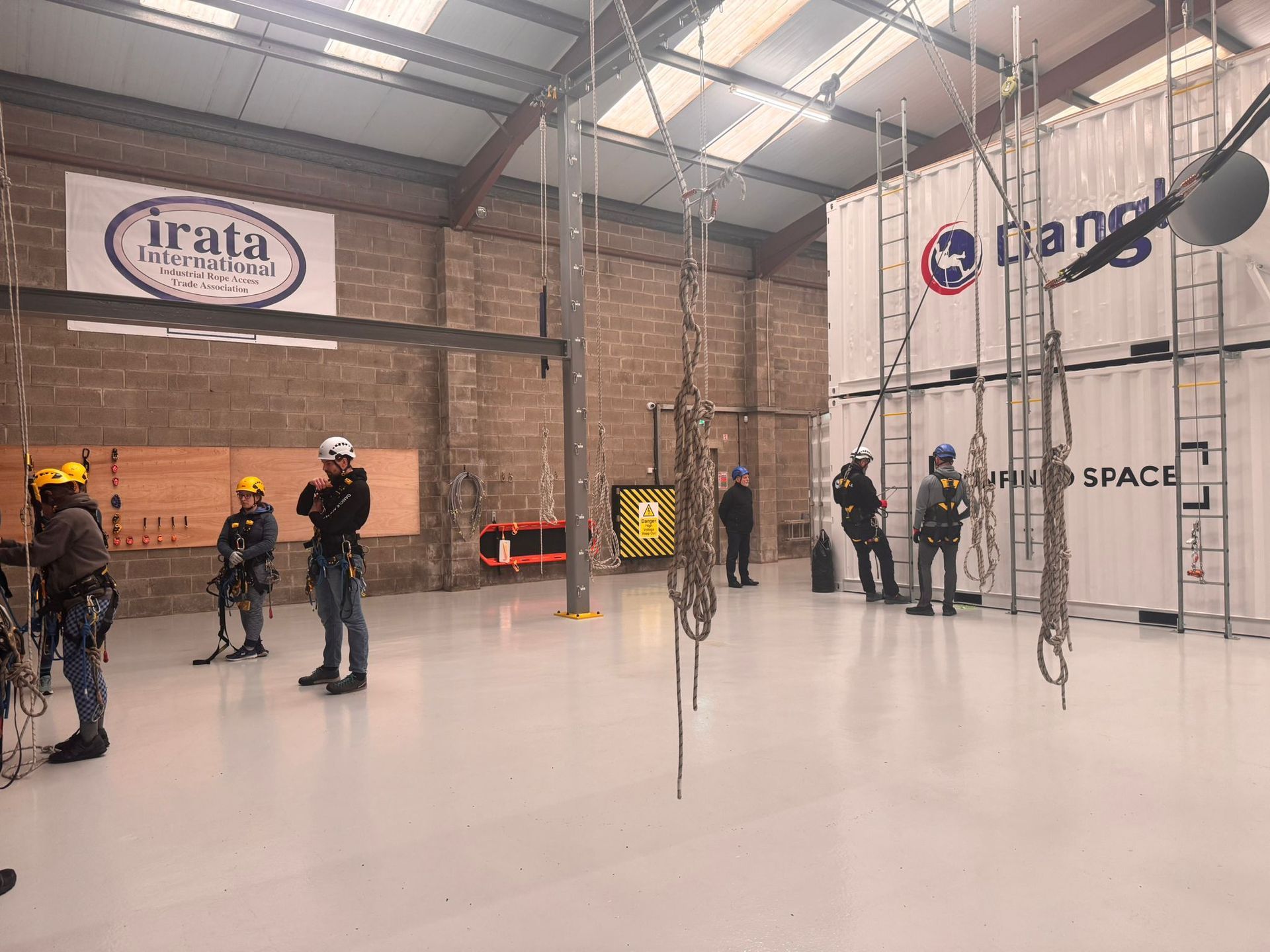
Physical preparation is often overlooked. A Level 2 assessment involves a full day of repetitive hauling, complex rigging, and multiple rescue manoeuvres. If you haven't been active on the ropes, the fatigue on assessment day can lead to mental lapses. Mental resilience is equally vital. You must remain calm whilst an external IRATA Assessor scrutinises every knot and carabiner gate. Our Belfast facility is designed to mimic real-world industrial environments, allowing you to familiarise yourself with specific rigs and heights before the pressure of the final evaluation begins.
The Day 6 Assessment: What to Expect
The Day 6 assessment is conducted by an independent assessor who hasn't been involved in your training. Their role is to objectively evaluate your competency against IRATA standards. They look for both technical accuracy and safe working practices. Minor discrepancies, like messy rope management, might be noted, but major discrepancies, such as a safety-critical error in a rescue, will result in an immediate fail. Presenting your logbook and ID correctly at the start of the day sets a professional tone, showing the assessor that you're organised and ready for the responsibilities of a Level 2 technician.
Refresher Training: Is it Necessary?
If you've spent the last six months performing basic tasks without rigging a single 3:1 system, skill fade is a genuine risk. Technicians in this position should strongly consider a rope access taster day or an IRATA refresher course before committing to their full assessment. Practising in the same centre where your evaluation occurs removes the "facility shock" of working on unfamiliar rigs. It allows you to focus entirely on your "weakest link" during the 5-day training window, ensuring that by Day 6, your technical execution is instinctive rather than forced.
Don't leave your progression to chance. You can book your irata level 2 training Belfast now to secure your preferred assessment date.
Beyond the Certification: Career Prospects for Level 2 Technicians
Securing your certification is only the beginning of a higher-tier professional trajectory. In Northern Ireland, the industrial landscape is shifting toward more complex, rope-dependent projects in civil engineering and infrastructure maintenance. An irata level 2 training Belfast qualification transforms you from a supervised worker into a technical lead, making you eligible for roles that demand both rigging precision and rescue readiness. At Dangle Academy, our graduates benefit from our dual identity as both a training provider and an active industrial services firm, ensuring the skills you learn are grounded in current site realities.
Many technicians find that the most lucrative path involves integrating their rope skills with specialist trades. For instance, combining your rigging expertise with industrial painting qualifications allows you to manage entire maintenance packages on marine assets or bridges. This versatility is highly valued by contractors who prefer "multi-skilled" technicians to reduce headcount on restricted-access sites. As you look ahead, your focus should remain on planning your next 1,000 hours. These hours must be meticulously logged and varied to prepare you for the ultimate goal: the IRATA Level 3 Supervisor assessment.
Specialising in Wind Energy
The offshore wind sector remains one of the most consistent employers for advanced technicians. By combining your IRATA Level 2 with GWO Basic Safety Training, you become a primary candidate for turbine blade maintenance and inspection teams. Level 2 riggers are specifically sought after for offshore projects because they can manage the complex hauling systems required for heavy tool transfers. The advanced rescue techniques mastered during your training are directly applicable to the confined and high-pressure environments of a turbine nacelle, where safety is the absolute priority.
The Telecoms and Utility Sector
Northern Ireland’s telecoms infrastructure requires constant maintenance, much of which occurs on masts and pylons where traditional access is impossible. Applying your Level 2 rigging skills to EUSR MATS tower climbing projects provides a significant competitive advantage. Utility companies prefer Level 2 technicians for these roles because they possess the technical depth to troubleshoot rigging issues independently whilst maintaining a higher safety margin for the rest of the team. This sector offers stable, long-term work for those who can prove their technical proficiency in challenging vertical environments.
The demand for skilled technicians in these high-growth industries continues to outpace the supply of qualified personnel. Taking the step to advance your credentials is a strategic move for any serious professional. Ready to level up? Book your IRATA Level 2 training at Dangle Academy in Belfast today and secure your place in the next generation of rope access leaders.
Advancing Your Rope Access Career in Northern Ireland
Transitioning to Level 2 is the most significant step an industrial technician can take toward professional autonomy. It requires moving beyond basic rope work to master complex rigging physics and high-pressure rescue scenarios. By choosing irata level 2 training Belfast at Dangle Academy, you ensure your progression is supported by an IRATA Member Company (No. 8313/OT) that understands the physical realities of the field. Our lead instructors bring over 20 years of industrial field experience to the training floor, providing insights that go far beyond the standard syllabus.
Your training concludes with a dedicated Day 6 independent assessment, giving you the best possible environment to demonstrate your competence. Whether you're targeting lead rigger roles in offshore wind or specialist maintenance in the telecoms sector, this certification is your gateway to higher-paying opportunities. Don't let skill fade or assessment anxiety hold back your career advancement. You can secure your spot for IRATA Level 2 training in Belfast today and take command of your professional future. We look forward to seeing you on the ropes.
Frequently Asked Questions
How many hours do I need for IRATA Level 2?
You must have a minimum of 1,000 logged and signed-off hours as a Level 1 technician to progress. These hours must be accumulated over at least 12 months of site experience. It's essential that your logbook is verified by an IRATA Level 3 Supervisor before you begin your irata level 2 training Belfast, as this ensures you meet the mandatory global entry requirements for the upgrade.
What happens if I fail my IRATA Level 2 assessment?
If you fail due to a major safety discrepancy, you'll need to wait at least seven days before attempting a re-assessment and may require a full re-course. In some cases, the assessor might recommend specific remedial training if the failure was due to a lack of technical rigging proficiency. Technicians who fail a minor discrepancy may be eligible for a re-assessment within 60 days, provided they maintain their training validity.
Is the IRATA Level 2 course harder than Level 1?
Yes, the difficulty jump is significant because the focus shifts from personal mobility to complex rigging and rescue management. Whilst Level 1 is about following instructions, Level 2 requires you to understand the physics of mechanical advantage and vector forces. You'll be expected to execute advanced rescues from re-belays and tensioned lines, which demands much higher mental and physical stamina than entry-level training.
Can I do my IRATA Level 2 training in Belfast if I did Level 1 elsewhere?
You can absolutely complete your irata level 2 training Belfast regardless of where you obtained your previous certification. IRATA qualifications are standardised globally, meaning your logged hours and Level 1 certificate are recognised at any accredited training centre. Just ensure your logbook is up to date and correctly signed by your previous supervisors before arrival at Dangle Academy so we can verify your eligibility.
How long does the IRATA Level 2 certification last?
The certification is valid for exactly three years from the date of your successful assessment. To maintain your status, you must complete a re-certification course before the expiry date. If you allow your certificate to expire, you may be required to restart at Level 1 or undergo a specific "expired technician" procedure depending on the length of the lapse, which often involves additional training days.
What is the difference between a Level 2 and a Level 3 Supervisor?
A Level 2 is a skilled rigger and rescuer who supports the team's technical operations, whilst a Level 3 is the legally responsible supervisor. The Level 3 technician is responsible for the entire site safety, including the creation of RAMS and the planning of all rope access activities. Level 2 technicians act as the technical engine room, executing the complex rigging plans that the Level 3 oversees and approves.
Do I need a medical certificate for the Level 2 course?
You must be medically fit to work at height and provide a signed self-declaration of fitness before IRATA training begins. For many industrial and offshore roles, a formal medical certificate like an OEUK medical or a Chester Step Test is also required. It's vital to ensure any pre-existing conditions won't compromise your safety or that of your team during the intensive rescue manoeuvres required throughout the Level 2 syllabus.
What equipment do I need to bring for my training at Dangle Academy?
We provide all the necessary technical rope access equipment, including harnesses, helmets, and hardware. You're required to bring your own workwear, and a valid form of photo ID. Crucially, you must bring your IRATA logbook, as the independent assessor cannot grade your performance without verifying your previous 1,000 hours of experience and current certification status.
Contact Us
We'd Love a Share...
Recent Blog Posts