Rope Access Bridge Maintenance
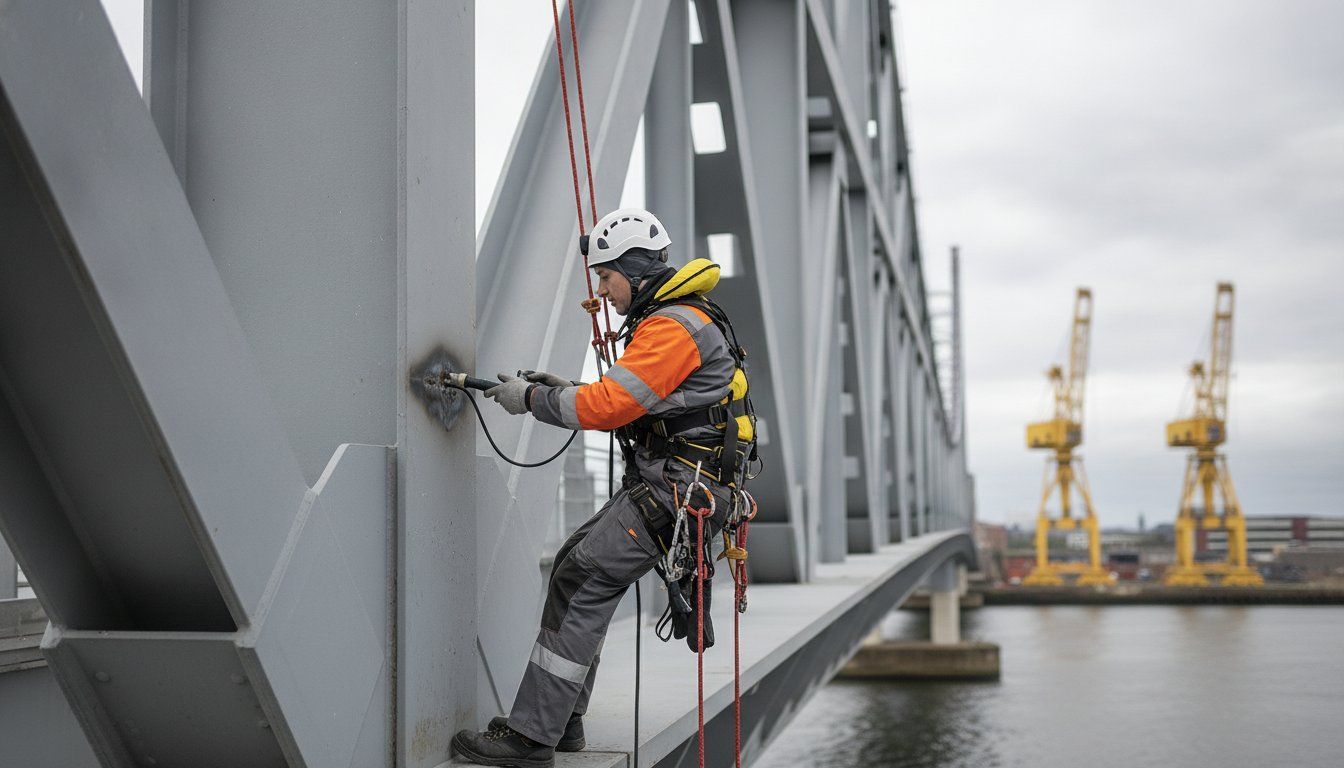
Expert Rope Access Bridge Maintenance: Safety, Efficiency, and Compliance
The assumption that heavy scaffolding or MEWPs are the default requirement for rope access bridge maintenance is a costly misconception that often results in unnecessary road closures and budget overruns. Asset managers frequently face the difficult choice between deferring essential repairs or absorbing the high costs of traffic management and environmental permits. You likely understand the frustration of seeing a project budget consumed by access equipment before a single bolt has been inspected or a single weld tested.
Specialist rope access offers a precise, low-impact alternative that prioritises both structural integrity and operational flow. At Dangle, we combine real-world site experience with accredited training to ensure every technician maintains the highest standards of proficiency. By utilising IRATA-certified teams, you can achieve full compliance with the Work at Height Regulations 2005 whilst significantly reducing project lead times. This guide explores the practical advantages of industrial rope access, including its superior efficiency over water or rail infrastructure and its role in meeting the rigorous requirements of UK bridge inspection standards.
Key Takeaways
- Understand why rope access provides a more cost-effective and faster alternative to traditional scaffolding and MEWPs for structural work.
- Learn about the non-negotiable safety requirements of IRATA standards, including the essential role of the Level 3 Safety Supervisor on-site.
- Discover how rope access bridge maintenance allows for tactile Principal Inspections and technical Non-Destructive Testing (NDT) with minimal traffic disruption.
- Identify the specific benefits of using rope access for complex structures located over water, rail, or difficult terrain where ground access is restricted.
- Explore the advantage of Dangle’s unique approach, combining accredited training with real-world site services across Belfast and the wider UK.
Table of Contents
- The Critical Role of Rope Access in Modern Bridge Maintenance
- Why IRATA Standards are Non-Negotiable for Bridge Work
- Comparing Access Solutions: Rope Access vs Scaffolding and MEWPs
- Core Bridge Maintenance Tasks Performed via Rope Access
- Partnering with Dangle: Expert Bridge Solutions in Belfast and the UK
The Critical Role of Rope Access in Modern Bridge Maintenance
Ageing infrastructure across the UK presents a growing challenge for asset managers. Many structures, particularly those built in the mid-20th century, now require more than just a distant visual survey. To ensure long-term structural integrity, tactile inspections are essential. These hands-on assessments allow technicians to identify hairline fatigue cracks or hidden section loss that a drone or binoculars would likely miss. Rope access has emerged as the most effective method for delivering these high-detail inspections without the logistical burden of traditional access systems.
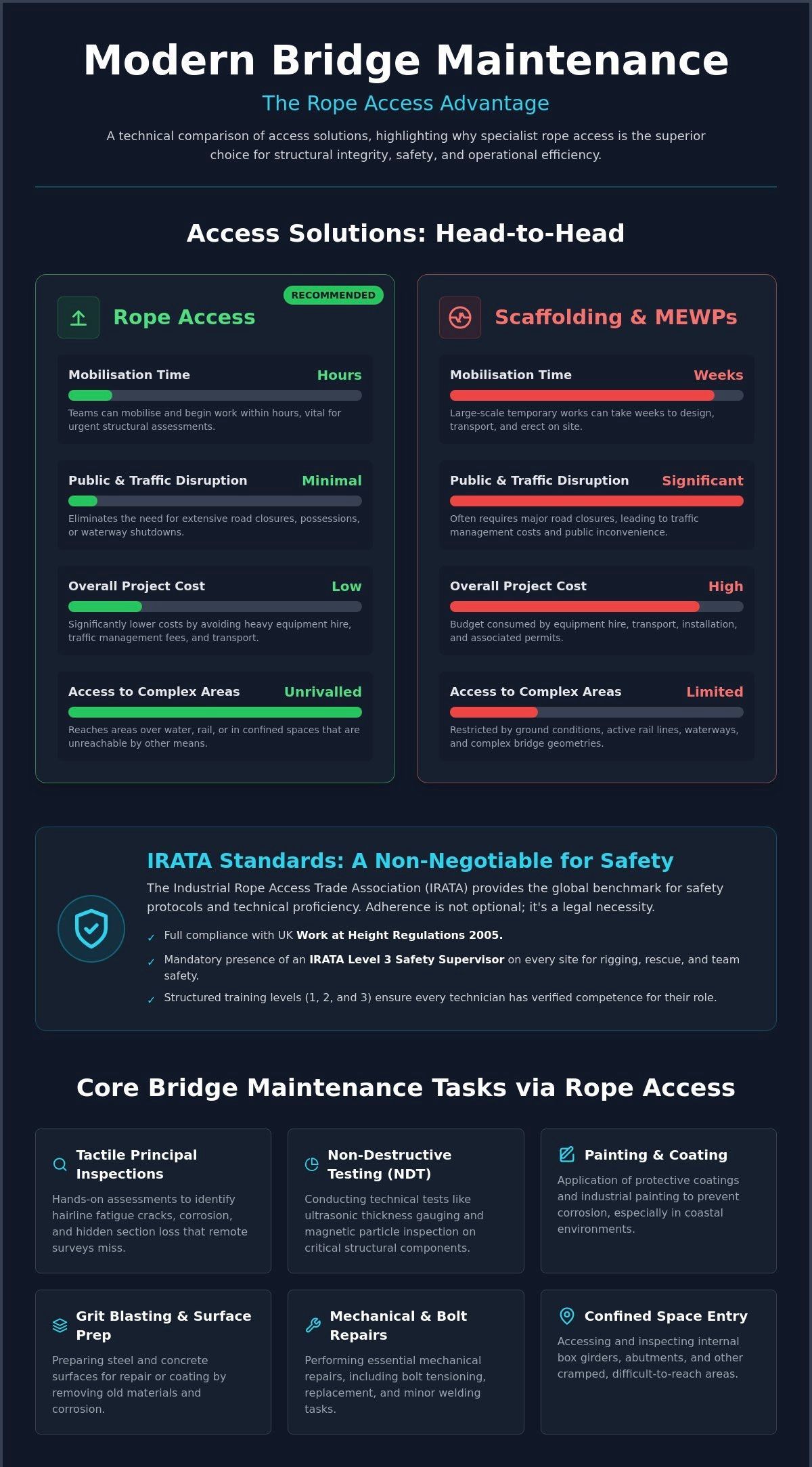
Traditional methods, such as fixed scaffolding, often prove prohibitive in terms of both cost and time. Setting up large-scale temporary works can take weeks, frequently requiring significant public transport disruption and road closures. In contrast, rope access bridge maintenance teams can mobilise and begin work within hours. This rapid-response capability is vital when urgent structural assessments are needed following vehicle strikes or extreme weather events. In Northern Ireland, our coastal environment introduces specific risks; salt-spray corrosion can accelerate the degradation of steel reinforcements, making regular, professional intervention a necessity rather than an option.
Addressing the Challenges of Difficult Access
Bridges spanning active rail lines or deep waterways pose unique access difficulties. Traditional platforms often require "possessions" or temporary waterway closures, which are expensive and difficult to coordinate. Rope access technicians navigate these environments with minimal footprint. They can access internal box girders and cramped confined spaces within bridge abutments that would be unreachable by other means. Even with complex geometries and steep heights, a qualified team can carry the necessary tools for grit blasting, painting, or mechanical repairs, maintaining safety while working in suspension.
The Commercial Impact of Asset Downtime
The true cost of maintenance isn't found in the invoice alone; it's found in the hidden expenses of downtime. Road closures for scaffolding installation lead to massive traffic management fees and lost economic productivity. For critical transport links in Belfast and the surrounding areas, keeping the network moving is a priority. By choosing a streamlined approach, clients can significantly reduce their carbon footprint by eliminating the need for heavy machinery and extensive transport of scaffolding materials. Our rope access services focus on high-efficiency delivery, ensuring that structural assets remain safe and operational with the least possible impact on the public.
Why IRATA Standards are Non-Negotiable for Bridge Work
Safety in the high-pressure environment of bridge maintenance isn't a matter of chance; it's a matter of rigorous standardisation. The Industrial Rope Access Trade Association (IRATA) provides the global benchmark for technical proficiency and safety protocols. For any rope access bridge maintenance project, adhering to these standards ensures that every technician on the ropes has undergone intensive, verified training. This isn't just about climbing; it's about executing complex engineering tasks whilst suspended hundreds of feet above water or rail lines.
Compliance with the Work at Height Regulations 2005 and BS 7985:2013 is a legal necessity for UK asset owners. These regulations demand that work is properly planned, supervised, and carried out by competent persons. By following these official safety requirements, contractors mitigate the risks of falls and equipment failure. A cornerstone of this system is the mandatory presence of an IRATA Level 3 Safety Supervisor on every site. This individual is responsible for the safety of the entire team, the integrity of the rigging, and the implementation of site-specific rescue plans.
Understanding IRATA Certification Levels
The IRATA hierarchy ensures that every team member has a clearly defined scope of competence. Level 1 technicians perform the core maintenance and inspection tasks under direct supervision. As technicians progress to Level 2 and Level 3, they gain the skills required for complex rigging and advanced rescue manoeuvres. This progression is vital for bridge work, where anchors might be hundreds of metres apart or located in awkward confined spaces. Investing in accredited IRATA Rope Access training is the only way to build a team capable of handling these technical demands safely.
Safety Management and Risk Assessment
Effective safety management on a bridge requires more than a generic risk assessment. Each structure demands a bespoke rescue plan, particularly when working over deep water or active transport corridors. Technicians must strictly follow the "two-point" attachment rule, ensuring they're always connected to two independent safety systems. If one line fails, the backup system prevents a fall. Dangle integrates decades of practical site experience into our safety consultancy, ensuring that theory translates into real-world protection. For those looking to step into a leadership role, pursuing a professional Level 3 certification is a critical milestone in mastering these safety systems.
Comparing Access Solutions: Rope Access vs Scaffolding and MEWPs
Selecting the right access method is a critical commercial decision that dictates the pace and budget of any infrastructure project. For decades, heavy scaffolding was the default choice for major works. However, the logistical footprint of fixed structures is often disproportionate to the task at hand. Scaffolding typically requires weeks of planning, transport, and manual assembly before bridge maintenance or repairs can even begin. This lead time creates a significant bottleneck in maintenance programmes, especially when dealing with ageing assets that require frequent intervention.
Mobile Elevating Work Platforms (MEWPs) offer a more mobile alternative, but they are frequently hampered by site-specific constraints. Reach limitations, weight restrictions on bridge decks, and the requirement for stable, level ground often make MEWPs impractical for structures spanning deep valleys or waterways. Furthermore, both scaffolding and MEWPs keep the technician at a slight distance from the work surface. Rope access allows for a truly "tactile" inspection. Technicians can perform hammer testing, ultrasonic thickness gauging, and weld inspections with a level of precision that is impossible to achieve from a platform or via drone alone.
Speed of Mobilisation and Demobilisation
The "light-touch" nature of rope access equipment transforms site logistics. A full team can often transport their entire kit in a single transit van, eliminating the need for heavy plant machinery. This efficiency is particularly valuable during rail possessions or night-shift work where every minute of track access is high-value. Technicians can rig their systems, complete the task, and de-rig within a single shift. This rapid turnaround ensures that critical transport links, such as those across the Lagan in Belfast, experience minimal disruption compared to the prolonged presence of fixed scaffolding.
Structural Impact and Heritage Considerations
Historic and heritage bridges require a sensitive approach to maintenance. The installation of scaffolding often involves drilling into masonry or applying significant pressure to fragile facades, which can cause long-term structural damage. Rope access is a non-invasive solution. By utilising existing structural points or temporary "dead weight" anchors, technicians can perform detailed surveys with minimal physical contact. This protects the integrity of the bridge facade whilst providing the high-quality data required for conservation. For projects requiring specialised technical skills, our rope access inspection services provide the necessary expertise without the environmental or structural cost of heavy access equipment.
Core Bridge Maintenance Tasks Performed via Rope Access
Effective bridge management relies on a rigorous schedule of inspections and proactive repairs. In accordance with UK standards such as BD 63/17, asset owners must conduct General Visual Inspections (GVI) every two years and comprehensive Principal Inspections every six years. These requirements ensure that structural defects are identified before they compromise public safety. Rope access bridge maintenance provides the technical platform necessary to execute these tasks with surgical precision, especially on structures where traditional access is restricted.
Our teams perform a wide range of essential maintenance duties, including:
- Concrete repairs and masonry repointing to restore structural mass.
- Vegetation removal from abutments and piers to prevent root-induced cracking.
- Debris clearance from drainage systems and expansion joints.
- Installation of bird deterrent systems to protect sensitive components from guano corrosion.
NDT and Structural Integrity Testing
Non-Destructive Testing (NDT) is the backbone of structural health monitoring. Technicians use rope access to perform tactile assessments that go far beyond visual observation. We utilise magnetic particle inspection and ultrasonic testing to identify subsurface flaws and fatigue cracks in steel members. Torque testing on critical fasteners ensures that bridge bolts haven't loosened due to vibration or thermal expansion. This data is vital for long-term asset management, allowing engineers to make informed decisions based on the actual condition of the material rather than theoretical models. For high-detail structural surveys, our rope access and drone inspection services provide the technical accuracy required for complex infrastructure.
Industrial Coatings and Corrosion Protection
The damp, salt-heavy environment of Northern Ireland makes corrosion the primary threat to bridge longevity. Coastal structures in Belfast and beyond face constant salt-spray, which accelerates the degradation of steel and leads to chloride ingress in concrete. Surface preparation is the first line of defence. Our technicians perform grit blasting and mechanical cleaning in high-risk environments to ensure a clean substrate. We then apply high-performance protective coatings to prevent carbonation and seal the structure against the elements. Dangle’s expertise in Industrial Painter Training ensures that our site teams understand the chemical properties of these coatings, ensuring a finish that lasts for years rather than months. If your project requires accredited specialists to manage asset protection, contact our team today to discuss your requirements.
Partnering with Dangle: Expert Bridge Solutions in Belfast and the UK
Choosing a partner for rope access bridge maintenance requires more than just a list of certifications. It requires a provider that understands the synergy between rigorous training and high-stakes site execution. Dangle occupies a unique position in the industry by operating both a world-class training academy and a specialist site services division. This dual expertise ensures that our technicians are not merely following a checklist; they possess a deep, practical understanding of the structures they maintain.
Our Belfast-based team is intimately familiar with the specific regulatory and environmental landscape of Northern Ireland. We understand how the local climate and coastal proximity affect structural longevity. To provide the most comprehensive asset data, we often combine drone inspection services with tactile rope access. Drones allow for rapid, wide-angle surveys of spans and towers, identifying areas of concern without any physical contact. Once identified, our rope access teams move in to perform the technical NDT and tactile testing required for a definitive structural health report. This multi-layered approach ensures no defect goes unnoticed.
The Dangle Academy Advantage
The quality of our site work is a direct result of the standards we set in our training facility. Our technicians are developed through our own IRATA Rope Access courses, where they are mentored by industry veterans. Unlike many providers, we advocate for the unique 5-day training programme followed by a dedicated Day 6 assessment. This extra day ensures that every candidate is fully prepared for the rigours of the IRATA evaluation and, more importantly, the realities of industrial site work. This commitment to continuous professional development across the wind, marine, and industrial sectors means our teams are always at the forefront of safety and technical proficiency.
Getting Started with Your Bridge Maintenance Project
Successful bridge maintenance starts with a clear understanding of the asset, its condition and the safest, most efficient access strategy. At Dangle, we work closely with bridge owners, principal contractors and local authorities to plan inspections, surveys and maintenance works with minimal disruption to the public. From the initial site visit and detailed reporting through to coating inspections and practical maintenance recommendations, our team provides dependable technical support at every stage of the project. To see how this same specialist approach applies to other high-level structures, read our latest blog on industrial chimney inspection. Our team is ready to deliver the technical expertise your infrastructure demands.
Securing the Future of UK Bridge Infrastructure
Maintaining the structural integrity of the UK's ageing bridge network requires a transition away from cumbersome and expensive access methods. Specialist rope access bridge maintenance delivers the technical precision needed for tactile inspections whilst ensuring minimal disruption to the public and the environment. By prioritising IRATA-accredited safety and technical proficiency, asset managers can significantly reduce project lead times and operational costs without compromising on regulatory compliance.
Dangle brings over 20 years of industrial access experience to every project. As an IRATA Accredited Training Provider based in Belfast, we offer a unique combination of local expertise and national reach. Our teams ensure that every weld, bolt, and protective coating is inspected and maintained to the highest industry standards. Whether you're managing a historic masonry arch or a modern steel span, we provide the technical solutions required to extend the service life of your assets safely and efficiently.
Contact Dangle for a specialist bridge maintenance consultation today to discuss your specific requirements. We're ready to help you navigate the complexities of difficult access with confidence.
Frequently Asked Questions
Is rope access safe for major bridge repairs?
Yes, it's exceptionally safe when performed according to IRATA standards. Technicians use a redundant two-rope system where each line is independently anchored. This setup ensures that if one system fails, the secondary safety line prevents a fall. IRATA's global safety record, which reported zero fatalities in 2022, proves that this method is often safer and more controlled than using ladders or mobile towers.
How does rope access compare to scaffolding in terms of cost?
Rope access is significantly more affordable for most bridge projects because it removes the massive overheads of scaffolding hire. You don't have to pay for weeks of installation and dismantling or the associated traffic management costs. Since teams are smaller and more mobile, the total man-hours required to complete the project are greatly reduced, leading to lower overall maintenance budgets.
What qualifications do your bridge maintenance technicians hold?
Every technician on our team holds a valid IRATA certification, ensuring they've met strict international standards for safety and technical skill. Many of our staff have also completed advanced training at Dangle Academy, including our unique five-day course and Day 6 assessment. This ensures they possess practical, real-world experience and proficiency that goes beyond basic classroom knowledge.
Can rope access be used for bridges over water or rail lines?
Yes, it's the ideal solution for bridges where ground access is restricted by deep water or active rail infrastructure. Technicians descend from the deck or piers, eliminating the need for barges or temporary rail platforms. This approach allows work to continue with a minimal footprint, avoiding the need for expensive waterway closures or long-term rail possessions.
How long does a typical rope access bridge inspection take?
A typical inspection can often be completed in a fraction of the time required for traditional methods. While a Principal Inspection for a large span might take several days, the rapid mobilisation of rope teams means work starts almost immediately. There's no waiting for scaffolding to be built, which keeps the project on a tight schedule and reduces the duration of site presence.
What kind of maintenance tasks can be completed using ropes?
Technicians can perform almost any structural task, from technical inspections to heavy mechanical repairs. Specialist rope access bridge maintenance includes grit blasting, applying industrial coatings, and torque testing critical fasteners. We also handle concrete repairs, masonry repointing, and vegetation removal, ensuring the structure remains compliant with UK safety and management standards.
Do you provide bridge maintenance services in Northern Ireland and the Republic of Ireland?
Yes, we're a leading provider of rope access bridge maintenance throughout Northern Ireland and the Republic of Ireland. Our Belfast headquarters allows us to respond quickly to projects in Dublin, Cork, and across the island. We understand the specific environmental challenges of the Irish climate, such as high salt-spray levels, and provide tailored solutions for both coastal and inland structures.
What is the role of a Level 3 IRATA supervisor on a bridge site?
The Level 3 supervisor acts as the site safety lead, responsible for all rigging, safety protocols, and rescue plans. They're legally required on every IRATA site to ensure work complies with the Work at Height Regulations 2005. Their expertise allows them to manage complex rope manoeuvres, conduct thorough risk assessments, and oversee the safety of the entire technical team.
Contact Us
We'd Love a Share...
Recent Blog Post's