Rope Access Concrete Repair
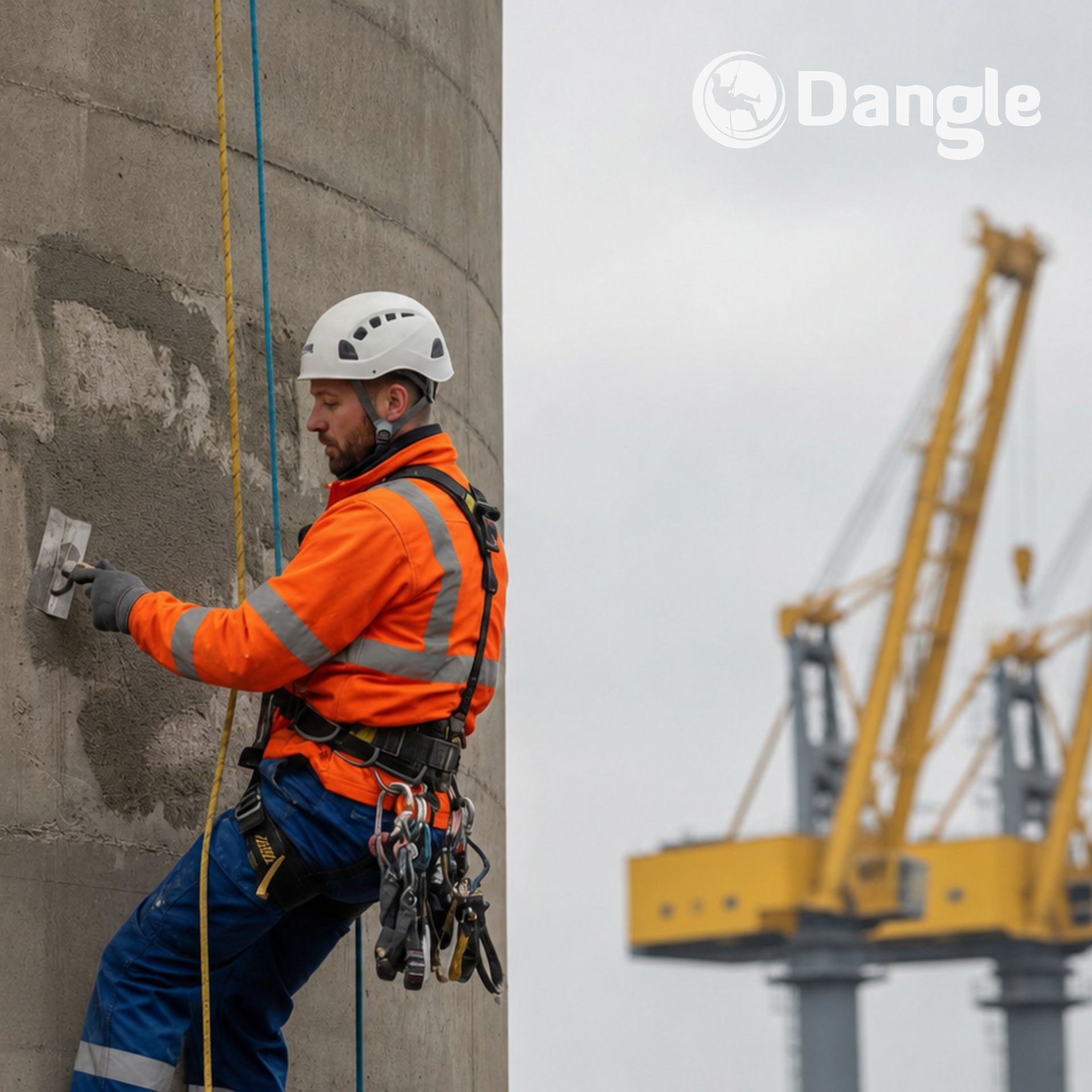
Ignoring a single patch of spalling concrete on a high-level industrial asset is more than a maintenance oversight; it's a direct liability that threatens both public safety and structural longevity. For many asset managers, the primary barrier to intervention is the escalating cost of traditional scaffolding, which often dwarfs the price of the actual remedial work. Utilising rope access concrete repair UK specialists allows you to bypass these logistical hurdles, addressing carbonation and reinforcement corrosion before they necessitate a full structural overhaul.
In this guide, we'll demonstrate how industrial rope access provides a surgical, high-safety alternative for structural surveys and repairs. We'll examine the technical processes involved, from initial hammer testing to the application of BS EN 1504 compliant mortars. At Dangle, we bridge the gap between technical expertise and IRATA proficiency by combining our real-world site services with accredited training. By the end, you'll have a clear framework for a cost-effective maintenance plan that prevents total structural failure whilst protecting your commercial bottom line.
Key Takeaways
- Recognise the commercial risks of concrete decay and how proactive intervention prevents the significant financial burden of public liability claims.
- Discover how rope access concrete repair UK solutions offer a reduced site footprint and faster mobilisation compared to the logistical constraints of scaffolding.
- Learn the precise technical workflow for remediating delaminated concrete, from initial condition surveys and hammer testing to structural mortar application.
- Understand why IRATA Level 3 supervision is a non-negotiable requirement for maintaining safety and technical compliance on high-risk industrial sites.
- Identify the advantages of the technician-tradesman hybrid model, where operators possess both IRATA certification and specialised industrial repair skills.
Table of Contents
- The Commercial and Safety Impact of Concrete Decay in UK Infrastructure
- Why Rope Access Outperforms Traditional Scaffolding for Concrete Remedials
- The Technical Workflow: From Hammer Testing to Structural Repair
- Ensuring Compliance: IRATA Standards and Technical Competence
- Dangle’s Integrated Approach to High-Risk Concrete Maintenance
The Commercial and Safety Impact of Concrete Decay in UK Infrastructure
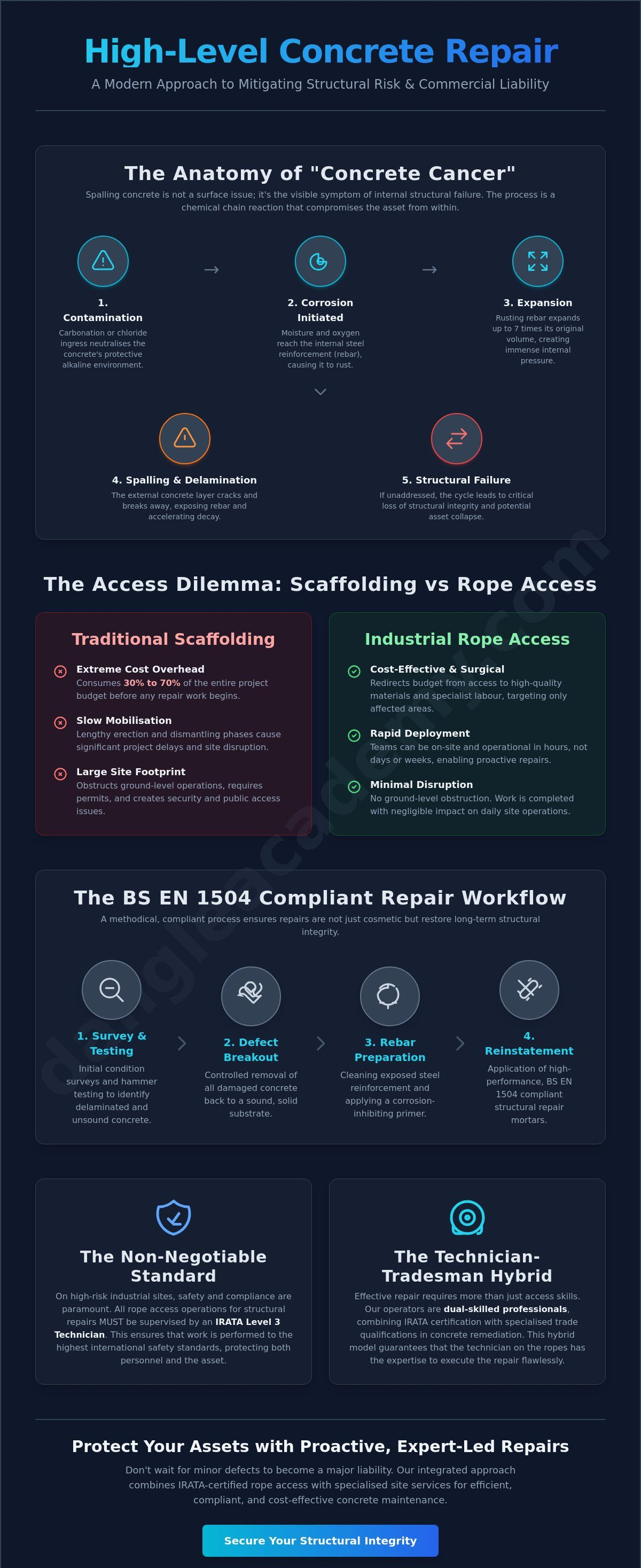
Industrial concrete assets are often viewed as permanent, indestructible fixtures. This "set and forget" mentality is a dangerous misconception that leads to rapid structural degradation and massive financial liability. In reality, reinforced concrete is a dynamic material susceptible to environmental and chemical attacks. When carbonation or chloride ingress reaches the steel reinforcement, the resulting corrosion causes the metal to expand. This expansion exerts immense internal pressure, eventually leading to "concrete cancer" and the detachment of large fragments known as spalling.
The financial consequences of deferred maintenance are severe. Falling debris from a high-level structure represents a critical safety risk to personnel and the public. Beyond the immediate danger, the presence of spalling concrete often leads to increased insurance premiums and a significant reduction in asset valuation. Deploying a Rope access team for early-stage intervention allows asset managers to address these issues surgically. By utilising rope access concrete repair UK specialists, companies can mitigate risks before they necessitate total structural demolition or prolonged site closures.
Understanding Rebar Corrosion and Spalling
Spalling is the visible symptom of a hidden chemical crisis. It occurs when the alkaline environment that protects the steel reinforcement is compromised by water, oxygen, and contaminants. As the steel rusts, it can expand to several times its original volume. Because concrete has high compressive strength but low tensile strength, it cannot contain this internal force. The outer layer eventually cracks and peels away, exposing the core of the structure to further decay.
This process is particularly aggressive in British coastal and industrial zones. Salt-laden air and atmospheric pollutants accelerate chloride ingress, leading to rapid pitting corrosion. For listed buildings and heritage structures across the UK, this decay is even more complex. These assets require a delicate balance of modern technical repair and historical preservation. Identifying these issues early through professional specialised site services is essential for maintaining the structural heritage and safety of the site.
The Risk of Deferred Maintenance
The British climate presents a unique challenge for concrete assets. The frequent freeze-thaw cycle turns minor hairline cracks into significant structural breaches. Water enters a fissure, freezes, and expands, widening the gap and allowing deeper penetration of corrosive elements. What begins as a negligible surface blemish can evolve into a major structural failure within a few seasons.
Insurance providers and regulatory bodies are increasingly strict regarding asset integrity. Evidence of neglected spalling can invalidate certain coverages or lead to "Improvement Notices" from the HSE. Proactive inspections serve as a first-response tool to document and rectify defects. This methodical approach ensures that maintenance budgets are spent on targeted repairs rather than emergency scaffolding and reactive reconstruction. It's about maintaining control of the asset's lifecycle whilst ensuring every worker on the ground remains protected from overhead hazards.
Why Rope Access Outperforms Traditional Scaffolding for Concrete Remedials
Scaffolding is often the default choice for work at height, but for concrete remedials, it's frequently the least efficient option. The logistical weight of erecting fixed towers for localised repairs creates unnecessary bottlenecks and inflated project timelines. When managing a rope access concrete repair UK project, the primary objective is the restoration of structural integrity without the commercial paralysis caused by massive scaffold structures. Traditional methods often see 30% to 70% of the budget consumed by access costs alone, whereas rope systems redirect those funds toward high-quality materials and technical expertise.
A standard scaffolding hire for a semi-detached structure can exceed £1,100 per week, whilst local authority permit fees for pavement hoarding typically sit around £140 per month. These costs escalate rapidly on industrial sites where complex designs are required. In contrast, industrial rope access teams can arrive, rig, and commence work within a single morning. This rapid mobilisation eliminates the weeks of lead time usually required for scaffold design and assembly, allowing for a more responsive approach to emerging structural defects.
By removing the need for heavy machinery and thousands of steel tubes, the site footprint remains negligible. Industrial operations or public thoroughfares can often remain open whilst technicians work overhead. This also significantly reduces the project's carbon footprint. There's no requirement for heavy transport vehicles to deliver access equipment, making it a more sustainable choice for modern asset management. For those looking to integrate these efficiencies into their maintenance programmes, exploring professional industrial rope access services is the first step toward reducing asset downtime.
Access Efficiency and Speed of Deployment
Traditional access methods are "all or nothing." If you have three isolated spalling patches across a high-rise facade, a scaffold must cover the entire elevation. Rope access allows for surgical intervention. Technicians can descend directly to the defect, perform the repair, and move to the next location in a fraction of the time. This agility enables multi-point rope access concrete repair UK inspections in a single shift, providing a more comprehensive overview of the asset's condition than a stationary platform.
Safety and Risk Management
Safety isn't just about the equipment; it's about the system. Adhering to the IRATA International Code of Practice (ICoP) provides a framework that consistently produces lower accident rates than traditional construction access. Rigging can be derigged quickly if UK weather conditions deteriorate, securing the site in minutes rather than hours. Managing exclusion zones is also simpler, as technicians only occupy the vertical space directly beneath their lines, minimising the risk to workers below.
The Technical Workflow: From Hammer Testing to Structural Repair
A successful rope access concrete repair UK project is never a matter of simply patching visible holes. It's a disciplined, multi-stage technical process that addresses the root cause of structural decay. Without a methodical workflow, repairs are merely cosmetic and will likely fail within a few seasons as internal corrosion continues unabated. At Dangle, we follow a rigorous four-phase approach to ensure every intervention meets the highest industrial standards for longevity and safety.
- Phase 1: Condition Surveying. We map the asset to identify both visible defects and hidden delamination using non-destructive testing (NDT).
- Phase 2: Substrate Preparation. Technicians remove all loose, carbonated, or chloride-contaminated concrete to expose sound aggregate and reinforcement.
- Phase 3: Steel Remediation. Exposed rebar is cleaned to a bright metal finish and treated with zinc-rich primers or bonding agents to halt further oxidation.
- Phase 4: Structural Reinstatement. We apply high-performance repair mortars, often finished with protective anti-carbonation coatings to seal the structure against the elements.
Adherence to IRATA International's Code of Practice ensures these technical stages are executed under strict safety protocols, even in the most challenging environments.
Condition Surveys and Hammer Testing
Visual checks often fail to reveal the true extent of concrete decay. Whilst a surface might look intact, internal delamination often hides just millimetres beneath the aggregate. This is why acoustic hammer testing remains the gold standard for tactile feedback. Technicians traverse the structure, tapping the surface to identify the tell-tale "hollow" sound of separated concrete. We often utilise drone surveys for initial wide-area mapping, but the physical verification provided by a technician on ropes is irreplaceable for accuracy. For deeper analysis, we take site-sampled cores to measure carbonation depth and chloride levels, ensuring the repair specification is based on hard data rather than guesswork.
Repair Methodologies and Material Selection
Selecting the right material is critical for a durable rope access concrete repair UK. We utilise BS EN 1504 compliant systems from industry leaders like Sika, Mapei, and Weber. On primary structural elements, we typically specify R4 structural repair mortars. These materials carry a 20% to 40% cost premium over standard R2 or R3 products, but their superior compressive strength and thermal compatibility with the original concrete are essential for permanent repairs. Once the mortar is cured, we apply anti-carbonation coatings. These coatings act as a breathable "skin" that prevents further CO2 and moisture ingress, significantly extending the asset's maintenance-free lifecycle.
Ensuring Compliance: IRATA Standards and Technical Competence
Compliance in industrial environments is non-negotiable. For any rope access concrete repair UK project, the legal requirements set out in the Health and Safety at Work Act and the Work at Height Regulations (WAHR) form the baseline of operations. It's a common industry failing to treat access and repair as separate disciplines. At Dangle, we advocate for the "Technician-Tradesman" hybrid model. This approach ensures that every operator on the ropes possesses the mechanical proficiency to execute complex structural repairs alongside the technical skill required to navigate high-risk environments safely.
The IRATA framework is the backbone of this system. Every site team must be led by an IRATA Level 3 supervisor. This individual is responsible for the site-specific risk assessment, method statements, and the implementation of a robust rescue plan. Without Level 3 oversight, a project lacks the safety redundancy required for industrial assets. This level of competence ensures that technical challenges, such as managing heavy mortar buckets or power tools at height, don't compromise the safety of the technician or the asset's structural integrity.
The Importance of Accredited Training
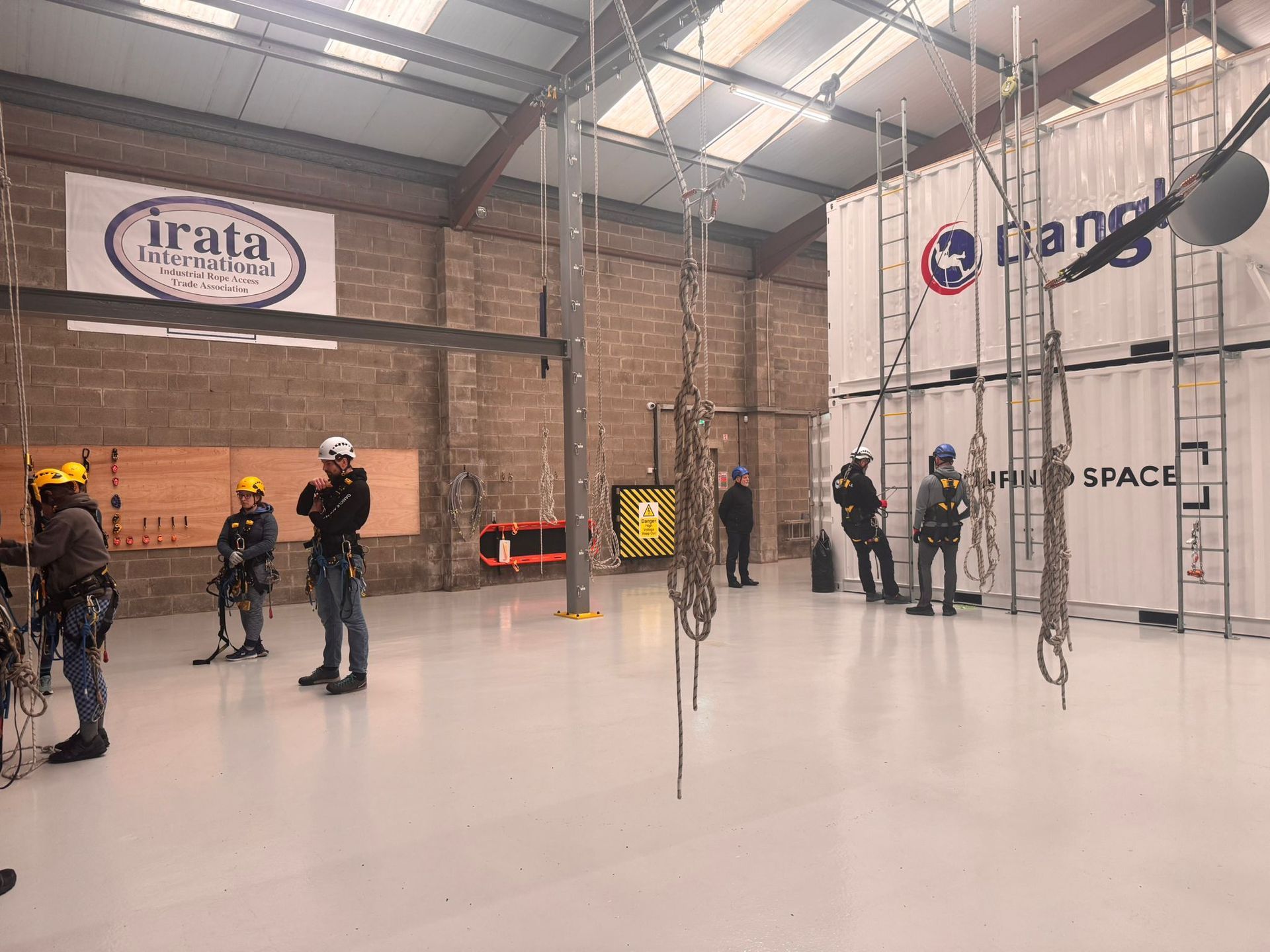
Safety standards are only as effective as the training behind them. Our IRATA Level 1 to 3 training programmes are designed to bridge the gap between classroom theory and site reality. We utilise a unique 6-day training model at our Belfast centre, consisting of five days of intensive practical instruction followed by a sixth day for independent assessment. This additional day of contact time allows candidates to consolidate their skills, ensuring they're prepared for the physical and technical demands of the field. Practical industrial experience is always superior to classroom-only knowledge. Our trainees learn to handle the specific chemicals and equipment they'll use during actual concrete remediation whilst maintaining perfect rope technique.
Medical Fitness and Safety Critical Roles
A technician's technical skill is irrelevant if they're physically incapable of performing the task. High-risk industrial roles require a verified level of physical resilience. We facilitate OEUK medicals and Chester Step testing to ensure all personnel are fit for both offshore and high-risk onshore environments. These assessments, alongside strict drug and alcohol testing, maintain a zero-incident culture on every project. Safety is a holistic commitment. It extends to ensuring all personnel hold current First Aid at Work certifications, providing a final layer of protection for the entire team.
If your team requires the technical proficiency to manage industrial assets effectively, consider our accredited IRATA training courses to build a safer, more competent workforce.
Dangle’s Integrated Approach to High-Risk Concrete Maintenance
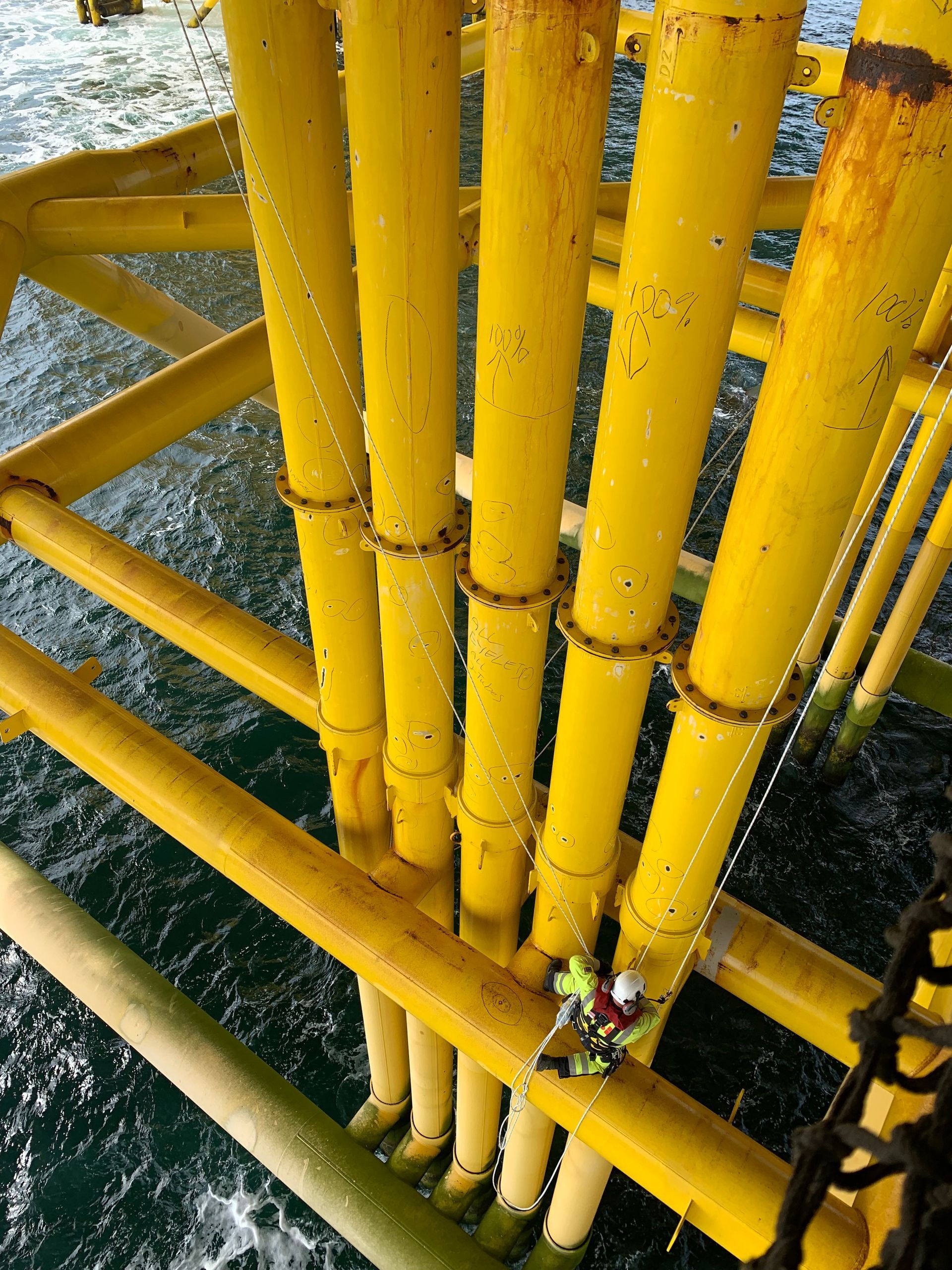
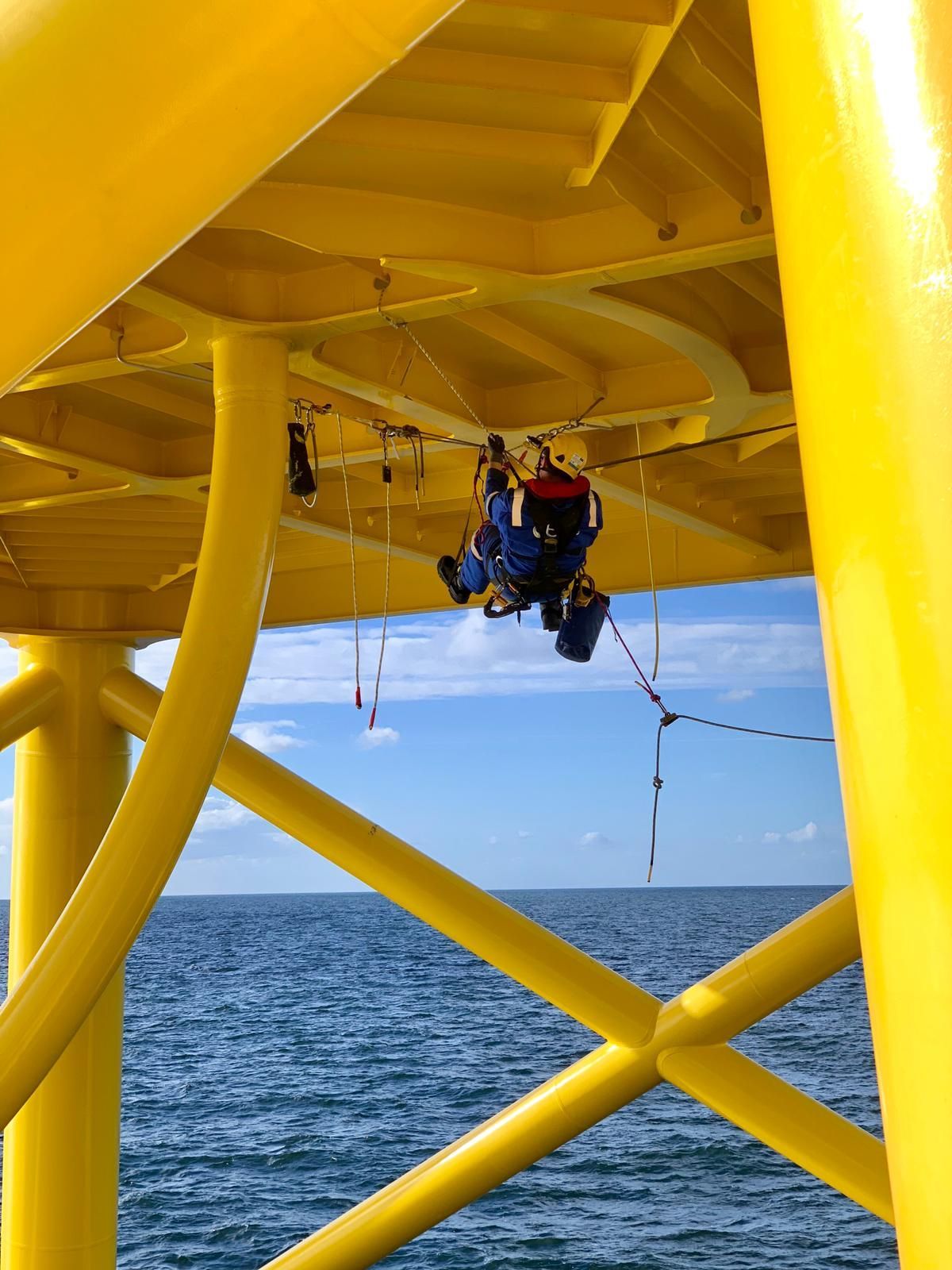
The Dangle Advantage is rooted in our dual identity as both a Tier 1 training academy and an active site services provider. We don't operate in a vacuum; our instructors are the same technicians who manage rope access concrete repair UK projects on offshore wind turbines and coastal marine assets. This synergy ensures that our technical solutions are informed by the latest field realities and IRATA safety benchmarks. By combining real-world site experience with accredited training, we deliver a level of proficiency that classroom-only contractors cannot match.
Our operational reach extends from our central hub in Belfast across Northern Ireland and the wider UK. This strategic positioning allows for rapid response mobilisation, which is critical when addressing emergency spalling or structural defects. We specialise in high-risk environments, including industrial chimneys and wind energy infrastructure, where traditional access is often impossible. Every project is backed by comprehensive reporting. We provide clients with detailed photographic evidence and technical data, ensuring that asset managers have a clear, auditable record of the structure's condition.
Specialist Industrial Services
Prevention is as vital as the repair itself. Our expertise in industrial painting and protective coatings allows us to seal concrete surfaces against the aggressive carbonation and chloride ingress discussed earlier. For assets with internal vulnerabilities, we provide specialised confined space access. This is essential for the internal inspection of tanks and vessels where concrete decay often goes unnoticed. In the Belfast context, we support local infrastructure by applying international safety standards to regional projects, ensuring Northern Ireland's industrial heritage remains structurally sound.
From Inspection to Long-Term Maintenance
We move beyond reactive fixes by developing bespoke maintenance programmes tailored to the specific lifecycle of your asset. By integrating rope access inspection services with advanced drone surveys, we achieve total structural oversight. This multi-layered approach identifies hairline fractures and thermal anomalies before they evolve into safety-critical failures. To secure your asset's future, you can book a structural survey or request a project consultation through our technical team. Proactive management is the only way to safeguard your commercial interests whilst maintaining a zero-incident safety culture.
Securing the Future of Your Industrial Assets
Structural concrete maintenance is a critical component of asset management that cannot be deferred without significant safety and financial risk. By transitioning from traditional scaffolding to industrial abseiling, you achieve a more surgical, cost-effective intervention that minimises site disruption. The key to success lies in the technician-tradesman hybrid model, ensuring that every repair is executed with technical precision whilst adhering to the highest safety standards.
Dangle provides the expertise required to manage these high-stakes environments. As an IRATA and GWO accredited training provider, we ensure all projects are overseen by IRATA Certified Level 3 Supervisors. Whether you're managing wind turbines, marine infrastructure, or industrial chimneys, implementing a robust strategy for rope access concrete repair UK is the most reliable way to prevent total structural failure and protect your commercial bottom line.
Don't wait for spalling to become a liability. We're ready to help you develop a sustainable maintenance programme that keeps your assets operational and your workforce safe. Request a Professional Rope Access Consultation today to discuss your specific site requirements.
Frequently Asked Questions
Is rope access safer than scaffolding for concrete repair?
Rope access is statistically safer than traditional scaffolding when performed by IRATA-certified technicians. The system's primary advantage is the elimination of heavy equipment assembly, which is a major source of construction site accidents. Every project is managed by an IRATA Level 3 supervisor who implements robust rescue plans and site-specific risk assessments to ensure a zero-incident environment.
What are the main causes of concrete failure on UK buildings?
Concrete decay in the UK is primarily driven by carbonation and chloride ingress, particularly in coastal or industrial zones. These chemical processes compromise the alkaline protection of the steel reinforcement, leading to internal corrosion and expansion. The British freeze-thaw cycle further accelerates this degradation by widening hairline cracks as moisture freezes and expands within the substrate.
How long does a typical rope access concrete repair project take?
Project timelines are significantly shorter with rope access because mobilisation takes hours rather than the weeks required for scaffolding. A rope access concrete repair UK project can often be completed in the time it would take just to erect a complex scaffold structure. Whilst the duration of the actual repair depends on the volume of delaminated concrete, the speed of deployment ensures the overall schedule remains highly efficient.
Do I need to close my building or site during rope access work?
Building closures are rarely necessary during rope access operations because the system has a negligible site footprint. Work is confined to specific vertical drops, requiring only small exclusion zones at ground level to protect against potential debris. This allows industrial operations, public thoroughfares, and office entrances to remain fully functional whilst technicians perform remedial work overhead.
What qualifications should I look for in a concrete repair contractor?
You should look for contractors who combine IRATA rope access certification with technical trade proficiency in BS EN 1504 standards. It is essential that the team includes Level 3 supervisors and that all technicians are medically fit, holding OEUK or Chester Step test certifications. Verification of accredited training ensures the team understands both the access methods and the technical application of repair mortars.
Can rope access be used for heavy structural strengthening?
Rope access is highly effective for structural strengthening tasks, including the application of carbon fibre reinforced polymers (CFRP) and plate bonding. Whilst there are weight limits for materials handled by individual technicians, specialist rigging and mechanical winches allow for the installation of heavy components. This makes it a viable solution for reinforcing bridges, industrial chimneys, and high-rise structural frames.
How much does rope access concrete repair cost compared to scaffolding?
Rope access is generally 30% to 70% more cost-effective than scaffolding for high-level concrete remediation. These savings are achieved by removing the massive overheads associated with scaffolding hire, transport, and lengthy assembly periods. By reducing the number of personnel required for access, a larger portion of the maintenance budget can be directed toward high-quality structural repair materials.
Does Dangle provide services throughout the UK and Ireland?
Dangle operates from a central hub in Belfast, providing comprehensive services across Northern Ireland and the wider UK. Our strategic location and rapid response teams allow us to manage projects on a variety of industrial assets, from offshore wind turbines to onshore facilities. We provide a seamless transition from accredited IRATA training to professional site services throughout the British Isles.
Contact Us
We'd Love a Share...
Recent Blog Posts