Industrial Chimney Inspection
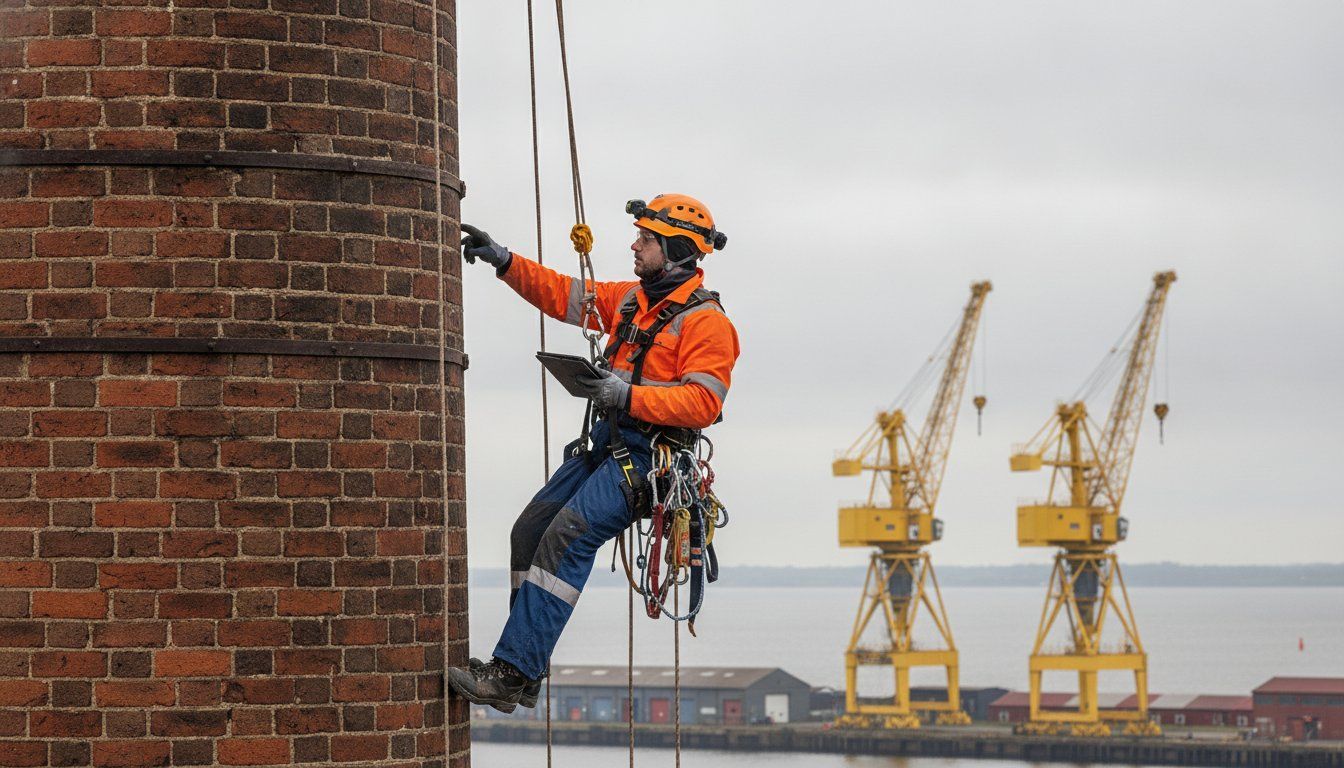
Traditional steeplejack ladders and heavy scaffolding are no longer the gold standard for maintaining high-level assets. For many site managers, the sheer cost and logistical delay of erecting steel frames for a routine industrial chimney inspection often outweigh the benefits of the survey itself. When production downtime is measured in thousands of pounds per hour, relying on outdated access methods isn't just slow; it's a commercial liability.
We understand that managing work at height whilst navigating complex UK safety regulations is a constant pressure. You need a solution that ensures structural integrity without draining your maintenance budget or compromising on-site safety. This guide will demonstrate how IRATA-certified rope access provides a more agile, cost-effective, and technically superior alternative to traditional methods.
By the end of this article, you'll have a clear understanding of mandatory inspection frequencies and a direct comparison of access costs. We'll also provide the technical insight needed to ensure your next maintenance programme meets the highest HSE standards, keeping your facility compliant and your workforce protected.
Key Takeaways
- Understand why structural surveys are mandatory for preventing masonry failure and managing long-term asset health.
- Compare the mobilisation speed and cost-efficiency of IRATA-certified rope access against traditional, heavy scaffolding.
- Discover how Non-Destructive Testing (NDT) and high-definition visual surveys identify hidden corrosion without damaging the chimney structure.
- Learn how to establish a compliant industrial chimney inspection frequency of one to three years based on your asset's age and material composition.
- Access specialist advice that combines real-world site services with accredited industrial training to streamline your maintenance programmes.
Table of Contents
- Understanding Industrial Chimney Inspection Requirements
- Rope Access vs Traditional Steeplejack Methods
- Core Inspection Techniques: Visual Surveys and NDT
- Planning Your Chimney Inspection: Steps for Asset Managers
- Specialist Chimney Services from Dangle
Understanding Industrial Chimney Inspection Requirements
An industrial chimney inspection is a mandatory structural assessment designed to verify the safety and longevity of high-level flue-gas stacks. It's not merely a visual check; it's a technical audit that ensures the asset can withstand environmental loads and internal thermal stresses. Regular industrial chimney inspection routines are critical for preventing masonry fall-off or steel corrosion that can lead to catastrophic failure. Without these surveys, minor defects quickly escalate into major structural liabilities.
Neglect carries a heavy commercial price. A small fracture in a concrete liner or a loose brick might seem insignificant, but they often signal deeper systemic issues. If masonry falls or a stack loses structural integrity, the resulting unplanned shutdown can cost a facility more in 48 hours than a decade of scheduled maintenance. Insurance providers and the HSE require evidence of these audits to maintain compliance and coverage. Proactive management ensures that small repairs are identified before they require multi-million pound reconstruction projects.
Regulatory Standards and Compliance in the UK
Asset owners must adhere to BS EN 13084, the primary standard for free-standing Industrial Chimneys. This standard provides the framework for design, construction, and ongoing maintenance. Furthermore, the Management of Health and Safety at Work Regulations 1999 places a legal duty on employers to assess risks and ensure all work equipment is safe. To meet these rigorous demands, industry leaders look to IRATA and ATLAS as the gold standards for high-level work. Utilising technicians who have undergone industrial training ensures that inspections are carried out by competent persons who understand both the access risks and the technical requirements of the survey.
Common Structural Risks by Chimney Type
Different materials present unique failure modes that technicians must identify during a survey. Concrete chimneys are particularly susceptible to carbonation and spalling (find out more on concrete repair using rope access by reading our comprehensive blog post). This happens when the alkaline protection of the concrete is lost, allowing reinforcement bars to rust and expand, which eventually blows the concrete face off the structure. Steel stacks face internal corrosion from acidic flue gases and external degradation from the elements. Technicians must also monitor guy wire tensioning and the health of the internal linings to prevent collapse.
Brick chimneys, whilst robust, often suffer from mortar decay and vertical cracking. Over time, the thermal expansion of the flue can stress the outer masonry. If the tensioning bands are not maintained, the structure can lose its lateral stability. Identifying these issues early through a specialist survey is the only way to guarantee the continued safe operation of the plant.
Rope Access vs Traditional Steeplejack Methods
The steeplejack trade has undergone a significant technical shift over the last two decades. Historically, an industrial chimney inspection required the installation of heavy timber or steel ladders pinned directly into the masonry. Whilst these methods served the industry for over a century, they're increasingly viewed as cumbersome and financially inefficient. Modern rope access has replaced these heavy-duty setups with lightweight, high-strength synthetic systems that offer greater versatility without the massive logistical footprint of old-school steeplejack equipment.
Mobilisation speed is the most immediate differentiator for asset managers. A traditional scaffolding project for a 60-metre stack can take two weeks to erect and another week to dismantle. In contrast, an IRATA-certified rope access team can often rig their systems and begin the survey within a few hours of arriving on site. This rapid deployment minimises site disruption and allows for a more responsive approach to maintenance. For facilities operating on tight schedules, this agility is essential to maintaining production continuity and reducing the overall duration of the project.
The Downside of Traditional Scaffolding
The financial overhead of scaffolding is often the largest single line item in a maintenance budget. Beyond the hire costs, the sheer physical presence of a steel frame creates significant site constraints. It can block access roads, restrict the movement of heavy machinery, and limit entry to adjacent buildings. There's also the hazard window to consider. The longer a structure remains on-site, the higher the risk of unauthorised access or environmental damage during high winds. By removing the need for permanent structures, rope access significantly reduces these secondary liabilities.
Why IRATA Rope Access is the Modern Standard
The safety profile of IRATA rope access is unparalleled. The system relies on a two-point independent suspension, meaning every technician is attached to two separate anchors at all times. If one line were to fail, the secondary backup system prevents a fall. This fail-safe methodology is why rope access consistently reports the lowest incident rates amongst all work-at-height sectors. It's also remarkably versatile, allowing technicians to reach internal flue linings and confined spaces that are physically impossible to access with traditional ladders.
Adhering to safety benchmarks like the NFPA 211 standards requires a level of detail that only a close-proximity technician can provide. Because rope access teams can position themselves within arm's reach of any defect, the quality of visual and tactile data is far superior to looking through binoculars from a scaffold platform. If you're looking to upgrade your team's internal capability, exploring our IRATA rope access training is a logical first step toward safer site operations.
Core Inspection Techniques: Visual Surveys and NDT
The technical efficacy of an industrial chimney inspection rests on the precision of the data captured. A high-quality survey moves beyond simple observation, combining close-proximity visual assessments with advanced Non-Destructive Testing (NDT). By using high-definition photography and thermal imaging, technicians create a digital record of the asset. This allows asset managers to perform side-by-side comparisons with previous reports to track the exact rate of structural decay. Visual surveys identify surface-level issues like masonry spalling or vegetation growth, but NDT is required to "see" beneath the surface.
A comprehensive safety report must include both internal and external inspections. Whilst the exterior of a stack faces environmental loading and weathering, the internal lining is subjected to aggressive chemical erosion and extreme thermal cycling from flue gases. Neglecting the internal flue can lead to hidden structural thinning that visual external checks will never catch. Identifying these internal vulnerabilities early is the most effective way to prevent unplanned outages and extend the operational life of the chimney.
Specialist NDT Methods for Chimneys
We utilise specific NDT techniques tailored to the construction material of the stack. For steel chimneys, Ultrasonic Thickness (UT) testing is the primary tool for measuring shell corrosion. It provides millimetre-accurate readings of the remaining wall thickness, ensuring the steel still meets its original design parameters. For concrete structures, Schmidt Hammer testing is used to assess compressive strength and identify the depth of carbonation. In high-stakes environments like flare stacks, we employ dye penetrant and magnetic particle inspection to verify the integrity of critical welds. These methods ensure that structural health is quantified with data rather than guesswork.
Evaluating Lightning Protection and Earthing
Every industrial chimney inspection must include a rigorous assessment of the Lightning Protection System (LPS). Given their height and isolation, chimneys are prime targets for lightning strikes. We test earth resistance and continuity to ensure the system remains compliant with BS EN 62305. Technicians look for corrosion in down conductors and verify the integrity of air termination networks at the chimney crown. An unmaintained LPS doesn't just risk fire; a single strike on a compromised system can cause explosive structural damage to masonry or concrete. Ensuring these systems are functional is a core component of our Rope Access Inspection Services, providing a layer of protection that is often overlooked during basic maintenance checks.
Planning Your Chimney Inspection: Steps for Asset Managers
Effective planning is what separates a smooth maintenance window from a logistical nightmare. For asset managers, the first step is establishing a compliant frequency for your industrial chimney inspection. Whilst newer stacks might only require a survey every three years, older masonry or steel assets often need annual reviews to monitor known defects. Reviewing historical data, including original construction drawings and previous maintenance logs, allows the inspection team to target high-stress areas before they even arrive on site. This proactive approach prevents the need for invasive, emergency repairs later.
Site-specific hazards must be identified during the pre-planning phase. Hot exhausts and chemical residues can dictate the timing of the work, often requiring a total plant shutdown or a reduced load. Wind speed restrictions are also a critical factor; rope access operations typically pause if gusts exceed specific safety thresholds. Clear communication between the plant manager and the lead technician ensures that these variables don't lead to expensive delays. It's about managing the physical realities of the site with precision and foresight.
The Pre-Inspection Checklist
Safety on site is paramount. A robust exclusion zone at the base of the chimney protects ground-level personnel from potential falling debris. Asset managers must also organise all necessary permits to work and, where applicable, confined space entry certifications. Crucially, any high-level work must be overseen by IRATA Level 3 supervision. This ensures that a dedicated safety professional is on hand to manage rigging and emergency rescue procedures. It's a non-negotiable requirement for HSE compliance that protects both the workforce and the site owner.
Interpreting the Structural Report
Once the survey is complete, the final report should provide a clear roadmap for your maintenance budget. We use a risk-rating system to categorise findings into urgent structural repairs or routine preventive maintenance. High-definition photographic evidence is vital here, providing an audit trail for insurance providers and stakeholders. Instead of reacting to failures, use these reports to build a multi-year preventive maintenance programme. This shift from reactive to proactive care saves thousands in the long run. If you need assistance with planning your next audit, our Rope Access Inspection Services offer the technical support required to manage complex high-level assets across the UK and Ireland, including our specialist teams based in Belfast.
Specialist Chimney Services from Dangle
Selecting a partner for an industrial chimney inspection requires more than just hiring a team with ropes. At Dangle, we occupy a unique position in the market by combining real-world site services with our own accredited industrial training centre. This dual approach means our technicians don't just identify structural issues; they understand the technical requirements of the repairs they recommend. Because we train the industry's workforce, our own teams operate to a standard that exceeds generic contracting, ensuring every survey is backed by deep technical proficiency.
Based in Belfast, we provide rapid mobilisation across Northern Ireland, the Republic of Ireland, and the wider UK. Our background in high-stakes sectors like offshore wind, marine assets, and heavy utilities has refined our approach to high-level maintenance. We don't view an inspection as a standalone event but as the first step in a comprehensive asset integrity programme. By integrating our training academy's expertise with our field operations, we ensure that the person on the ropes is a qualified specialist, not just a general labourer.
From Inspection to Industrial Coatings
The value of our service extends beyond the initial report. Once an industrial chimney inspection identifies corrosion or masonry decay, our teams transition seamlessly into remedial works. For steel stacks, we apply high-performance protective coatings via rope access to halt oxidation and extend the asset's operational life. For historic brick structures, we provide specialist masonry repairs and repointing. Our service delivery is bolstered by our Industrial Painter Training, which ensures our technicians apply coatings with the precision required for harsh industrial environments.
The Dangle Advantage in Northern Ireland
Our commitment to excellence is rooted in our Northern Ireland headquarters. We're proud to offer a unique 5-day training plus a day 6 assessment model for IRATA certifications, providing a more thorough preparation than the standard five-day courses found elsewhere. This emphasis on practical, hands-on industrial experience over simple classroom knowledge defines the Dangle advantage. We've built a proven track record supporting the renewable energy and utility sectors, delivering safety and structural stability where it matters most.
If you're managing a high-level asset and require a compliant, technical audit, contact Dangle today. Our specialists are ready to provide a comprehensive chimney inspection consultation to ensure your facility remains safe, productive, and fully compliant with UK regulations.
Securing Your High-Level Assets with Specialist Care
Maintaining structural integrity requires more than a distant visual check from the ground. Moving from traditional scaffolding to IRATA-certified rope access allows for a far more detailed industrial chimney inspection whilst significantly reducing site disruption and mobilisation costs. By integrating Non-Destructive Testing and lightning protection audits into your routine maintenance, you protect your facility from both environmental degradation and regulatory non-compliance.
Dangle stands apart as an IRATA Accredited Member Company that bridges the gap between field expertise and technical training. Our Belfast-based team is ready for rapid mobilisation across the UK and Ireland, providing comprehensive NDT and protective coating capabilities to fix structural defects the moment they're identified. This integrated approach ensures that your assets aren't just inspected, but actively maintained by technicians who understand the technical reality of the work.
Book a Specialist Chimney Inspection Consultation with Dangle today to safeguard your infrastructure. We're here to help you navigate your safety requirements with absolute precision and professionalism.

Industrial Chimney Inspection - FAQs
How often should an industrial chimney be inspected?
Industrial chimneys should typically be inspected every one to three years, depending on the age and construction material of the asset. Older masonry stacks or those exposed to high chemical loads often require annual surveys to monitor decay. Newer steel stacks may adhere to a three-year cycle. Regular audits ensure compliance with BS EN 13084 and allow for the early detection of structural issues before they become catastrophic liabilities.
Can rope access be used for internal chimney inspections?
Yes, rope access is highly effective for internal industrial chimney inspection tasks, especially within narrow flues or confined spaces. Technicians can descend the full height of the internal lining to perform close-up visual checks and NDT.
This method is far safer and more versatile than using temporary internal platforms or ladders, providing a comprehensive view of chemical erosion and thermal damage that external surveys might miss.
What is the difference between a steeplejack and a rope access technician?
The primary difference lies in the access methodology and safety systems used to reach high-level assets.
Traditional steeplejacks often rely on fixed ladders and scaffolding, which can be time-consuming to install. Rope access technicians utilise IRATA-certified two-rope systems that offer superior mobility and a lower incident rate.
This modern approach allows for faster mobilisation and closer proximity to the structure for more accurate technical data collection.
What happens if we find structural cracks during the inspection?
If structural cracks are identified, they are risk-rated to determine if immediate remedial action is necessary. Minor surface cracks might be scheduled for routine maintenance, whereas deep vertical fractures in masonry or carbonation in concrete require urgent repair.
Our teams can transition from inspection to repair, applying industrial coatings or performing masonry repointing to stabilise the structure and prevent further ingress of moisture or corrosive gases.
Do I need to shut down production during a chimney survey?
Production shutdowns are generally only required for internal surveys or when hot flue gases pose a thermal risk to the technicians. Many external inspections can be completed whilst the plant remains operational, provided wind speeds and environmental conditions are safe. We coordinate closely with site managers to plan the industrial chimney inspection during scheduled downtime or low-load periods to minimise any impact on your facility's commercial output.
What qualifications should I look for in a chimney inspection team?
You should prioritise teams with IRATA accreditation and Level 3 safety supervision for all work-at-height activities. Look for technicians with specific NDT certifications and a background in industrial training to ensure they can interpret structural data accurately. It's also beneficial to choose a provider with a proven track record in heavy sectors like renewables or marine assets, as this demonstrates a high level of technical competency.
Is lightning protection testing included in a standard chimney survey?
Lightning protection testing is a core component of a standard chimney survey and is essential for BS EN 62305 compliance. Technicians will check the continuity and earth resistance of the system to ensure it can safely dissipate a strike. Given that chimneys are primary targets for lightning, verifying the integrity of down conductors and air termination networks is a critical safety measure that protects the structure from explosive damage.
Contact Us
We'd Love a Share...
Recent Blog Post's