
First Aid at Work Training in Belfast

First Aid at Work Training in Belfast: Course Length and Options
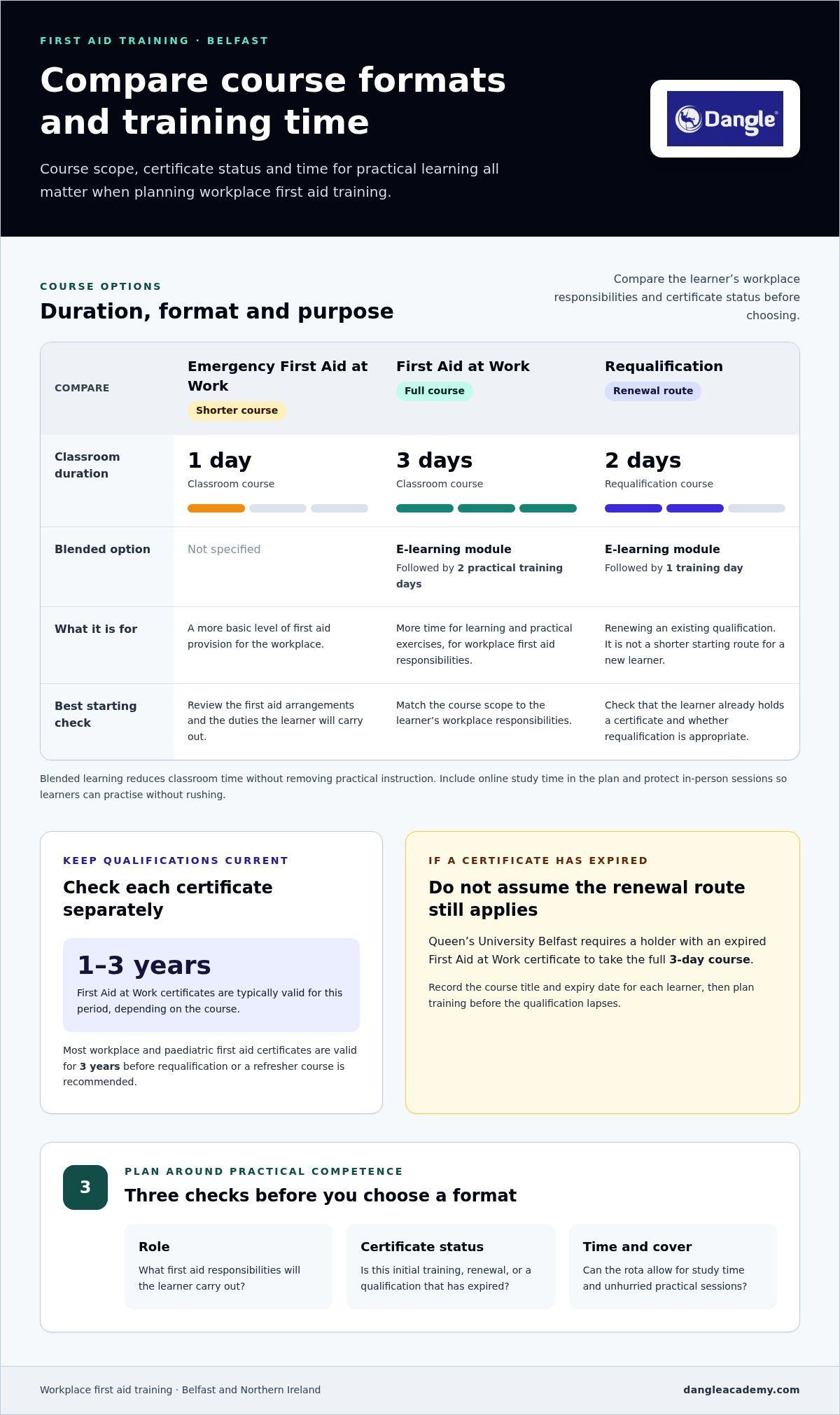
First aid at work training in Belfast takes three days. The requalification course takes two days, with a blended option of classroom and practical training; Emergency First Aid at Work is a one-day course.
Choosing the right format means more than fitting training around a busy rota. Staff need time to practise skills they may use at work, while employers need to arrange cover and keep qualifications current.
This guide explains the training formats available, how certificate validity works, and what to consider when arranging on-site training for a team across Northern Ireland. You’ll also find out how to apply and which course format may suit your workplace, so you can plan training around operational needs without losing sight of practical competence.
Key Takeaways
- Compare classroom and blended learning formats to find a course schedule that fits your team’s operational needs.
- Plan renewal ahead: certificate validity depends on the course, and many workplace first aid certificates last three years.
- On-site training can bring learning to your workplace across Northern Ireland; consider the group size and time needed away from normal duties.
- Before applying, gather learner details and identify the course type, preferred format and training arrangements you need.
- Review how the course develops practical response skills, not just theoretical knowledge, so learners can apply what they learn at work.
Table of Contents
- Course durations and e-learning options
- Certificate validity
- On-site workplace training across Northern Ireland
- Application process
- What topics and practical skills are covered in a First Aid at Work course?
- Dangle®: Industrial Rope Access Services
Course durations and e-learning options
Course length affects rota cover, but the right option also depends on the first aid responsibilities required at work. In Northern Ireland, Emergency First Aid at Work is a one-day classroom course. First Aid at Work takes three days, or can be completed through an e-learning module followed by two practical training days.
The difference is scope. Emergency First Aid at Work provides a shorter route for workplaces needing a more basic level of first aid provision. The full First Aid at Work course allows more time for learning and practical exercises. For employers comparing first aid at work training in Belfast, course scope should carry more weight than choosing the fewest days away from work.
How does First Aid at Work training compare with Emergency First Aid at Work? Emergency First Aid at Work takes one classroom day. First Aid at Work takes three days, or an e-learning module followed by two practical days. The longer course provides more training time for workplace first aid responsibilities.
Blended learning can reduce classroom time without removing practical instruction. Learners complete the online module before attending practical training. Include study time in the plan, then protect the in-person sessions so learners can practise without rushing between exercises and work tasks. This format may suit teams that can schedule practical attendance more easily than a full classroom programme.
You do not need prior experience to compare these course options. A first-time learner can consider the course scope alongside their workplace role. If a learner already holds a certificate, check whether requalification is appropriate. The requalification course takes two days, or an e-learning module followed by one training day.
Workplace first aid courses should match the responsibilities assigned to staff. For example, a team working across a busy site may need broader preparation than a small office team. Employers arranging first aid at work training in Belfast can compare the one-day emergency course with the full course by reviewing their first aid arrangements and the duties learners will carry out.
Course accreditation and recognition matter because the certificate must suit the role. Check the course title and certificate outcome against the workplace’s first aid arrangements. Emergency First Aid at Work, First Aid at Work and requalification are distinct options, not interchangeable labels. Start by identifying whether the learner needs initial training or renewal.
When planning a refresher, distinguish the full First Aid at Work course from requalification. Requalification takes two days, or one practical day after e-learning. It is intended to renew an existing qualification, not as a shorter starting route for a new learner.
When comparing workplace training courses, map each learner’s role, certificate status and available training time before choosing a format. That preparation helps keep the course selection aligned with workplace responsibilities and supports practical rota planning.
Certificate validity
A certificate’s expiry date affects who can be counted in workplace first aid arrangements. First Aid at Work certificates are typically valid for one to three years, depending on the course. Most workplace and paediatric first aid certificates are valid for three years before requalification or a refresher course is recommended. Record each learner’s course name and expiry date so renewal can be planned before the qualification lapses.
What are the renewal and requalification requirements for First Aid at Work? Most workplace first aid certificates are valid for three years, after which requalification or a refresher course is recommended. If a First Aid at Work certificate has expired, Queen’s University Belfast requires the holder to take the full 3-day course.
Use the certificate as the starting point for a renewal plan. Record its course title, issue date and expiry date, then compare those details with the learner’s current role. This helps avoid confusing Emergency First Aid with First Aid at Work or assuming one certificate renews another. Keep the record accessible to the person organising workplace first aid cover.
Build renewal into staff planning rather than waiting for a certificate to lapse. For example, a manager reviewing training records can flag certificates approaching expiry and schedule the relevant course around shift patterns. If a learner’s certificate is already out of date, the Queen’s University Belfast example is clear: the holder must take the full course, not the shorter requalification route.
- Record: Write down the certificate title and expiry date for each learner.
- Review: Compare the qualification with the first aid role the person performs.
- Plan: Allow time to arrange training before the recorded expiry date.
- Act on expiry: Treat a lapsed certificate differently from one still in date.
These steps are especially useful when staff move between departments or sites. A certificate suited to an earlier role may not match current responsibilities. Review the learner’s qualification alongside the workplace’s first aid arrangements, and keep an up-to-date record for each location. In a Belfast workplace with rotating shifts, a central training log helps managers see which trained staff are available across the working pattern.
Certificate validity also varies across different first aid courses. The one-to-three-year range means employers should not apply one renewal date to every course. Check each certificate separately, including emergency first aid qualifications, and arrange the appropriate refresher or requalification route. For course-specific details, review the First Aid at Work course information when planning the next training step.
On-site workplace training across Northern Ireland
On-site first aid training can bring the course to a team’s workplace, reducing the need for learners to travel to a separate venue. In Belfast, the available on-site option runs from half a day to three days, depending on the course. Group training is available for up to 12 learners, allowing colleagues to learn together in a familiar setting.
Training can make practical discussion more relevant to the workplace. Learners can consider how an emergency response would work on site, including how staff raise the alarm and direct help to the incident. For a Belfast warehouse, for example, the organiser can explain site access arrangements before training begins. The course still needs protected time for instruction and practice.
Plan the session around the qualification the team needs. A half-day course and a three-day course require different rota arrangements and learning time. Confirm who is attending, their work patterns and the time needed for training. This helps managers maintain operations without expecting learners to leave practical exercises early to return to their duties.
- Choose the course: Match its scope to the workplace’s first aid arrangements.
- Set the group: Keep attendance within the 12-learner limit for the Belfast on-site option.
- Agree the location: Identify a suitable room at the workplace before the training date.
- Protect the time: Arrange cover so learners can take part throughout the session.
For a team spread across Northern Ireland, a workplace venue can simplify coordination. A manager might gather staff at one site for a shared session, then arrange separate training around another location’s shifts. Keep each group within the stated limit and allow for the full course duration. This makes attendance easier to organise while keeping training relevant to where learners work.
Before the session, prepare a clear training area and tell learners where to report. Share relevant site entry or sign-in instructions, particularly at operational sites with controlled access. These arrangements help prevent avoidable delays and protect time set aside for learning. Identify a workplace contact who can support the trainer with basic site logistics.
On-site delivery suits employers who want colleagues trained together at their workplace. It may be less convenient when staff are spread across distant sites or cannot be released at the same time. In those cases, compare a shared workplace session with individual course attendance. Consider the qualification required, the team’s availability and the time needed away from normal duties.
Training arrangements are only one part of workplace readiness. Next, identify how to apply, prepare learner details and organise the course around the team’s working pattern.
Application process
Start by identifying the course each learner needs. A new learner may need First Aid at Work, while someone renewing an existing certificate may need requalification. Check the certificate title and expiry date before choosing. This helps prevent applications for the wrong course and matches training to each person’s workplace responsibilities.
Next, decide whether learners will attend classroom training, use a blended option or join an on-site session. For a blended course, plan when learners will complete the online module and attend practical training. For workplace delivery, identify the training location and colleagues attending together. These choices shape the booking details and arrangements needed around shifts.
Prepare the information needed to organise the booking. A practical checklist includes:
- The course name required for each learner.
- Each learner’s full name and relevant certificate details, if applying for requalification.
- The preferred course format and suitable training dates.
- Whether learners will attend individually or as a workplace group.
- A contact person who can coordinate attendance and workplace arrangements.
Before submitting an application, compare the course choice with the learner’s current qualification. A certificate that has expired may affect whether requalification is suitable. For example, Queen’s University Belfast requires a holder whose First Aid at Work certificate has lapsed to take the full 3-day course. Use the certificate record to avoid selecting a renewal route that does not fit.
For a Belfast workplace group, agree attendance before completing the booking. Consider shift cover, site access and time away from normal duties. If learners work across Northern Ireland, record each person’s work location and whether travel affects attendance. This information helps organise training without disrupting operational handovers.
Once the course and learner details are ready, submit the application through the relevant course booking route. Keep a copy of the selected course, attendee names and booking correspondence in the workplace training record. For an online and practical format, include both parts in the learner’s plan so the e-learning is completed before practical attendance.
After booking, give each learner clear joining instructions. State the training date, location, arrival arrangements and any preparation needed for the chosen format. For a workplace session, explain where attendees should report and who will coordinate access. For an individual course, make sure the learner knows the venue and has protected time to complete the full programme.
A well-organised application matches the right course to the right person and carries that decision through to attendance. After training, update learner records with the new certificate details. This provides a clear starting point for future renewal planning and keeps qualifications organised across the team.
What topics and practical skills are covered in a First Aid at Work course?
A workplace emergency rarely gives staff time to search for instructions. First Aid at Work training teaches a structured response: recognise what has happened, assess the situation, take appropriate action and communicate clearly. Practice helps learners follow these steps in sequence instead of treating first aid as a list of separate facts.
Training connects the response to the work environment. A casualty in an office, workshop or industrial area may need help in surroundings with different access arrangements and hazards. Learners need to consider their own safety, the casualty’s condition and how to get support. In a noisy workshop, for example, clear communication and asking a colleague to raise the alarm are part of the response.
Practical exercises let learners rehearse decisions and communication. A scenario might ask a learner to describe what they observe, explain what support is needed and pass relevant information to someone else. During a shift handover, a clear account can help colleagues understand what happened and what action has already been taken.
First aid also depends on knowing how the workplace organises help. The Health and Safety (First Aid) Regulations 1981 require employers to provide adequate first aid cover, according to legislation.gov.uk. Training should therefore be considered alongside workplace arrangements, such as how staff summon assistance and where responders can reach an incident. A site induction can explain local procedures, but it does not replace learning and practice.
Remembering a topic and applying it under pressure are different skills. A learner may understand an explanation in the classroom, then need to use that knowledge in a practical exercise. Scenario-based practice supports judgement, concise communication and a calm, methodical response. It also lets learners identify where they need more practice before returning to their workplace role.
For teams in Belfast, useful scenarios can reflect real work settings without creating unsafe simulations. A blocked access route, a casualty in a shared work area or a colleague needing prompt assistance can prompt discussion about roles and communication. The aim is to practise decisions and coordination, not to recreate an incident or expose learners to workplace hazards.
After training, employers can reinforce learning through workplace briefings and clear response arrangements. A supervisor, for example, can explain how to raise an alarm, who coordinates access and how responders receive information. This connects course learning with the working environment. Review the First Aid at Work course details when deciding which training route suits the role.
Dangle®: Industrial Rope Access Services
Dangle® also supports organisations with safety needs beyond workplace first aid. Its Industrial Rope Access Services help businesses carry out inspection and maintenance in difficult-to-access industrial environments, while IRATA Rope Access Training develops rope access competence across all levels.
For wind energy teams, GWO Advanced Rescue Training (ART) focuses on rescue capability, while Wind Turbine Blade Repair supports blade maintenance. These services suit employers planning work that requires specialist access, rescue or blade repair skills. First aid training is a separate part of workplace preparedness and should match the organisation’s arrangements.
To discuss industrial access services or related training, contact Dangle® and outline the work or skills your team needs.
Put your workplace training plan into action
Training works best as part of a clear workplace plan. Decide who needs a qualification, how it fits their role and who will keep the training records current. For employers arranging first aid at work training in Belfast, planning connects learning with the procedures staff use on site.
Where work involves difficult access or specialist industrial environments, Dangle® also provides Industrial Rope Access Services, IRATA Rope Access Training across all levels and GWO Advanced Rescue Training (ART). These capabilities support different operational needs alongside workplace first aid preparation.
Set out your training requirements and preferred arrangements before taking the next step. A clear outline of learner needs, work setting and course priorities helps identify a suitable approach for your team.
Contact Dangle® about training and take the next step towards a more prepared workplace.
What first aid at work training courses are available in Belfast?
Available options include First Aid at Work, Emergency First Aid at Work and First Aid at Work requalification. Dangle® Academy delivers First Aid at Work and Emergency First Aid at Work training for learners and employers in Belfast. To choose between them, identify the first aid responsibilities attached to the role and consider the workplace setting. A learner assigned broader response duties may need a different course from someone covering a more limited workplace need.
How long is a First Aid at Work course in Belfast?
The course takes three days, with blended classroom learning and practical attendance. When planning, fit the course around the learner’s work pattern, then reserve uninterrupted time for practical training. This helps managers organise cover and gives learners a clear plan for completing each part.
What are the HSE requirements for workplace first aid training in Northern Ireland?
Employers should assess their workplace’s first aid needs and make arrangements suited to its activities and working patterns. Consider where staff work, how incidents would be reported and how responders could reach the affected area. A site with separate operational zones, for example, may need clear instructions for raising an alarm and directing assistance. Documenting these arrangements helps managers explain how first aid provision works in practice.
What qualification and certificate do learners receive, and how long is it valid?
Learners receive a certificate for the course they complete, such as First Aid at Work or Emergency First Aid at Work. Keep it with the learner’s training record and note the course title, so managers can distinguish qualifications when assigning responsibilities. Certificate validity periods are covered earlier in the article. A clear record also helps when staff change roles or move between workplace locations.
Which Belfast training providers offer accredited First Aid at Work courses?
Dangle® Academy offers First Aid at Work and Emergency First Aid at Work training. Compare course options by checking whether the qualification fits the role and learners can apply what they learn in their workplace. Employers can also consider how training arrangements suit the team’s setting. For example, site-based staff may benefit from discussing local reporting and access procedures.
What are the entry requirements and assessment methods for the course?
Choose the course according to whether the learner needs initial training or is renewing an existing qualification. Make sure each learner can attend the required training and take part in course activities. Before booking, gather their course history and relevant certificate details, if applicable. This helps match the route to the learner’s circumstances and avoid confusion between initial training and requalification.
Are weekend, evening, or on-site workplace courses available in Belfast?
On-site workplace training is available in Belfast. For weekend or evening attendance, use the course booking information to plan around the dates offered. First identify shift patterns, travel needs and suitable training space. If workers cannot attend together, consider the effect of separate attendance and make sure everyone has time to complete the course.
What should employers consider when choosing a first aid training provider in Northern Ireland?
Start with the job each learner performs, then identify the qualification that supports that responsibility. Review the course title, learning format and practical arrangements before booking. Employers should also consider whether learners can discuss workplace procedures relevant to their environment. For example, a team working across controlled-access areas may need to understand how responders are directed to an incident. Keep the decision and resulting training records organised.
First Aid at Work Frequently Asked Questions
Contact Us
We'd Love a Share...
Recent Blog Posts


