OEUK Medical Requirements | Guide for Belfast Workers
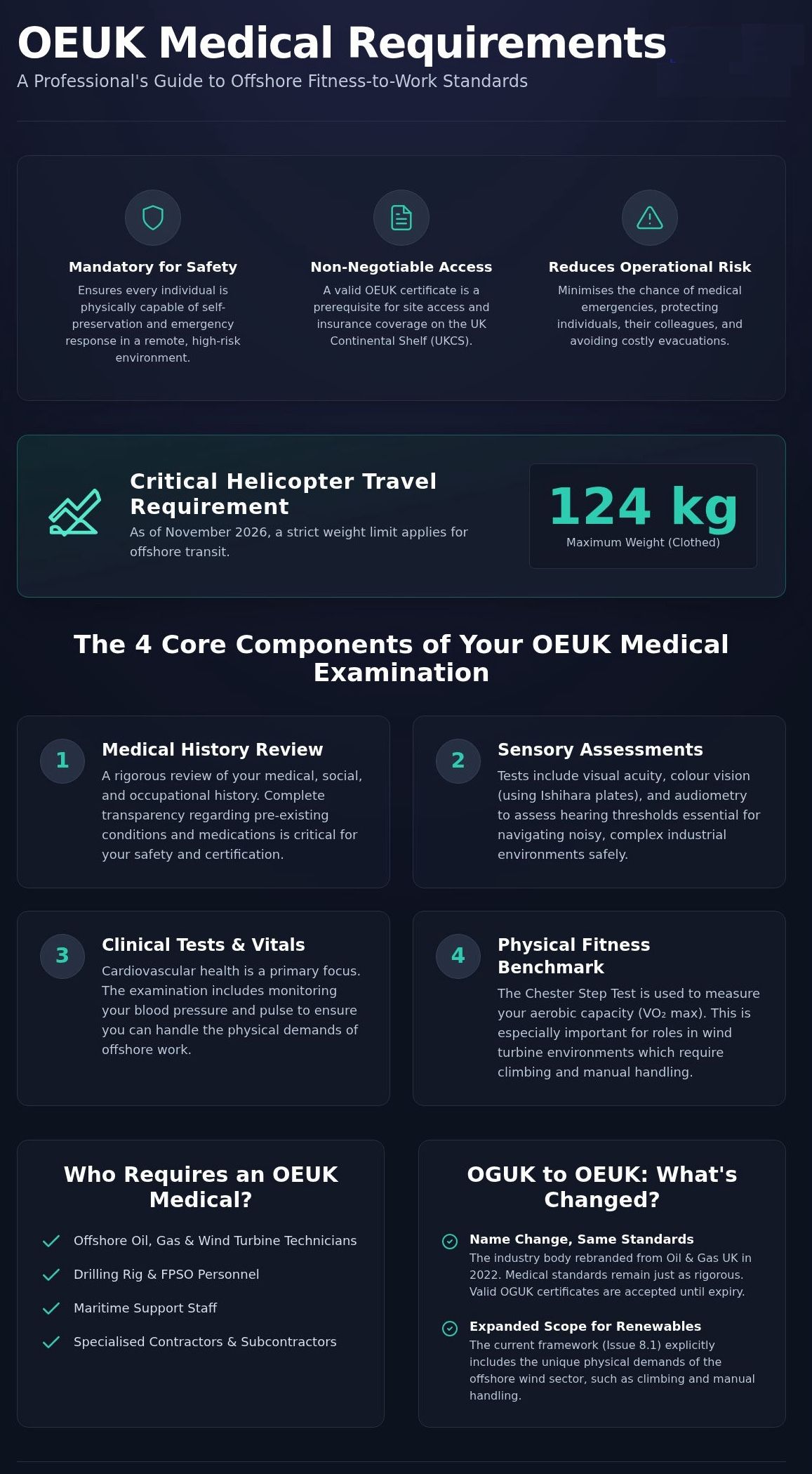
As of November 2026, weighing over 124 kg whilst clothed means you cannot travel by helicopter to an offshore installation or receive a certificate, regardless of your technical skill. For many Belfast workers, the fear of failing an assessment and losing a hard-earned job offer is a significant source of stress. Understanding the specific OEUK medical requirements is no longer just an administrative task; it's a critical component of your professional safety and career longevity in the offshore energy sector.
We understand that the shift from OGUK to OEUK terminology has created uncertainty, particularly regarding the latest fitness benchmarks and clinical expectations. Building on our previous analysis of offshore safety standards, this guide provides a professional breakdown of the current Issue 8.1 guidelines. You'll gain a clear insight into the required clinical tests and practical methods to prepare for your assessment, ensuring you can secure your certificate for offshore deployment with total confidence.
Key Takeaways
- Understand why the OEUK (formerly OGUK) medical is the mandatory fitness standard for offshore energy roles and how it impacts your site access and insurance.
- Learn the specific components of the clinical assessment, including medical history reviews and the physical benchmarks used to determine your fitness to work.
- Master the OEUK medical requirements related to the Chester Step Test to ensure your aerobic capacity meets the VO2 Max standards required for wind turbine environments.
- Discover how current Issue 8.1 guidelines regarding weight limits and BMI can affect your certificate validity and helicopter travel eligibility.
- Identify how to streamline your deployment by organising your medical examination alongside accredited GWO or IRATA training at our Belfast facility.
Table of Contents
- What are OEUK Medical Requirements and Why Do They Matter?
- The Components of an OEUK Medical Examination
- Physical Fitness Benchmarks: The Chester Step Test
- Understanding Certificate Validity and Restricted Status
- Organising Your OEUK Medical in Belfast
What are OEUK Medical Requirements and Why Do They Matter?
The offshore environment is unforgiving. Unlike onshore facilities where emergency services are minutes away, offshore assets require every individual to be physically capable of self-preservation and emergency response. This is the foundation of the OEUK medical requirements. These standards ensure that personnel working on the UK Continental Shelf (UKCS) don't have underlying health conditions that could lead to a medical emergency in a remote location. When you're miles out at sea, a manageable health issue onshore can quickly become a life-threatening crisis for you and a logistical nightmare for the operator.
From a commercial perspective, this certification is a non-negotiable requirement for site access and insurance coverage. Asset owners and operators cannot permit individuals on-site without a valid certificate. It protects the individual, their colleagues, and the commercial viability of the project by reducing the risk of costly medical evacuations. The guidelines are set by Offshore Energies UK (OEUK), the trade body responsible for upholding safety and operational excellence across the energy sector. By adhering to these benchmarks, the industry maintains a high level of safety and reliability across all UKCS operations.
The Transition from OGUK to OEUK
In 2022, the industry body formerly known as Oil & Gas UK rebranded to reflect the shifting energy landscape. Whilst the name changed, the rigorous medical standards remained consistent. If you still hold a valid OGUK certificate, it remains acceptable until its expiry date. The current framework, specifically Issue 8.1, now explicitly accounts for the unique demands of the offshore wind and renewables sector. This evolution ensures that technicians are fit for the specific physical challenges of turbine environments, where climbing and manual handling are daily requirements.
Who Requires an OEUK Medical?
Compliance isn't optional for those deployed to oil and gas platforms, drilling rigs, or FPSOs. However, the scope has expanded significantly. Offshore wind turbine technicians, maritime support staff, and even specialised contractors must meet these benchmarks. Whether you are undergoing industrial training for rope access or preparing for a long-term maintenance contract, meeting the OEUK medical requirements is a prerequisite for any deployment. Subcontractors must ensure their entire team is compliant to avoid being turned away at the heliport or quay. It acts as a professional passport, proving you are medically fit to handle the rigours of the job.
The role of these medicals in maintaining safety across the UKCS cannot be overstated. By filtering for conditions like uncontrolled hypertension or significant cardiovascular issues, the industry maintains a safer working environment for everyone. It's about ensuring you can handle the physical strain of climbing vertical ladders or navigating confined spaces during an emergency. This proactive approach to health is what keeps the offshore industry moving safely and efficiently.
The Components of an OEUK Medical Examination
The examination begins with a rigorous review of your medical, social, and occupational history. This phase is critical for identifying potential risks that might not be immediately apparent during physical testing. You must be entirely transparent regarding pre-existing conditions and current medications. Withholding information doesn't just jeopardise your certificate; it puts your life at risk during high-stakes operations like advanced rescue scenarios. Being honest allows the examiner to provide support or suggest management strategies that keep you deployable.
Visual acuity and colour vision are assessed to ensure you can safely navigate complex industrial environments. For safety-critical roles, failing a colour vision test using Ishihara plates can be a major hurdle, especially for those working with electrical systems or complex control panels. Audiometry is also performed to check hearing thresholds. Offshore environments are notoriously noisy; you must be able to hear emergency alarms and verbal instructions over the hum of machinery. If you already use hearing protection or aids, these will be factored into your assessment to ensure compliance with OEUK medical requirements.
Clinical Tests and Vital Signs
Cardiovascular health is a primary focus of the OEUK medical requirements. We monitor your blood pressure and pulse to ensure you can handle the physical stressors of offshore life. A reading under 140/90 is the standard benchmark. If your blood pressure exceeds 180/120, no certificate will be issued until the condition is medically managed and stabilised. Urinalysis is also conducted to screen for indicators of underlying issues like diabetes or kidney dysfunction, which could lead to sudden illness whilst on a remote asset.
Body Mass Index (BMI) and weight are assessed with increasing scrutiny. Under the OEUK Medical Guidelines, a BMI of 40 or higher triggers a mandatory mobility assessment. This involves walking 550 metres in under six minutes without stopping. These standards are designed to ensure that every individual can effectively self-evacuate during an emergency. If you're concerned about your current health metrics, booking a professional occupational health screening can help identify potential issues before your official assessment.
Respiratory and Physical Assessments
Lung function is measured through spirometry, which assesses your capacity to work in confined spaces or use respiratory protective equipment. This is particularly relevant for those involved in industrial painting or blade repair where chemical exposure is a risk. A basic physical exam then checks your reflexes, coordination, and general musculoskeletal health. You must demonstrate the mobility required to climb vertical ladders and navigate tight spaces safely. Your lifestyle choices, such as smoking, directly impact these results by reducing lung capacity and increasing cardiovascular strain.
Physical Fitness Benchmarks: The Chester Step Test
The Chester Step Test is often the most daunting part of the medical for many technicians. It isn't a test of speed; it's a measure of aerobic capacity, specifically your VO2 Max. In an offshore emergency, your ability to sustain physical effort whilst wearing heavy PPE can be the difference between a safe evacuation and a medical incident. This fitness benchmark aligns with OEUK medical requirements and broader safety standards, including the HSE guidance on offshore first aid, which emphasises the need for personnel to be capable of assisting in their own rescue.
The Mechanics of the Test
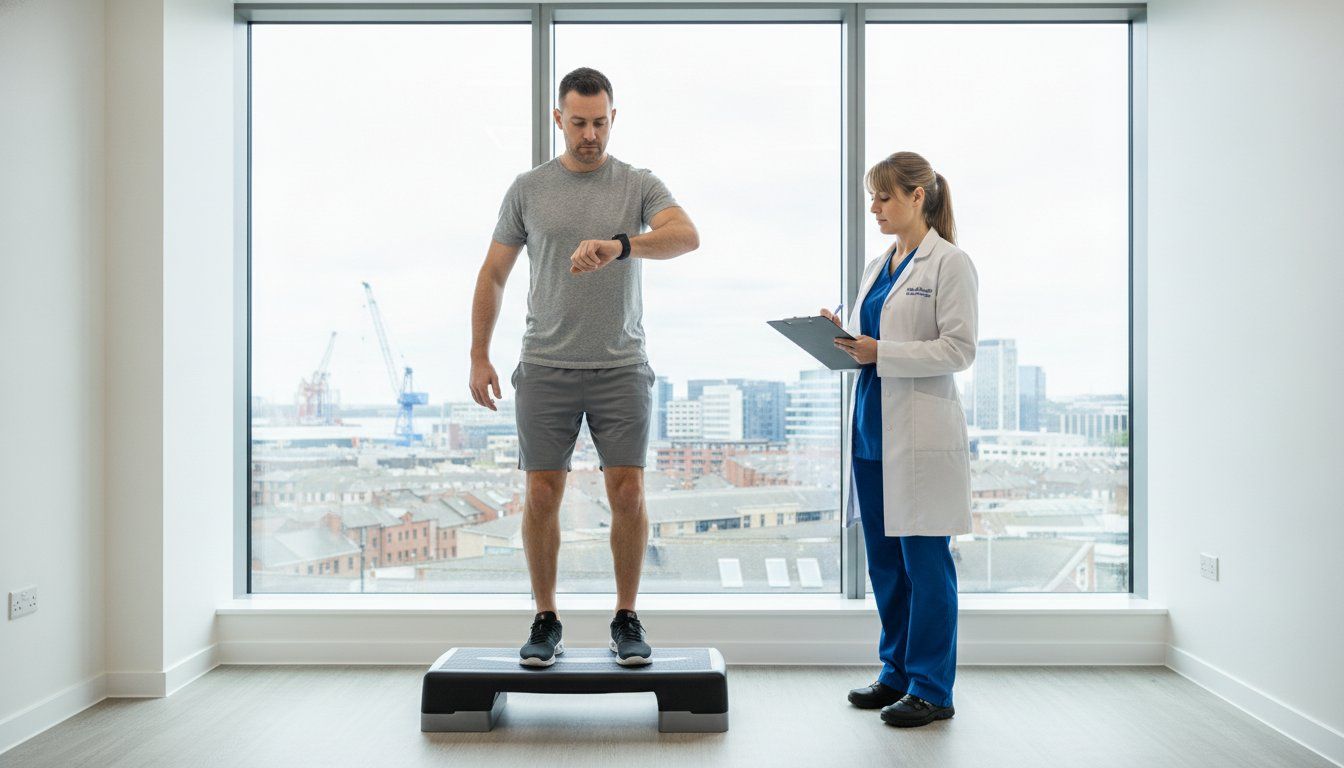
During the assessment, you step onto and off a sturdy bench at a steady rate set by a metronome. Every two minutes, the tempo increases. The examiner monitors your heart rate throughout the process to predict your maximum oxygen uptake based on how your heart responds to increasing intensity. The step height varies between 15cm and 30cm depending on your age and fitness level. Consistency and heart rate recovery are the primary metrics measured here.
| Personnel Category | Minimum VO2 Max Requirement (ml/kg/min) |
|---|---|
| Standard Offshore Workers | 33.8 |
| Emergency Response Team (ERT) - Men | 35.0 |
| Emergency Response Team (ERT) - Women | 33.0 |
Preparing for the Assessment
Improving your aerobic capacity doesn't happen overnight. We recommend a structured programme of cardiovascular exercise, such as interval training or incline walking, for at least six weeks prior to your medical. This preparation is particularly vital for those undertaking GWO training, where the physical demands of the course mirror the intensity of the step test. If you fail the fitness portion but pass the clinical exam, you may be issued a restricted certificate, which can limit your deployment options until a retest is successfully completed.
Offshore Wind vs Oil and Gas Fitness
The transition to renewables has changed the physical profile of the offshore worker. Wind turbine technicians frequently face more rigorous fitness scrutiny than their oil and gas counterparts due to the sheer volume of vertical ladder climbing required. Scaling a 100-metre turbine transition piece requires significant lower-body strength and cardiovascular endurance. These OEUK medical requirements ensure you have the stamina for GWO Advanced Rescue Training (ART), where you may need to haul a casualty through a narrow hub or nacelle. Managing fatigue is a safety skill in itself; a fit technician makes fewer errors in high-risk environments.
Understanding Certificate Validity and Restricted Status
A common misconception amongst technicians is that the medical is a simple binary pass or fail. In reality, the outcome is a professional assessment of your suitability for specific offshore environments. Under standard OEUK medical requirements, a certificate is typically valid for two years. However, this duration is at the discretion of the examining physician. If you have underlying health concerns that require closer monitoring, such as borderline hypertension, the doctor may issue a certificate valid for only six or twelve months to ensure your condition remains stable.
Receiving a "Restricted" certificate isn't a career-ending event, but it does require careful management. A restriction might specify that you cannot participate in Emergency Response Teams (ERT) or that you are restricted from certain high-intensity tasks. This status is often a temporary measure whilst you address specific health issues. If you are declared "Temporarily Unfit," it usually means a clinical finding, such as a blood pressure reading above 180/120, requires immediate GP intervention. You can appeal or re-test once the underlying issue is controlled and documented by your primary care provider.
Managing Pre-existing Conditions Offshore
Conditions like asthma or hypertension don't automatically disqualify you from offshore work. The examiner assesses how well these conditions are managed and whether they pose a risk during remote deployment. Workers on long-term medication must provide evidence of stability. For instance, an asthmatic technician needs to demonstrate that their condition is well-controlled and hasn't required hospitalisation recently. The doctor acts as a safety consultant, ensuring your medical regime is compatible with the rigours of the UKCS environment.
Role-Specific Medical Considerations
The physical demands vary significantly between roles. A technician starting their IRATA Rope Access Level 1 training faces different cardiovascular stressors than a site supervisor. Similarly, confined space entry requires a specific focus on respiratory health and the absence of claustrophobia. There is also a direct link between your medical fitness and First Aid at Work responsibilities; you cannot effectively assist a colleague in a rescue if your own health is compromised.
If you're unsure how your current health status aligns with industry standards, we recommend booking a professional occupational health screening to identify any potential restrictions before your deployment date.
Organising Your OEUK Medical in Belfast
For many Northern Ireland workers, the logistical burden of travelling to Great Britain for offshore certifications is a significant hurdle. Organising your assessment locally in Belfast eliminates unnecessary travel costs and reduces the time away from work or family. Choosing a facility that understands the specific OEUK medical requirements and the local industrial landscape ensures a smoother transition from the clinic to the site. Whether you're based in the city or travelling from the Republic of Ireland, having a central hub for medical compliance is a major professional advantage.
One of the most efficient ways to manage your deployment is to bundle your medical examination with your industrial training. This integrated approach allows you to complete your GWO or IRATA certifications and your occupational health screening in a single visit. When you attend your appointment, you must bring valid photographic identification, such as a passport or driving licence, and a comprehensive summary of your medical history. Arriving prepared prevents delays and ensures the examining doctor has all the necessary data to issue your certificate promptly.
The Dangle Academy Advantage
We provide more than just a clinical checklist. Our team combines real-world site experience in wind turbine maintenance and rope access with accredited medical screening. This means our examiners understand the physical realities of climbing a transition piece or performing a mid-rope rescue. By choosing our Belfast facility, you gain access to experts who can offer practical advice on maintaining your health for long-term career progression. This local expertise is particularly valuable for technicians completing our unique 5-day IRATA training followed by a day 6 assessment.
Final Checklist Before You Attend
Your actions in the 24 hours leading up to the exam can directly influence your results. To ensure an accurate audiometry test, you must avoid exposure to loud noises for at least 16 hours before your appointment. Similarly, avoid caffeine and energy drinks, as these can artificially elevate your heart rate and blood pressure, potentially complicating your OEUK medical requirements during the Chester Step Test. We recommend wearing comfortable gym clothing and trainers suitable for physical exertion. Ensure you have a clear list of any current medications, including dosages and the reasons for their prescription, to facilitate a thorough review.
Secure Your Offshore Career with Professional Medical Certification
Mastering the OEUK medical requirements is the definitive step toward ensuring your safety and compliance on the UK Continental Shelf. By addressing clinical standards and physical benchmarks like the Chester Step Test early, you eliminate the risk of last-minute deployment delays. This professional readiness protects your health and your commercial standing within the offshore energy sector.
Dangle Academy offers a local, expert-led solution for Northern Ireland workers. Our Belfast-based Occupational Health Centre features accredited OEUK Medical Examiners who understand the physical demands of high-risk environments. We are a trusted partner for IRATA and GWO technicians, providing integrated services that combine medical screening with industrial training excellence.
Take the next step in your professional progression today. Book your OEUK Medical in Belfast with Dangle Academy and secure your valid certificate with confidence. We look forward to supporting your continued success in the offshore energy industry.
Frequently Asked Questions
How long does an OEUK medical take?
A standard examination usually takes between 45 and 60 minutes, depending on the complexity of your medical history and whether additional tests like the Chester Step Test are required.
Can I book my medical alongside my IRATA or GWO course?
Yes. We specialise in integrating occupational health screening with our training schedules in Belfast to save technicians time and travel expenses.
Do I need a "Fit to Train" certificate separately?
If you are undertaking in-water survival training, such as BOSIET, you will require a "Fit to Train" certificate. This is often completed during the same appointment as your main OEUK medical.
How long does an OEUK medical certificate last?
A standard OEUK medical certificate remains valid for a maximum of two years. However, the examining doctor may reduce this period to six or twelve months if they need to monitor specific health conditions like high blood pressure or BMI concerns. Your age can also influence the validity period, as more frequent screening is often required for older personnel to ensure continued fitness for the rigours of offshore work.
Can I fail an OEUK medical if I am a smoker?
Smoking itself is not an automatic cause for failure, but it significantly impacts the clinical results required for a pass. Smoking reduces lung capacity and increases cardiovascular strain, which can lead to poor performance in spirometry and the Chester Step Test. If your respiratory or aerobic capacity falls below the minimum safety benchmarks due to long-term tobacco use, you may be declared unfit or receive a restricted certificate.
What is the difference between an OGUK and an OEUK medical?
There's no functional difference between the two assessments; OEUK is simply the rebranded name for what was formerly the OGUK medical. The industry body changed its name to Offshore Energies UK in 2022 to better represent the inclusion of renewable energy sources. Existing OGUK certificates remain valid until their stated expiry date, after which you must renew under the current OEUK medical requirements.
Do I need a separate medical for offshore wind and oil and gas?
You don't need separate medicals for different offshore sectors, as the OEUK standard is accepted across oil, gas, and renewable energy assets. One certificate covers your fitness for both drilling rigs and wind farms. However, if you're undertaking specific survival training like BOSIET, you'll also require a "Fit to Train" certificate, which is a separate document typically issued during the same appointment.
What happens if I fail the Chester Step Test?
Failing the Chester Step Test usually results in a "Restricted" or "Temporarily Unfit" status rather than a permanent ban from offshore work. This outcome prevents you from joining Emergency Response Teams or performing high-intensity tasks until your aerobic capacity improves. Most technicians use this time to follow a cardiovascular training programme before booking a retest to demonstrate they meet the necessary VO2 Max benchmarks.
Can I get an OEUK medical if I have a pre-existing heart condition?
You can still obtain a certificate with a pre-existing heart condition, provided it's well-managed and documented by your specialist or GP. The examiner will assess the risk of a sudden cardiac event whilst you're in a remote offshore location. You may be issued a restricted certificate that limits your duties or requires more frequent medical reviews to ensure your condition remains stable under operational stress.
Is drug and alcohol testing included in the OEUK medical?
Drug and alcohol testing is not a mandatory part of the standard OEUK clinical examination, but many offshore operators require it as a supplementary test. At Dangle Academy, we often combine these screenings to ensure you meet all OEUK medical requirements and specific company policies in one visit. It's always best to check with your employer or recruitment agency if they require a verified laboratory screen alongside your medical.
How much does an OEUK medical cost in Belfast?
The cost of an OEUK medical in Belfast varies depending on whether you require additional assessments like the Chester Step Test or drug and alcohol screening. Prices are also influenced by whether the medical is bundled with industrial training courses. For the most accurate and current pricing for our Belfast facility, we recommend contacting our team directly to discuss your specific certification needs and any combined training packages.
Contact Us
We'd Love a Share...
Recent Blog Posts