Harness Inspection Training

Harness Inspection Training Belfast: Professional Courses
Harness inspection training helps workers recognise damage, follow manufacturers' instructions and record their findings. A course certificate supports learning, but competence also depends on relevant knowledge, practical skills and experience.
This guide explains the difference between a pre-use check and a detailed inspection. It also covers what to look for in a course and how employers can manage fall protection equipment.
Key Takeaways
- Check equipment before use and follow the planned inspection regime.
- A competent inspector needs knowledge and practical experience of the equipment.
- Inspection intervals depend on use, site conditions and manufacturers' guidance.
- Record findings and remove suspect equipment from service.
- Confirm that your course covers the equipment and responsibilities required by your employer.
The Critical Role of Professional Harness Inspection in Industrial Safety
Harnesses, lanyards and connectors are important parts of a fall protection system. Wear, contamination and damage can affect their condition. Inspection helps identify problems before equipment is used.
Site conditions matter. Equipment used around salt, grit, heat or chemicals may need closer monitoring. A serviceable appearance alone does not prove that an item is safe.
Understanding the Risks of Non-Compliant Equipment
Check equipment identification, age and service history. If the history is missing, or there is doubt about its condition, keep it out of use until a competent person has assessed it.
Follow the manufacturer's cleaning, storage and retirement instructions. Do not make an unapproved repair or assume that cleaning will remove all effects of contamination.
The Distinction Between User Checks and Formal Inspections
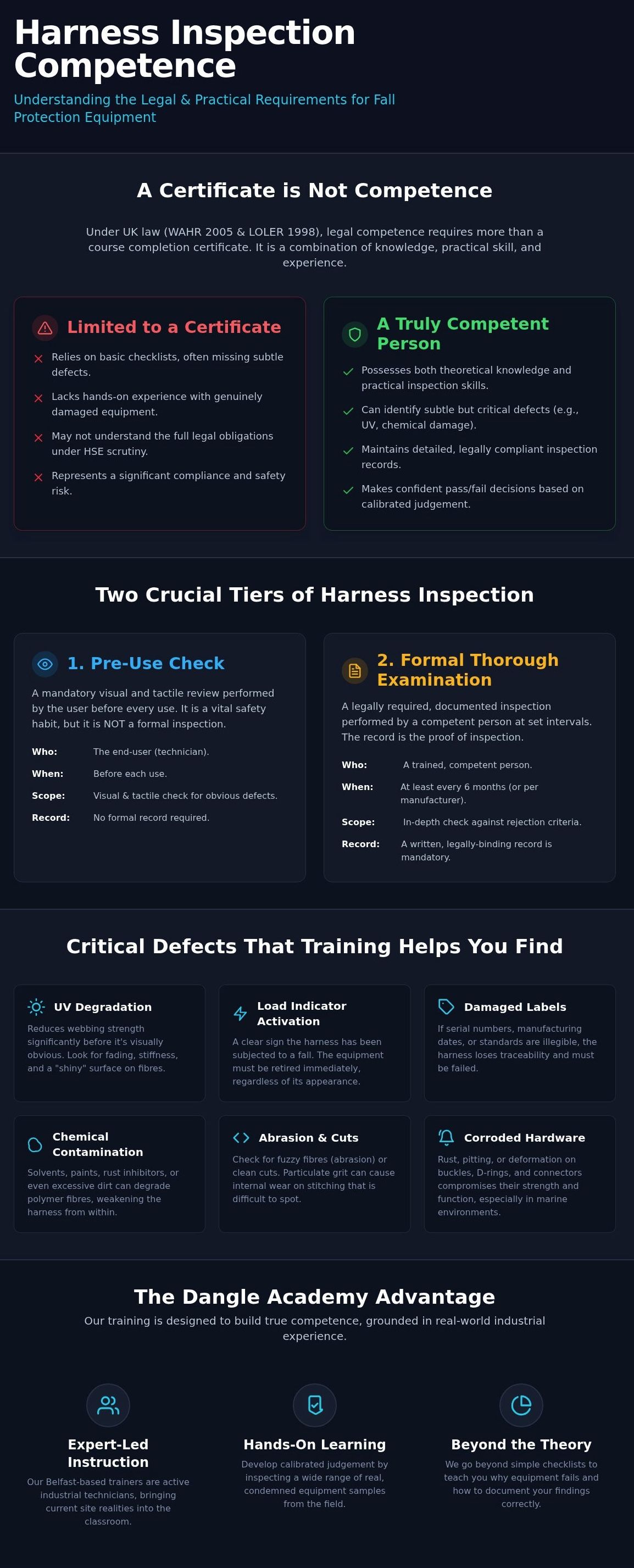
A pre-use check is carried out before using the equipment. It includes a visual and tactile check of webbing, stitching, buckles, connectors and any fall indicators.
A detailed inspection is a separate, planned check by a competent person. Interim inspections may also be needed after heavy use or unusual exposure. These checks complement one another.
Defining Competence: What Professional Harness Inspection Training Covers
Training should explain the equipment's design, inspection method and rejection criteria. Delegates also need practice identifying defects and deciding what action to take.
Employers must ensure that inspectors are competent for the specific equipment and task. Completing a general awareness course does not automatically qualify someone to carry out every type of detailed inspection.
Technical Syllabus: Textiles, Hardware, and Stitching
- Webbing: cuts, abrasion, burns, unusual stiffness and signs of contamination.
- Stitching: broken threads, pulled stitches and changes in the load-bearing stitch pattern.
- Hardware: corrosion, distortion, cracks and problems with buckles or connector gates.
- Identification: labels, serial numbers, age and traceable inspection records.
Use the manufacturer's criteria for the exact model. An inspector should know when to seek advice and when an item must be withdrawn.
The Inspection Process: A Methodical Approach
Work in good light on a clean surface. Examine each component in a consistent order so that no part is missed. Compare findings with the manufacturer's instructions and the equipment history.
Record the item identifier, inspection date, findings, action taken and inspector details. Paper and digital records can both support traceability if they are complete and accessible.
Explore Dangle Academy's training programmes to discuss learning that fits your team's equipment and duties.
Statutory Requirements: LOLER and the Legal Framework for Fall Protection
Work at height, work equipment and PPE duties all matter when managing fall protection equipment. Northern Ireland has its own regulations and regulator, HSENI. Employers should identify the rules that apply to their work.
LOLER applies to lifting equipment and lifting operations. Its scope depends on how equipment is used. Do not assume that every fall arrest harness has the same legal status simply because it is worn at height.
The 6-Month Rule and Thorough Examination
Set inspection intervals using the manufacturer's instructions, the risk assessment and relevant industry guidance. HSE guidance for webbing and rope fall arrest equipment recommends detailed inspections at least every six months, with shorter intervals for arduous use.
Where LOLER applies, equipment used to lift people normally requires thorough examination every six months, or under a written examination scheme. This is separate from routine pre-use checks.
Withdraw equipment after a fall arrest event or whenever its safety is in doubt. Follow the manufacturer's instructions for inspection, retirement or disposal before any further use.
Review the scope of our harness inspection training before booking. Ask which inspection responsibilities the course covers.
Traceability and Equipment Marking
Link each item to a clear equipment record. Keep identification, purchase and service information, manufacturers' instructions and inspection findings together.
If markings cannot be read or the history is uncertain, seek competent advice. Digital tags can help manage records, but they do not replace the inspection itself.
For help with wider site requirements, view our inspection and safety consultancy services.
Selecting the Right Course: Classroom Theory vs. Practical Site-Based Training
Look beyond the course title. Check whether training covers pre-use checks, detailed inspections or both. The syllabus should match the equipment and responsibilities used at your workplace.
Practical sessions help delegates compare serviceable equipment with examples of damage. Ask how the provider assesses inspection skills and records the outcome.
The Limitations of Online-Only Certification
Online learning can explain regulations, terminology and inspection principles. Practical inspection also requires hands-on skills, such as checking webbing and operating buckles and connectors.
Choose a course that gives delegates enough practice with relevant equipment. A course's duration or delivery format alone does not establish competence.
Employers should assess whether a delegate can apply what they have learned. Consider their experience, the equipment involved and any need for further supervised practice.
Integrating Inspection Training with Other Certifications
Inspection knowledge can support technicians working towards Rope Access Level 1 certification. It helps them understand equipment checks, but does not replace the training or assessment required by IRATA.
Wind technicians may also need GWO Basic Safety Training. BST develops core safety skills; detailed equipment inspection is a separate responsibility. Confirm your employer's requirements for both.
For teams managing a large equipment inventory, trained staff can support inspection planning and record keeping. Employers must ensure that anyone appointed to inspect equipment has the relevant competence.
Review Dangle Academy's training programmes to choose courses that fit your team's roles and current qualifications.
Expert-Led Harness Training at Dangle Academy: The Belfast Advantage
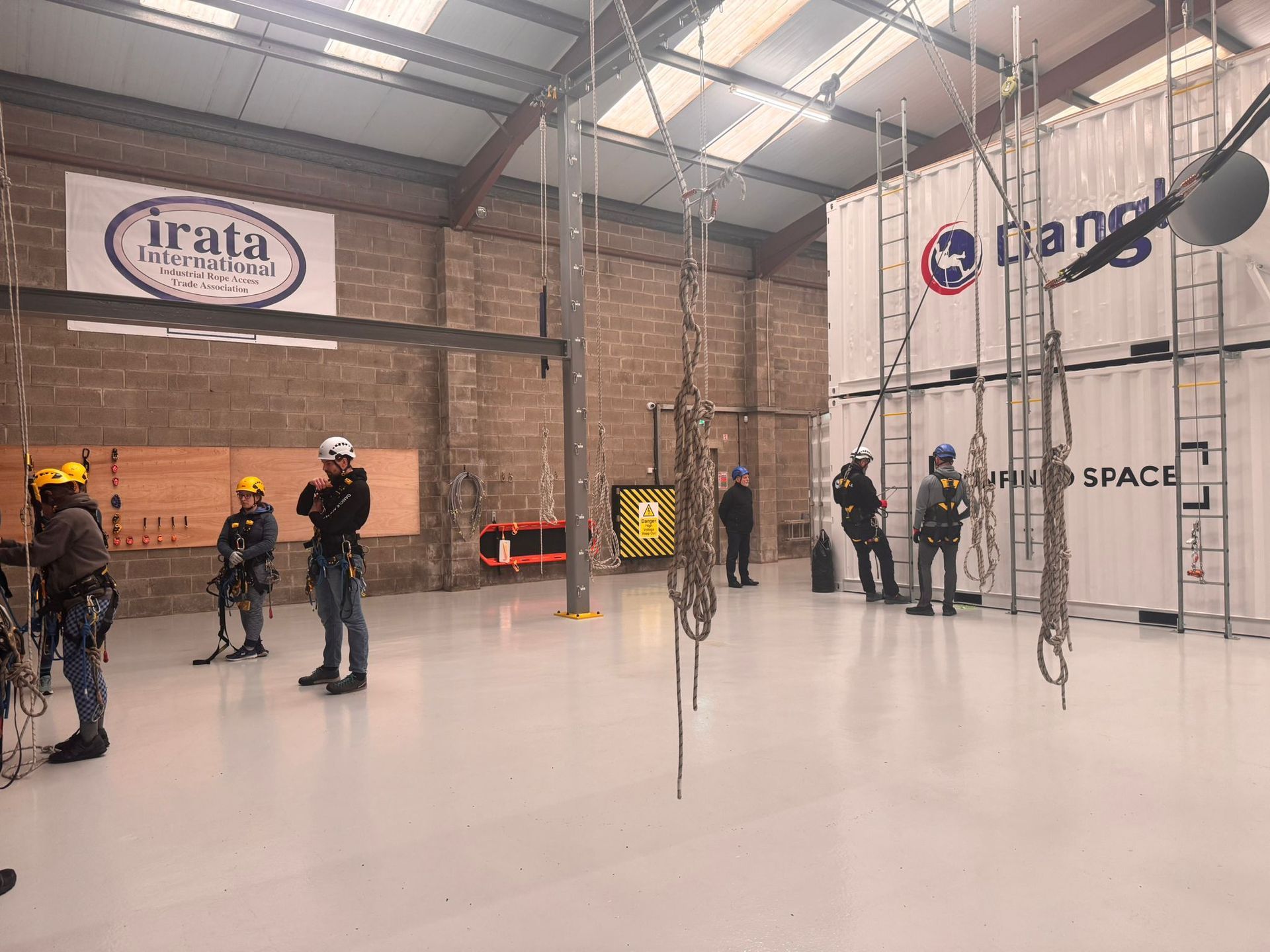
Dangle Academy provides training from Belfast, drawing on practical industrial work. Our centre supports hands-on learning and discussion of equipment used on site.
Work carried out by Dangle's site services division helps inform our approach to access and safety. Ask our team how the available course relates to your equipment and inspection duties.
Learning from Industry Veterans
Bring questions about your own site conditions, inspection regime and record keeping. Clear examples help tutors explain how course principles apply to everyday work.
Other practical training options include Rope Access Level 1 and GWO Advanced Rescue Training. Each programme has its own entry requirements, syllabus and assessment. The IRATA day-six assessment format does not apply automatically to other courses.
Booking Your Training in Belfast
We welcome individual delegates and employer teams from Northern Ireland and the Republic of Ireland. Check the current course scope, duration, availability and assessment details before booking.
View Dangle Academy's full range of training courses to find the option relevant to your work. If you need formal inspection competence rather than harness-user awareness, discuss that requirement with our team first.
Take the Next Step Towards Documented Competence
Effective equipment management combines trained people, planned checks and clear records. A certificate is one part of that system; employers remain responsible for appointing competent people and following the inspection regime.
Book your harness inspection training at Dangle Academy today. Confirm the course scope and entry requirements so that your booking fits your role.
Frequently Asked Questions About Harness Inspection Training
What is the legal definition of a "competent person" for harness inspections?
A competent inspector needs relevant knowledge, practical skills and experience of the equipment. They must recognise defects, understand their significance and know what action to take. A certificate alone does not establish competence; employers must assess the person for the specific inspection role.Under the Work at Height Regulations 2005 and LOLER 1998, a competent person is someone with sufficient practical and theoretical knowledge, experience, and skill to detect defects or weaknesses in fall protection equipment and assess their significance. There's no single qualification that automatically confers this status. Competence is judged against what a person can actually demonstrate, not what certificate they hold.
This means an employer must be able to evidence that their designated inspector understands rejection criteria, can apply them under real inspection conditions, and produces documentation that meets the statutory standard. A short awareness course doesn't satisfy that test. Structured harness inspection training that includes practical, assessed examination does.
How often must a safety harness be formally inspected in the UK?
Set intervals using the manufacturer’s instructions, risk assessment and relevant guidance. HSE recommends detailed inspections of webbing and rope fall arrest equipment at least every six months, with shorter intervals for arduous use. Where LOLER applies, its examination requirements also apply. Pre-use checks remain separate.Under LOLER 1998, full body harnesses classified as lifting accessories used to support a person must undergo thorough examination at intervals not exceeding six months. This is a statutory minimum, not a guideline. Manufacturers may specify shorter intervals depending on the equipment type and operating environment, and those requirements take precedence where they're more stringent.
Certain events also trigger an immediate unscheduled inspection before the equipment returns to service. These include any fall arrest event, exposure to chemicals or extreme environmental conditions, and any change of custodian where the full inspection history can't be verified. The six-month clock resets from the date of each completed, documented examination.
Does a harness inspection training certificate expire?
Validity and refresher requirements depend on the course and awarding scheme. Check your certificate and provider’s guidance. Employers should also review practical competence when equipment changes or a worker has been away from inspection duties.Most accredited harness inspection qualifications carry a defined validity period, typically three years, after which a refresher or renewal assessment is required to maintain recognised competence. The specific interval depends on the awarding body. Employers should treat expiry dates as hard deadlines rather than administrative formalities, because an inspector operating on an expired certificate has no documented basis for competence if an incident triggers an HSE investigation.
Beyond formal renewal, inspectors should also consider whether their practical knowledge remains current. Changes to EN standards, new equipment types entering service, or extended periods away from inspection duties can all erode the calibrated judgement that certificated training is designed to establish.
Can I perform my own harness inspections after completing this course?
Only if you are competent for the equipment and inspection task, and your employer has authorised that role. Check whether the course covers user checks or detailed inspections. Further experience, supervised practice or specialist training may be needed.Yes, provided the training you've completed equips you with the knowledge and practical skill that the competent person standard requires, and your employer formally designates you in that role. Completing an accredited harness inspection training course is the foundation, but the employer retains the legal responsibility for ensuring the person they appoint genuinely meets the competence threshold for the equipment types and environments in question.
In practice, this means your training must have included hands-on assessment with real equipment, not just theory. You must also be able to produce inspection records that satisfy the documentation standard under LOLER. If your course didn't include practical examination and assessed record-keeping, it's unlikely to support a defensible competence claim.
What is the difference between a pre-use check and a thorough examination?
A pre-use check reviews equipment before it is used. A detailed inspection or, where required, a LOLER thorough examination is a separate planned assessment by a competent person. It has its own scope, interval and record requirements. One does not replace the other.A pre-use check is a visual and tactile review carried out by the operative before each use. It covers obvious defects in webbing, stitching, buckles, and connectors, and it's mandatory, but it has no legal standing as a formal inspection. It doesn't generate a statutory record and doesn't reset the thorough examination interval.
A thorough examination is a structured assessment conducted by a competent person at the intervals required by LOLER, with written findings recorded against the specific equipment's unique identifier. The documentation is legally inseparable from the inspection itself. Without it, the examination hasn't occurred in any sense that matters to the HSE or a duty holder's legal defence.
What happens if a harness fails an inspection?
Remove it from service and prevent accidental reuse. Record the defect and action taken. Follow the manufacturer’s instructions for retirement, disposal or authorised repair; do not return suspect equipment to use without a competent decision.Equipment that fails a thorough examination must be withdrawn from service immediately and clearly marked or segregated to prevent inadvertent reuse. The competent inspector must document the findings, the specific defects identified, and the date of withdrawal. That record becomes part of the equipment's permanent history and must be retained.
Failed equipment should not be repaired unless the manufacturer explicitly permits it and the repair is carried out under their authorised procedure. In most cases, retirement is the only defensible outcome. Attempting to return failed fall arrest equipment to service, or delaying withdrawal whilst awaiting a replacement, creates direct legal liability for the employer and the individual who conducted the inspection.
Is harness inspection training a legal requirement for supervisors?
Responsibilities depend on the task, not the job title. Employers must ensure that people inspecting equipment are competent. A supervisor appointed to inspect harnesses needs the relevant knowledge, skills and experience for that equipment.The legislation doesn't prescribe a specific job title. It requires that thorough examinations are conducted by a competent person, and that employers appoint someone who genuinely meets that standard. Whether that individual holds a supervisory role is secondary to whether they possess the required knowledge and practical skill. A supervisor who signs off inspections without adequate training is personally exposed if those records are scrutinised following an incident.
For supervisors with equipment management responsibilities across a site or workforce, structured training is the most reliable way to establish and evidence that competence. It also protects the employer, because a documented training record from an accredited provider is a far stronger position than a general claim that the supervisor "has experience" with fall protection equipment.
Can I do harness inspection training online?
Online learning can cover theory and inspection principles. Practical inspection also requires hands-on skills. Check how the course assesses those skills and whether its scope meets your employer’s requirements.Online learning can deliver the regulatory context, legislative framework, and theoretical knowledge that underpins harness inspection. What it can't do is assess whether you can physically detect a compromised bar tack, identify heat glazing on nylon webbing, or distinguish a load-indicator activation from normal wear. Those are tactile skills that require hands-on assessment with real equipment under supervised conditions.
For roles where the outcome of a missed defect is a fatality, e-learning alone doesn't satisfy the competent person standard. Sectors including offshore wind, telecoms, and rail routinely mandate face-to-face, practically assessed training precisely because of this. If you're considering harness inspection training, prioritise a provider whose programme includes physical examination of real equipment and assessed record-keeping, not just a multiple-choice test at the end of a screen-based module.
Contact Us
We'd Love a Share...
Recent Blog Posts