Abrasive Blasting Training
Abrasive Blasting Training: Mastering Surface Preparation for Industrial Assets
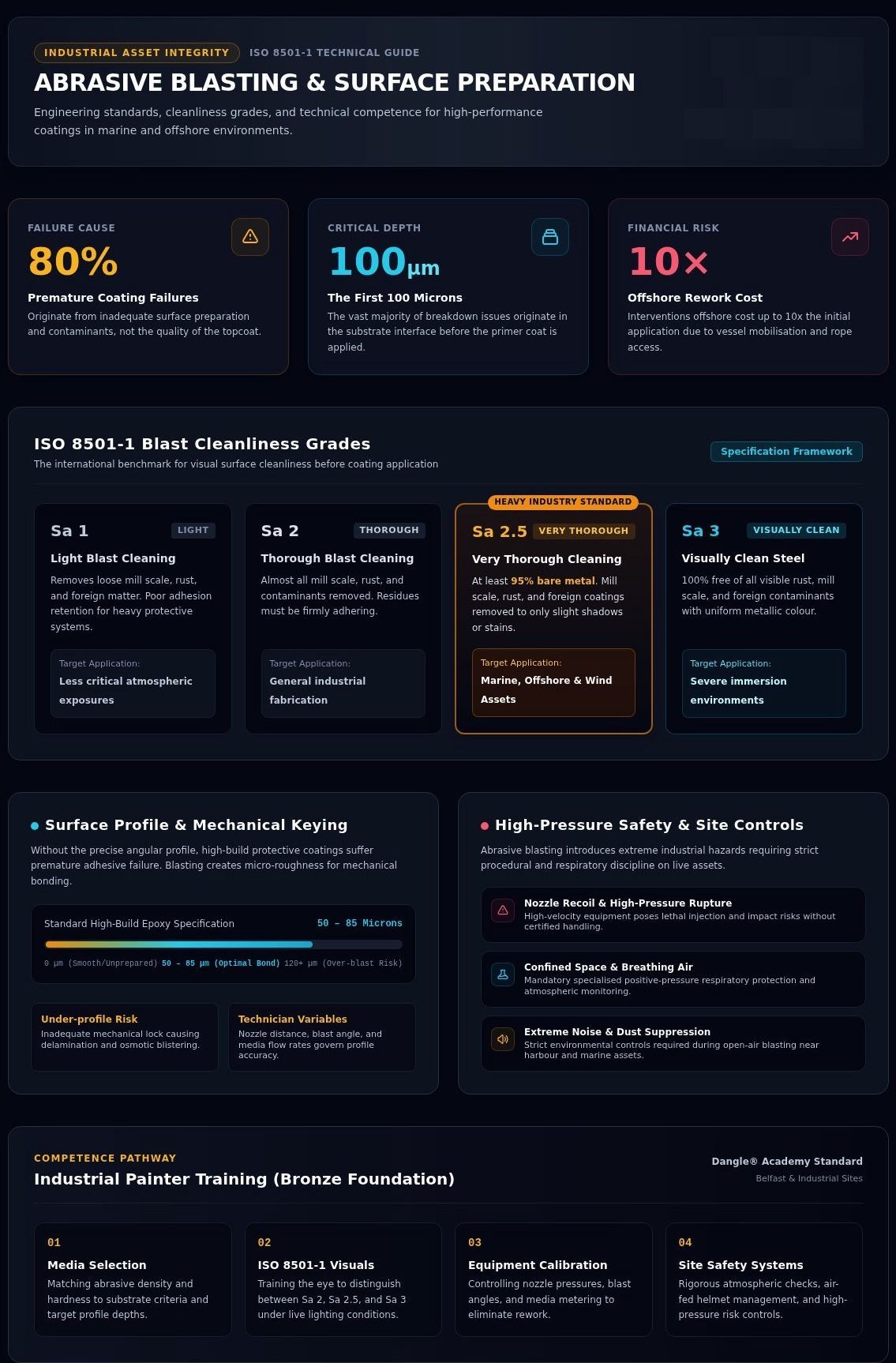
Did you know that roughly 80% of all premature industrial coating failures have nothing to do with the quality of the paint? These costly breakdowns almost always stem from poor surface preparation or invisible contaminants left behind before the first primer coat is applied. In harsh environments like offshore wind farms or marine terminals, there is no room for guesswork when navigating high-pressure equipment and complex ISO 8501-1 cleanliness grades. The physical risks are just as real as the financial ones, with nozzle recoil and extreme noise levels demanding absolute technical precision.
You likely recognise that maintaining asset integrity requires more than just a steady hand; it demands a deep understanding of grit profiles and safety protocols. Abrasive blasting training provides the essential foundation to bridge the gap between basic operation and professional mastery. This expert guide, written by our AMPP (formally NACE) Senior Corrosion Technoligst and ICORR Level 3 who holds professional membership to the UK's Institute of Corrosion, explores how formal competency ensures asset longevity, protects your workforce from serious injury, and keeps your projects compliant with the strictest international standards. We will break down why practical, site-led experience is the only way to transform a high-risk task into a controlled, efficient engineering process.
Key Takeaways
- Understand why the majority of coating failures originate in the first 100 microns of surface preparation and how to create a precise mechanical key for asset longevity.
- Master the visual cleanliness requirements of ISO 8501-1 through accredited abrasive blasting training, ensuring compliance with international industrial standards.
- Recognise the lethal potential of high-pressure equipment and why specialised respiratory protection is mandatory for safe operations in confined or offshore spaces.
- Explore the professional progression offered by the Industrial Painter Training, covering everything from media selection to site safety.
- Learn the advantage of training delivered by active coatings specialists who bridge the gap between classroom theory and the technical realities of live site operations.
Table of Contents
- The Critical Role of Abrasive Blasting Training in Industrial Asset Integrity
- Technical Standards and Modern Blasting Equipment
- Why Accredited Blasting Training is Non-Negotiable for Safety
- Path to Certification: Industrial Painter Training
- Dangle® Academy: Bridging the Gap Between Training and Site Operations
The Critical Role of Abrasive Blasting Training in Industrial Asset Integrity
Industrial assets operating in the North Sea or Belfast Harbour face some of the most corrosive conditions on earth. It is a common misconception that the quality of the topcoat alone determines the lifespan of these structures. In reality, industry research confirms that up to 80% of premature industrial coating failures are caused by inadequate surface preparation. Most of these issues originate within the first 100 microns of the surface preparation phase, long before the first litre of paint is even opened.
Abrasive blasting is not merely a method for cleaning a surface. It is a highly controlled engineering process used to remove mill scale, rust, and old coatings whilst creating a mechanical 'key'. By utilising various abrasive blasting processes and equipment, technicians ensure the substrate is chemically and physically prepared to bond with high-performance protective systems. In high-stakes environments, 'good enough' is never an acceptable standard; it is a significant commercial risk that leads to rapid asset degradation.
Why Surface Preparation Governs Coating Longevity
The performance of any protective system relies on meeting specific visual cleanliness grades defined by ISO 8501-1. For heavy industrial and marine assets, Sa 2.5 (very thorough blast cleaning) is the standard benchmark. This requires at least 95% of the surface to be bare metal, free of all visible rust and mill scale. If preparation is sub-standard, residual salts and moisture trapped under the paint will lead to osmotic blistering and premature corrosion.
Surface profile is the foundation of any protective coating system. Without the correct angular profile, typically specified between 50 and 85 microns for high-build epoxy paints, the coating will suffer from adhesive failure. Achieving this level of precision consistently requires formal abrasive blasting training to ensure operators understand the complex variables of nozzle distance, blast angle, and media flow rates.
The Commercial Cost of Preparation Errors
In the offshore wind sector, the cost of rework is astronomical compared to the initial investment in correct training. A coating failure on a turbine transition piece (TP) requires vessel mobilisation, specialised rope access teams, and strict weather-dependent windows. These interventions often cost ten times more than the original application. Professional blasting reduces these long-term maintenance cycles by ensuring the coating reaches its full design life.
Operational challenges vary significantly depending on the environment. Blasting in confined spaces requires rigorous atmospheric monitoring, whereas open-air environments demand strict dust suppression. Technicians who undergo the Industrial Painter Training at Dangle® Academy learn to navigate these site-specific risks whilst maintaining the technical standards required for asset integrity. Practical industrial experience remains the only way to manage these variables effectively on a live project.
Technical Standards and Modern Blasting Equipment
Achieving a high-performance finish depends on the synergy between precise international standards and the technical configuration of the blasting system. Whilst the previous section highlighted the importance of surface integrity, the practical execution relies on a technician's ability to interpret ISO 8501-1. This standard serves as the global benchmark for visual surface cleanliness, categorising initial rust grades and defining the required level of preparation before any coating is applied.
Understanding ISO Cleanliness Grades
The ISO 8501-1 standard defines four primary blast cleaning grades: Sa 1, Sa 2, Sa 2.5, and Sa 3. Sa 1 (light blast) is typically reserved for less critical atmospheric exposures where only loose scale is removed. Sa 2.5 (very thorough blast cleaning) remains the industry requirement for heavy industrial, offshore, and marine assets, requiring at least 95% of the surface to be bare metal, including staining. For the most aggressive immersion environments, Sa 3 (blast cleaning to visually clean steel) is often mandated to ensure maximum adhesion, and is often referred to as a "white metal blast". A key part of abrasive blasting training involves training the eye to recognise these subtle differences under site conditions, ensuring compliance with project specifications.
Media Selection and Nozzle Physics
The choice of equipment must be tailored to the specific substrate. Steel often requires aggressive chilled iron grit or almandine garnet to remove heavy corrosion and establish a profile. In contrast, aluminium substrates require softer media, such as glass beads, or even ice pellets to prevent surface warping or metallic contamination. The blast system itself is a complex assembly where the compressor capacity must match the nozzle size to maintain consistent pressure. A #7 nozzle, for example, requires significantly more air volume than a #4 to maintain the 100-120 psi typically needed for efficient production.
Environmental and safety factors also dictate equipment choice. Modern systems often incorporate dust suppression or vacuum recovery to manage respirable crystalline silica (RCS) risks. Proper ventilation is critical in enclosed spaces, as outlined in OSHA standard 1910.94 for abrasive blasting ventilation. Using contaminated or damp media can introduce soluble salts to the substrate, leading to catastrophic coating failure regardless of the blast grade achieved. If you are looking to standardise your team's technical proficiency, reviewing our Industrial Painter Training (Bronze Foundation) at Dangle® Academy is an excellent first step. This ensures every operator understands the of industrial protective coatings on the final asset lifespan.
Why Accredited Blasting Training is Non-Negotiable for Safety
Operating a high-pressure blast nozzle is one of the most physically demanding and potentially hazardous tasks in the industrial sector. A standard #8 nozzle operating at 100 psi generates a continuous reactive thrust of approximately 90 lbf, which can cause rapid operator fatigue and loss of control. A burst hose or a failed coupling is not just a mechanical issue; it is a risk event if the equipment is not fitted with whip checks and secondary safety cables. This is exactly why abrasive blasting training at Dangle® Academy prioritises the mastery of safety interlocks over simple production speed.
The 'Dead Man's Handle' is the most critical safety component in any blasting circuit. This pneumatic or electric switch ensures that if the operator drops the nozzle or becomes incapacitated, the flow of air and abrasive media stops instantly. We often encounter technicians who claim a decade of experience but lack formal certification. Relying on "doing it my way" for years often leads to dangerous shortcuts, such as taping down the safety handle or ignoring worn hose walls. Abrasive blasting training replaces these legacy habits with a disciplined, regulated approach to equipment management.
Mitigating Respiratory and Physical Risks
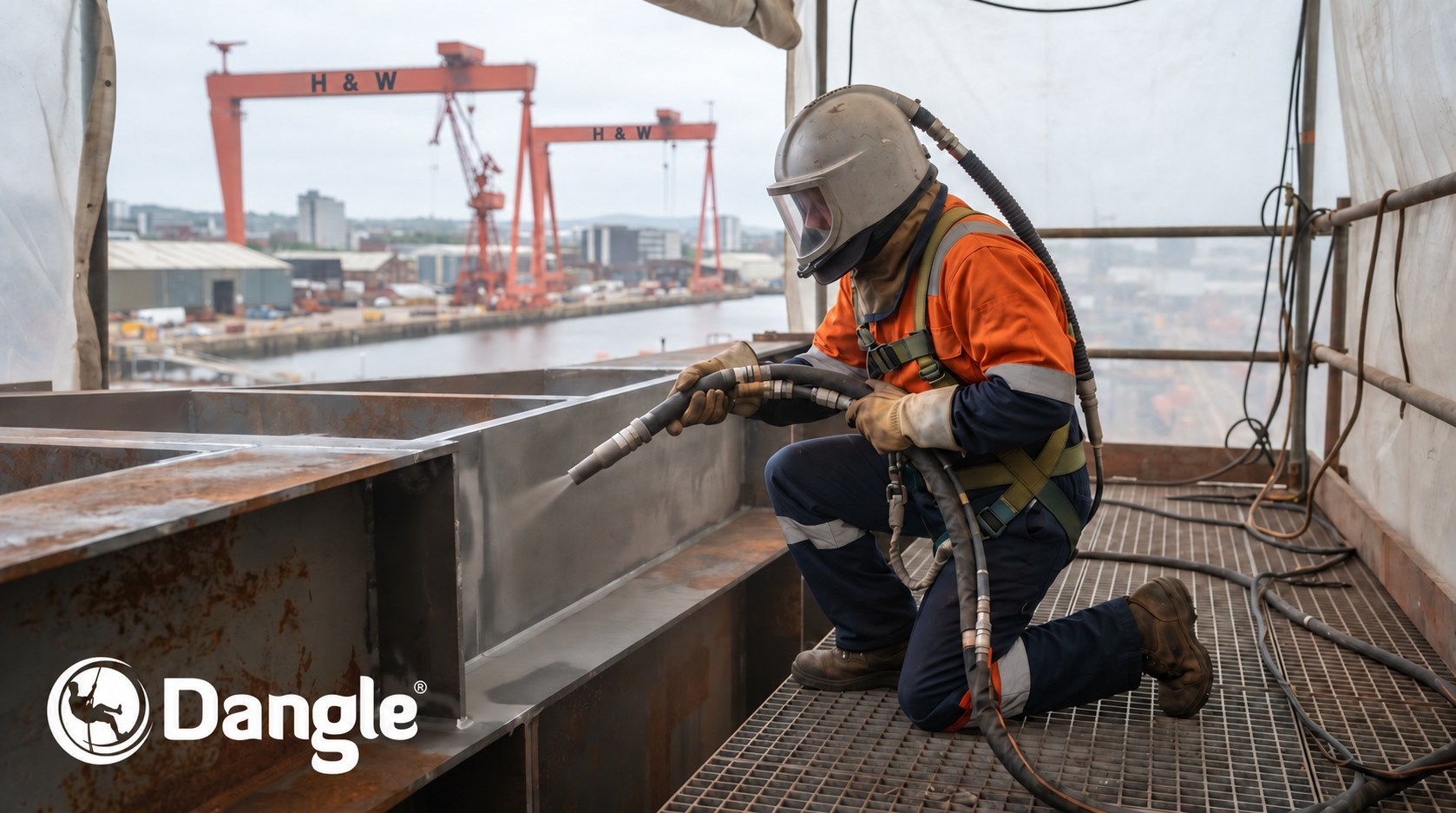
Industrial blasting generates extreme levels of airborne contaminants, including respirable crystalline silica (RCS) and toxic particulates from old lead-based coatings. A standard disposable mask offers zero protection in these environments. Technicians must be equipped with positive-pressure blast helmets that provide a constant flow of grade D breathing air. This air must be regularly tested to meet BS EN 12021 standards for purity. Our commitment to these rigorous safety standards is a cornerstone of our operations, a value we reinforced whilst Dangle® celebrates its first birthday this year. Beyond respiratory health, operators must manage noise levels that frequently exceed 120 dB(A) and the long-term risks of Hand-Arm Vibration Syndrome (HAVS) caused by continuous nozzle recoil.
Regulatory Compliance and the Law
The Health and Safety Executive (HSE) in the UK maintains strict oversight of abrasive blasting operations under the COSHH Regulations. Employers have a legal duty to provide
health surveillance for vibration and noise exposure whilst ensuring all equipment is fit for purpose. Supervisors are tasked with establishing a secure 'blast zone', preventing unauthorised personnel from entering areas where stray abrasive or dust clouds pose a risk. Site managers at major UK ports and energy hubs now demand verified proof of competence before allowing contractors on-site. They increasingly look for technicians who hold recognised credentials, to ensure that safety is treated as a technical discipline rather than an afterthought.
Path to Certification: Industrial Painter Training
Entering the industrial coatings sector requires a structured approach to skill acquisition that goes beyond simple observation. It is no longer acceptable to learn high-risk tasks on the job without formal validation of competence. The Industrial Painter Training programme provides this essential framework. It combines the technical theory of corrosion control with the practical rigour required to operate in heavy industrial environments like shipyards or wind farms.
The curriculum is divided into three core pillars: surface preparation, coating application, and health and safety. While previous sections of this guide explored the physics of blasting, this certification path focuses on the execution. You will learn to manage the entire workflow, from initial substrate assessment to the final wet film thickness (WFT) checks. Proficiency is demonstrated through rigorous practical assessment, ensuring you can maintain a consistent anchor profile under pressure, rather than just ticking boxes on a multiple-choice test.
Career progression in this field is clearly defined. Once you have mastered the Bronze foundation, you can advance to Silver and Gold levels. These higher tiers introduce specialist modules such as airless spray painting and advanced abrasive blasting training. This modular progression allows technicians to build a portfolio of accredited skills that are recognised by major asset owners across the UK and Europe.
Inside the Bronze Foundation Programme
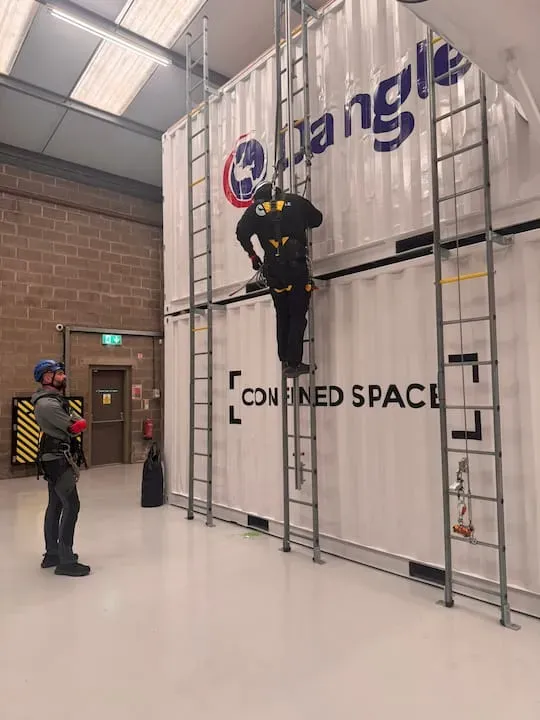
A typical day at our Belfast Harbour training centre balances classroom technical briefings with intensive sessions in our purpose-built facility. You will spend significant time handling equipment under the guidance of a mentor. This mix ensures that the theory of ISO standards translates directly into muscle memory. The 'Bronze' level is the industry entry standard for professional applicators.
Evaluating Training Providers
Many 'training-only' centres struggle to teach real-world problem solving because their instructors lack recent site experience. At Dangle® Academy, our trainers are active coatings specialists and rope access technicians who understand the physical realities of working at height or in confined spaces. When choosing a provider, use this checklist to ensure you receive the highest standard of instruction:
- Accreditation: Does the centre hold recognised industrial credentials?
- Facilities: Are the blasting and spraying booths representative of a live site?
- Instructor Pedigree: Do the trainers have a background in active industrial services?
Choosing a expert mentor who understands the technical and physical demands of the industry is the best way to secure your professional future. If you are ready to begin your journey, you can book your abrasive blaster industrial painter training today through our Belfast centre.
Dangle® Academy: Bridging the Gap Between Training and Site Operations
Dangle® Academy does not operate in a technical vacuum. Unlike training-only providers, our curriculum is forged by the daily operational realities of Dangle® site services. Our instructors are active coatings specialists and rope access technicians who spend their weeks on offshore platforms and maritime assets. This dual perspective ensures that our abrasive blasting training is not merely about meeting a minimum standard; it is about succeeding in a live industrial environment. We translate site-won experience into practical lessons that classroom-only courses simply cannot replicate.
Training in Belfast provides a unique strategic advantage. Situated in a hub of maritime and renewable energy excellence, our centre reflects the infrastructure technicians will encounter in the field. There is a powerful synergy when you combine industrial coatings proficiency with IRATA Rope Access training. For difficult-access projects, such as maintaining wind turbine transition pieces, the ability to safely manage high-pressure blasting equipment whilst suspended on ropes is a rare and highly valued skill set. A technician who understands both the physics of the nozzle and the mechanics of their descent is far more efficient than two separate teams trying to coordinate on a single asset.
Blasting in Difficult-to-Access Areas
Managing a blast hose in a confined space or at height introduces variables that a standard booth cannot simulate. The weight of a charged hose, combined with the reactive thrust of the nozzle, can easily pull a technician out of position if they lack advanced rope management skills. Technical competence must be significantly higher when you don't have the luxury of a stable floor. How Dangle® Academy prepares technicians for these high-stakes environments involves teaching them how to secure equipment and manage recoil forces without compromising their safety or the integrity of the anchor profile. We focus on the practical workflow: from setting up the blast pot at the base to maintaining the correct standoff distance whilst suspended 50 metres above the waterline.
Your Next Step in Industrial Coatings
For contractors across the UK and Ireland, having a local, Belfast-based centre means reduced travel costs and access to mentors who understand regional industrial challenges. We offer a full suite of certifications, from entry-level foundations to specialist advanced modules. Preparing for your first certification starts with choosing a provider that lives the standards they teach. Our purpose-built facility in Belfast Harbour is designed to bridge the gap between theory and the harsh technical realities of site work. You can explore our full range of training programmes to find the right path for your career progression. Whether you are looking to upskill your workforce or start a new career in industrial coatings, we provide the practical expertise to ensure you are site-ready from day one.
Secure Your Professional Future in Industrial Coatings
Mastering surface preparation is the single most effective way to eliminate the technical risks and commercial costs associated with premature coating failure. By moving beyond basic operation and committing to accredited abrasive blasting training, you ensure that every micron of preparation meets the rigorous demands of ISO 8501-1. This technical proficiency doesn't just protect the asset; it protects the workforce from the high-pressure hazards inherent in heavy industrial environments.
Dangle® Academy provides a unique advantage by combining classroom instruction with the operational insight of active industrial coating contractors. As an accredited IRATA and GWO provider based in the heart of Belfast's industrial sector, we bridge the gap between theoretical standards and the physical realities of the site. Whether you are operating in the maritime industry or the renewable energy sector, formal certification is your gateway to professional advancement and operational excellence.
Take the next step in your career and ensure your skills are vetted by industry experts. Book your Industrial Painter Training at Dangle® Academy today and join a community of professionals dedicated to safety and technical precision. We look forward to supporting your progression in this essential industrial discipline.
Frequently Asked Questions
What is the difference between sandblasting and abrasive blasting?
Abrasive blasting is the modern, regulated umbrella term for using high-pressure media to clean or profile a substrate. Whilst the terms are often used interchangeably, sandblasting specifically refers to the use of silica sand, which is legally prohibited in the UK due to the health risks of silicosis. Modern abrasive blasting training focuses on using safer, engineered media like garnet or iron grit to achieve precise ISO 8501-1 cleanliness grades.
How long does a professional abrasive blasting certification last?
Industrial certifications for abrasive blasting typically remain valid for three to five years. After this period, technicians are required to undergo a refresher or reassessment to ensure their technical skills comply with the latest health and safety regulations. Regular competency checks are highly recommended for anyone operating high-pressure equipment in safety-critical environments, such as offshore wind farms or maritime terminals, to maintain asset integrity standards.
Do I need prior experience to join the Industrial Painter Training Bronze course?
No prior experience is necessary to enrol in the Industrial Painter Training (Bronze Foundation) course. This programme is designed specifically for new entrants to the industry or those transitioning from general construction into specialist industrial roles. It provides a structured introduction to surface preparation and coating application, serving as the essential industry entry standard for professional applicators looking to build a career in high-stakes environments.
Is abrasive blasting training required for rope access technicians?
Whilst not a mandatory part of an IRATA qualification, abrasive blasting training is highly recommended for rope access technicians looking to work on offshore or maritime contracts. Many asset owners require multi-skilled technicians who can perform specialist maintenance at height. Combining access skills with technical trade certification significantly enhances your career progression and employability, allowing you to manage complex surface preparation tasks in difficult-to-reach areas.
What PPE is mandatory for industrial abrasive blasting?
Mandatory PPE includes a positive-pressure blast helmet with a continuous-flow airline, heavy-duty leather blasting suits, gauntlets, and safety boots. Because nozzle noise frequently exceeds 120 dB(A), secondary ear protection is often required beneath the helmet. All respiratory equipment must be vetted through regular inspections to ensure breathing air meets BS EN 12021 standards for purity, protecting the operator from respirable crystalline silica and toxic dust.
Can I perform abrasive blasting training online?
Whilst some theoretical concepts can be introduced through digital platforms, professional abrasive blasting training requires intensive practical assessment that cannot be replicated remotely. Mastery of nozzle recoil, grit flow adjustment, and surface profile creation can only be achieved through hands-on experience. Dangle® Academy prioritises live booth sessions at our Belfast centre to ensure every technician is site-ready and competent before they step onto a live project.
What are the cleanliness grades Sa 2.5 and Sa 3?
These grades define visual cleanliness under ISO 8501-1. Sa 2.5, known as very thorough blast cleaning, is the standard requirement for most heavy industrial coatings, requiring 95% of the surface to be bare metal. Sa 3, or blast cleaning to visually clean steel, is the highest grade possible, removing all traces of contamination and rust. Technicians learn to achieve these grades to ensure maximum coating adhesion in aggressive immersion environments.
How much does abrasive blasting training cost in the UK?
The cost of training varies depending on the level of certification and the duration of the course. Standalone abrasive blasting modules for experienced technicians differ in price from full five-day foundation programmes that include surface preparation and coating application. We recommend contacting our Belfast Harbour centre directly for current availability and tailored quotes for your specific professional development needs or corporate workforce requirements in the UK and Ireland.
Contact Us
We'd Love a Share...
Recent Blog Posts