Safety Training
Why Safety Training Is Recognised as a Primary Control in Safety-Critical Work
In safety-critical industries, risk is not controlled by paperwork alone. This is why safety training is widely recognised as a primary control measure for managing risk in environments where conditions change, hazards evolve, and decisions must be made in real time.
While policies, procedures and method statements play an essential role in planning work safely, they are only effective when translated into real-world action by people operating in complex and often unpredictable environments. Without effective safety training, even the most comprehensive safety management systems begin to weaken at the point of execution.
Understanding why safety training functions as a control — rather than simply a compliance requirement — is central to managing risk at height and in other high-risk working environments.
Training as a Control, Not a Credential
In many organisations, training is still viewed primarily as a prerequisite: something that must be completed before work can begin, evidenced by certificates or training records. While these records are important, they represent only the most visible outcome of safety training, not its true purpose.
At its core, safety training exists to influence behaviour, judgement, and decision-making under real conditions. It equips individuals with the ability to recognise hazards, understand the limitations of controls, and respond appropriately when situations evolve beyond what was originally planned.
When training is reduced to attendance or certification alone, its value as a control diminishes. The presence of a certificate does not, in itself, prevent incidents. What prevents incidents is the application of knowledge, skills, and situational awareness developed through structured safety training.
Why Safety-Critical Work Demands More Than Static Controls
Safety-critical work is defined not only by the severity of potential harm, but by the dynamic nature of the environments in which it takes place. Work at height, confined spaces, live environments, and exposed locations all involve variables that cannot be fully predicted during planning.
These variables include environmental conditions, asset condition and degradation, access constraints, interaction with other trades, and time pressure.
Static controls such as risk assessments and method statements establish a baseline for safe work, but they cannot account for every change encountered on site. This is where safety training becomes critical, enabling individuals to recognise when conditions no longer align with original assumptions.
In work at height environments in particular, training provides the foundation for recognising risk, selecting appropriate controls, and responding effectively when conditions change.
The Relationship Between Training and Dynamic Decision-Making
One of the most important functions of safety training is its role in supporting dynamic decision-making.
When conditions change during a task, workers must be able to identify emerging hazards, assess the effectiveness of existing controls, and decide whether work can continue safely or should be paused or stopped. These decisions are rarely supported by additional paperwork in the moment.
Instead, they rely on understanding and judgement developed through training and reinforced through experience and supervision. Without adequate safety training, dynamic decision-making becomes inconsistent and reactive.
This reality is particularly evident in sectors such as renewable energy, where technicians routinely work at height in exposed, changing conditions. As explored in our recent article on
renewable energy technicians, the long-term performance and safety of renewable assets depends not only on technology, but on the capability of the people maintaining and inspecting them in real-world environments.
Training, Competence, and Capability
While competence is often discussed alongside training, the two are not interchangeable. Training is one of the primary mechanisms through which competence is developed, but competence also depends on experience, supervision, and ongoing reinforcement.
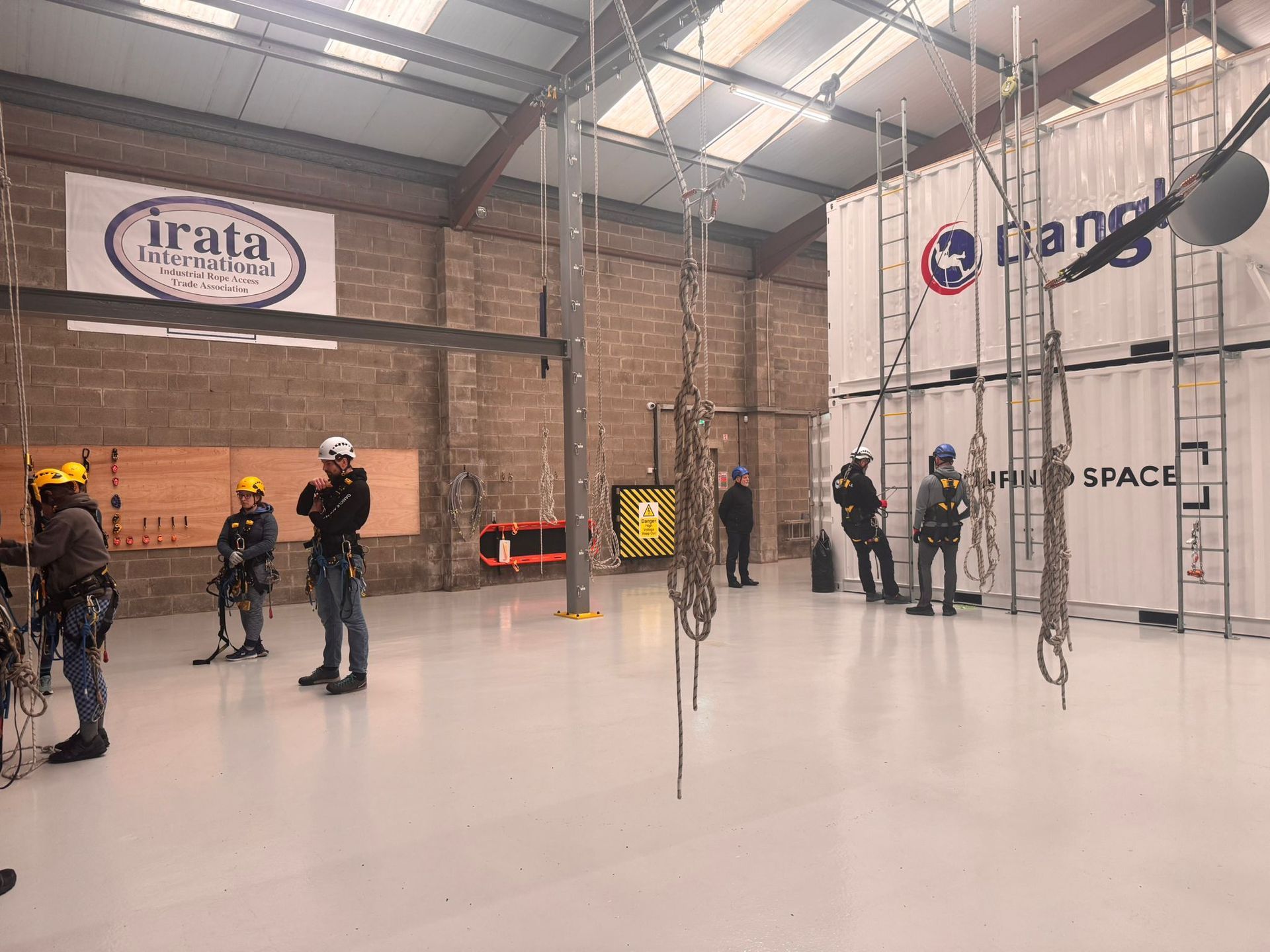
This distinction becomes particularly clear at supervisory level. For example, progression to an IRATA Level 3 Rope Access Supervisor represents a shift in how safety training functions as a control. At this level, training moves beyond individual task execution and focuses on oversight, decision-making, and control of the worksite.
Level 3 supervisors are trained to manage changing conditions, assess emerging risk, coordinate teams, and intervene when planned controls are no longer adequate — including stopping work where necessary. In this context, safety training directly underpins the ability to manage risk dynamically, not just personally, but across an entire operation.
Why Training Is Recognised as a Primary Control Measure
Within safety management frameworks, controls are often described using a hierarchy, ranging from elimination and substitution through to administrative controls and personal protective equipment.
While training is sometimes categorised as an administrative control, its role in safety-critical work is more nuanced. Safety training enables individuals to apply higher-order controls effectively and to recognise when those controls are no longer adequate.
Engineering controls, procedures, and PPE all rely on people using them correctly. In this way, safety training acts as a foundational control that supports the effectiveness of all other measures.
The Health and Safety Executive (HSE) recognises the importance of training and competence in managing workplace risk, emphasising that employers must provide workers with clear information, adequate training, and appropriate supervision to enable them to work safely and without risk to health. This reinforces the role of safety training as a fundamental control within effective safety management systems.
When Safety Training Stops Being Effective
Although safety training is a critical control, it is not immune to degradation over time. Training can lose effectiveness when it is too generic, delivered too far in advance of task execution, poorly assessed, or not reinforced through supervision and practice.
Skills fade when they are not used, particularly in high-risk tasks that may be carried out infrequently. Training that does not reflect current equipment, methods, or site conditions can quickly become outdated.
Recognising these limitations is essential if training is to remain a meaningful and reliable control.
The
Institution of Occupational Safety and Health
(IOSH) offers practical guidance and expert resources to help professionals and organisations improve health and safety performance, highlighting the importance of competence, ongoing learning, and effective risk control mechanisms as part of wellbeing and operational effectiveness.
Training, Risk Management, and Legal Responsibility
In safety-critical work, safety training is not simply a good practice or organisational preference — it is a core element of legal compliance and structured risk management.
Under UK health and safety law, duty holders are required to ensure that work is planned, managed, and carried out safely by people who are competent to do so. Competence, in this context, must be supported through appropriate training, instruction, information, and supervision proportionate to the level of risk involved.
Beyond minimum legal requirements, recognised safety management standards reinforce this expectation. International standards such as ISO 45001 place clear responsibility on organisations to ensure competence through training, particularly where work involves foreseeable and elevated risk. These standards emphasise that training must be suitable, sufficient, and aligned with real working conditions, rather than treated as a one-off compliance activity.
In high-risk, access-led environments, duty holders also rely on recognised industry frameworks to evidence competence and control risk in practice. Organisations such as IRATA define training, supervision, and operational requirements that support safe systems of work where tasks are carried out in complex and changing conditions.
From a legal and operational perspective, training alone is not a defence. What matters is whether safety training is relevant to the task, reflective of real-world conditions, and applied effectively on site. Where organisations can reasonably foresee that conditions may change during a task, they are expected to ensure that those carrying out the work are trained to recognise and manage that change safely.
In this way, safety training operates as a legally significant control — underpinning safe systems of work, supporting risk assessments, and forming part of an organisation’s duty to reduce risk so far as is reasonably practicable.
Why Choose Dangle
Here at Dangle, we pride ourselves on offering a wide range of professional and comprehensive inspection, access, coatings, and composite (IACC) industrial services and training courses to cater to the needs of both the private and public sectors. Our dedication to providing high-quality work at height solutions and training has helped us establish a strong reputation in the industry.
With a team of highly skilled and experienced professionals, we are committed to delivering exceptional results that not only meet but exceed our clients' expectations. Our on-site working at height services are designed to minimise maintenance costs in the long and short-term, allowing our clients to save on valuable resources.
Located in Belfast, Northern Ireland, our headquarters serve as the centre of our operations across Northern Ireland and Ireland. However still ensuring that we can extend our services to a wider clientele across the United Kingdom. No matter where you are located, our team is always ready to assist you with your industrial maintenance or training needs.
If you would like to learn more about how our dedicated team can help you, we encourage you to
get in touch
with us today. Our friendly and professional staff are always available to provide you with the information and support you require.
How do I book a course?
Choose your safety course from our website, and add it to your basket, then at checkout select a date from our calendar, select your preferred payment method and complete the booking. You’ll receive confirmation by email. If you’re booking a group, contact us for dates and pricing.
When will I receive joining instructions?
We send joining instructions before the course, including location, start/finish times, what to bring, and any pre-course requirements.
Can I book multiple staff onto the same course?
Yes—group bookings for Safety Training are welcome. We recommend you contact us to check availability for numbers, if you would like all your staff on the same course.
Contact Us
We'd Love a Share...
Recent Blog Posts