Renewable Energy Technicians
Why Renewable Energy Depends on Competent renewable energy technicians — Not Just Technology
Renewable energy infrastructure depends on skilled people long after construction is complete, and at the centre of that reality are renewable energy technicians responsible for accessing, inspecting, maintaining and repairing assets in exposed, elevated and technically demanding environments. Long after turbines are installed and solar arrays are commissioned, the day-to-day reliability of these systems relies on people working directly on the structure.
This is where renewable energy becomes real. Not in strategy documents or capacity targets, but at the point where technicians climb towers, transition onto structures, assess wear, manage corrosion and make safety-critical decisions in changing conditions. At that interface between technology and reality, sit renewable energy technicians.
As the UK continues to expand wind and solar capacity, the conversation is often dominated by innovation and investment. RenewablesUK is the established, influential voice of the UK's renewable energy industry, however far less attention is given to the practical reality of keeping this infrastructure operational over decades — and the skilled workforce required to do so. Renewable energy is not a passive system. It is an operational industry that relies on trained, competent individuals who can work safely at height, adapt to complex environments and take responsibility for the assets they maintain.
For those considering a career in the sector, this reality matters. Renewable energy is not only about clean power generation; it is about skilled, hands-on work that combines technical ability, safety awareness and problem-solving in real-world conditions. Understanding what happens on the ground — and who makes it possible — is essential to understanding how the energy transition will succeed.
This article looks at renewable energy from that operational perspective, examining why renewable energy technicians are central to the sector’s success, how competence is developed through training and experience, and why the demand for skilled people will continue to grow as infrastructure expands.
Renewable Energy Is an Operational Industry
Once construction is complete and assets are energised, renewable energy becomes an operational discipline. Wind turbines, solar farms and associated infrastructure must be accessed, inspected and maintained throughout their service life.
For renewable energy technicians, this work is rarely straightforward. Assets are frequently located in exposed or remote environments, where weather, access constraints and system availability dictate how work can be carried out. Elevated work positions, vertical access routes and confined areas are common features of renewable energy sites.
The reliability of renewable energy infrastructure therefore depends not just on equipment design, but on the competence of the people tasked with working on it safely and consistently.
Where Things Really Go Wrong: Access and Intervention
Most unplanned downtime, safety incidents and costly remedial work occur not during normal operation, but during inspection, maintenance or repair activities. These are the moments when technicians physically interact with the asset. For renewable energy technicians, the highest-risk points typically involve:
- Gaining access to elevated or restricted areas
- Transitioning between access systems and work positions
- Carrying out manual tasks in awkward or exposed environments
- Responding to unexpected conditions uncovered during inspection
At this stage, procedures and planning give way to judgement, experience and practical competence. This is why renewable energy performance is inseparable from the quality of the workforce supporting it.
Competence as the Primary Risk Control
In renewable energy, competence is not a formality or a paperwork exercise. It is the most important control measure for managing risk in live operational environments.
Competent renewable energy technicians are able to:
- Assess site-specific hazards rather than rely on generic assumptions
- Adapt methods safely when conditions differ from plan
- Maintain control while working at height or in exposed positions
- Recognise when work should stop, change or escalate
This level of competence cannot be achieved through theory alone. It is developed through structured training, reinforced through practical application and maintained through continual assessment.
Training as the Enabler of Safe Access and Maintenance
Every renewable energy task begins with a fundamental question: how will technicians access the asset safely and reliably?
Work at Height as a Baseline Skill
A significant proportion of renewable energy maintenance takes place above ground level. Whether accessing turbine towers, nacelles, blade surfaces or rooftop solar arrays, technicians must understand how to manage the risks associated with working at height.
Work at height training provides the baseline skills that allow work to take place safely, including fall prevention, positioning, emergency response and legal awareness. For renewable energy technicians, these competencies underpin all subsequent technical development.
Rope Access and Difficult Access Environments
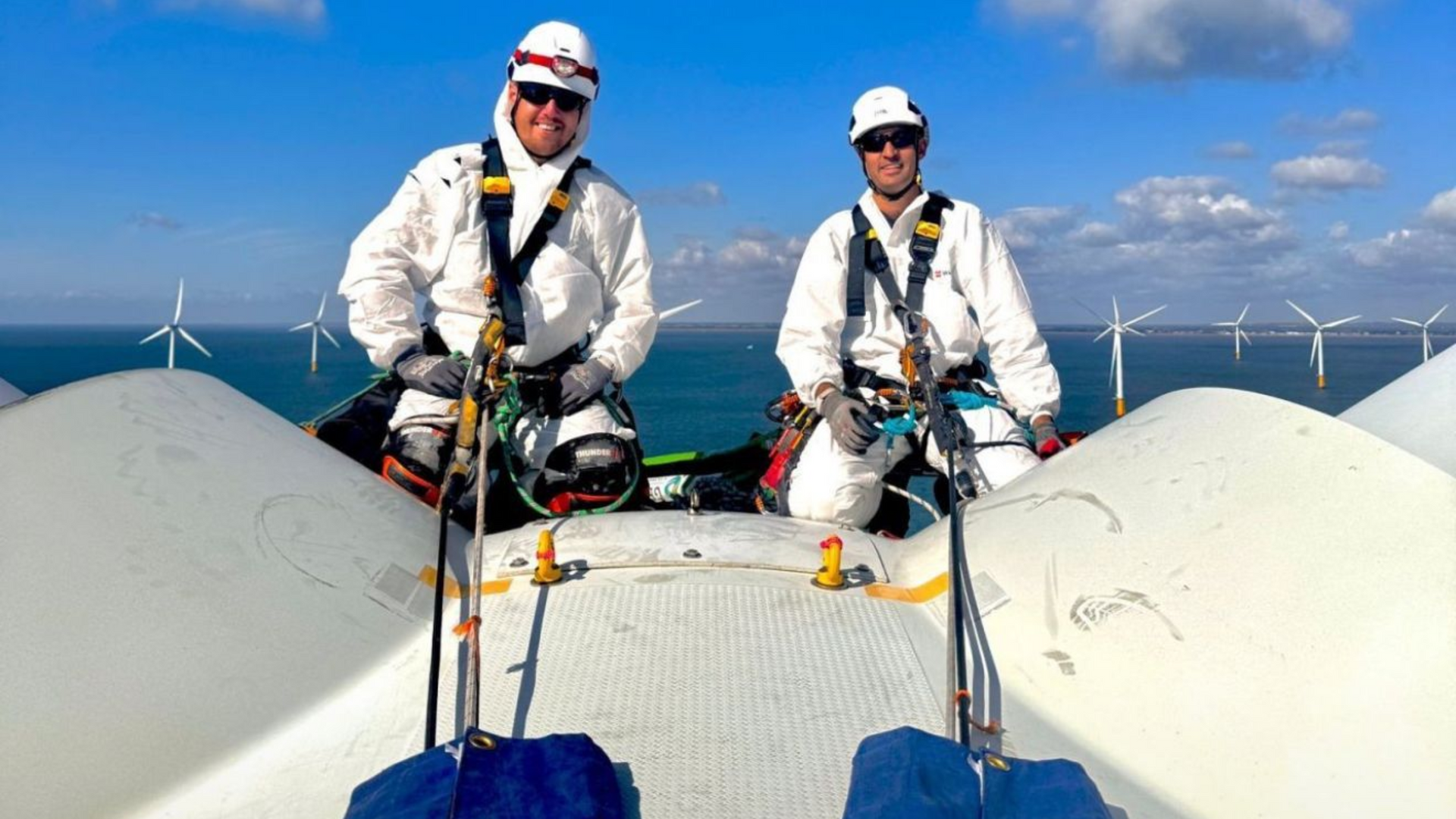
In many renewable energy scenarios, traditional access methods such as scaffolding or mobile platforms are impractical or disruptive. Rope access techniques are therefore widely used to support inspection, maintenance and repair activities on wind turbines and other renewable infrastructure.
For renewable energy technicians, rope access is not simply a way of reaching the work position. When delivered in line with recognised industry standards, it is a structured system of work built around redundancy, procedural control and rescue capability. The most widely recognised framework for this is IRATA International.
IRATA rope access courses place strong emphasis on technician competence, progressive training and emergency preparedness, with rescue embedded directly into the method. When applied correctly, it enables safe, efficient access in environments where mechanical access is not feasible, supporting the long-term inspection and maintenance of renewable energy assets.
Services: Where Training Is Tested
Training environments are controlled by design. Operational environments are not.
Once on site, renewable energy technicians must apply their training in conditions that change daily. Weather, asset condition, access constraints and operational priorities all influence how work is executed.
Inspection and maintenance activities frequently uncover issues that were not anticipated during planning, such as localised corrosion, damaged coatings or degraded fixings. These findings require renewable energy technicians to make informed decisions that protect both safety and asset integrity.
This is where the relationship between training and services becomes clear. Well-trained technicians are better equipped to adapt safely, identify emerging risks and deliver consistent outcomes in unpredictable environments.
Maintenance, Longevity and Asset Protection
Renewable energy assets are designed for long operational lifespans, often exceeding 20 years. Achieving this lifespan depends heavily on proactive inspection and preventative maintenance.
For renewable energy technicians, this includes:
- Identifying early-stage defects before they escalate
- Carrying out surface preparation and coating maintenance
- Supporting condition-based maintenance strategies
- Maintaining access systems and safety equipment
In offshore and coastal environments, corrosion management alone can determine whether assets meet their intended service life or require premature intervention. Skilled technicians play a direct role in protecting asset value.
In many cases, asset deterioration begins with relatively small surface issues that go unnoticed or untreated. Understanding how coating failures develop — and how they can be prevented — is a key part of protecting renewable energy infrastructure over its full design life, as explored in our article on coating defects in industrial environments.
Workforce Demand at the Sharp End
As renewable energy capacity expands, the demand for competent technicians continues to rise. Industry bodies estimate that hundreds of thousands of trained workers will be required globally by 2030 to support wind and solar deployment and ongoing operations. In the wind sector specifically, recent analysis from the Global Wind Workforce Outlook (GWWO) suggests that the number of technicians needed globally may rise to around 628,000 by 2030, driven by both new capacity and ongoing operations and maintenance demand.
This demand matters because renewable energy delivery ultimately bottlenecks at the point of skilled labour. Turbines and panels can be manufactured quickly, but without sufficient renewable energy technicians able to access and maintain assets safely, infrastructure performance suffers.
Industry Standards and the Direction of Travel
As renewable energy becomes increasingly global, the sector is moving towards clearer, more consistent competence frameworks.
The Global Wind Organisation has established widely adopted safety training standards for the wind sector. More recently, GWO has collaborated with the Global Solar Council to develop global training standards for the solar industry, recognising that similar access, safety and rescue challenges exist across renewable technologies.
This alignment reflects a broader shift towards transferable skills and standardised expectations for renewable energy technicians working across different asset types.
Careers Built on Practical Competence
Renewable energy offers long-term career opportunities precisely because assets require ongoing human involvement. Inspection, maintenance and repair will remain essential regardless of advances in automation.
For many technicians, renewable energy offers a rare combination of long-term stability, technical challenge and purpose.
For those entering the sector, renewable energy technicians roles offer clear progression routes — from foundational safety and access training through to specialist technical and supervisory positions. For the industry, investing in these pathways supports retention, safety culture and operational resilience.
Why Choose Dangle
Here at Dangle, we pride ourselves on offering a wide range of professional and comprehensive inspection, access, coatings, and composite (IACC) industrial services and training courses to cater to the needs of both the private and public sectors. Our dedication to providing high-quality work at height solutions and training has helped us establish a strong reputation in the industry.
With a team of highly skilled and experienced professionals, we are committed to delivering exceptional results that not only meet but exceed our clients' expectations. Our on-site working at height services are designed to minimise maintenance costs in the long and short-term, allowing our clients to save on valuable resources.
Located in Belfast, Northern Ireland, our headquarters serve as the centre of our operations across Northern Ireland and Ireland. However still ensuring that we can extend our services to a wider clientele across the United Kingdom. No matter where you are located, our team is always ready to assist you with your industrial maintenance or training needs.
If you would like to learn more about how our dedicated team can help you, we encourage you to
get in touch
with us today. Our friendly and professional staff are always available to provide you with the information and support you require.
What does a renewable energy technician do?
Renewable energy technicians install, inspect, maintain and repair equipment used to generate power from renewable sources — most commonly wind turbines, but also solar and other assets. Day-to-day work often includes planned maintenance, fault-finding, safe isolation, inspections, and working at height under strict safety systems.
What qualifications do renewable energy technicians need in the UK?
There isn’t one single route, but most technicians need a mix of technical competence (engineering/mechanical/electrical background or apprenticeship) plus industry safety training. For wind, employers commonly expect GWO Basic Safety Training (BST) and role-specific modules depending on your tasks.
What is GWO training, and do I need it to work in wind?
GWO (Global Wind Organisation) sets safety training standards used widely across the wind industry. If you’re aiming for wind turbine work, GWO BST is often a baseline requirement before site access, alongside employer induction and any additional modules relevant to your role.
What does GWO Basic Safety Training (BST) include?
GWO BST typically covers core safety topics used on wind sites, such as Working at Height, First Aid, Manual Handling, and Fire Awareness. The exact modules you need can depend on your job role and employer requirements.
Is renewable energy technician work physically demanding?
Yes, it can be. You may climb ladders, work in harnesses, handle tools, and work outdoors in changing weather. A good level of fitness helps, and you will need to have a vaild OEUK medical, but what matters most is working safely — following procedures, using the correct PPE, and staying within your competence.
Do I need rope access (IRATA) to work as a renewable energy technician?
No, not always. Many wind roles rely on GWO Working at Height and site-specific rescue arrangements rather than rope access. IRATA can be useful for certain inspection/repair tasks, but it depends on the employer, asset type, and the scope of work.
Contact Us
We'd Love a Share...
Recent Blog Posts