Work at Height in Northern Ireland
Work at Height in Northern Ireland: Legal Duties, Enforcement and the HSENI Campaign
Work at height continues to represent one of the most serious risk categories across Northern Ireland’s construction, maintenance and industrial sectors. Despite longstanding legislation and sustained regulatory attention, falls remain a leading cause of workplace fatalities and life-changing injuries.
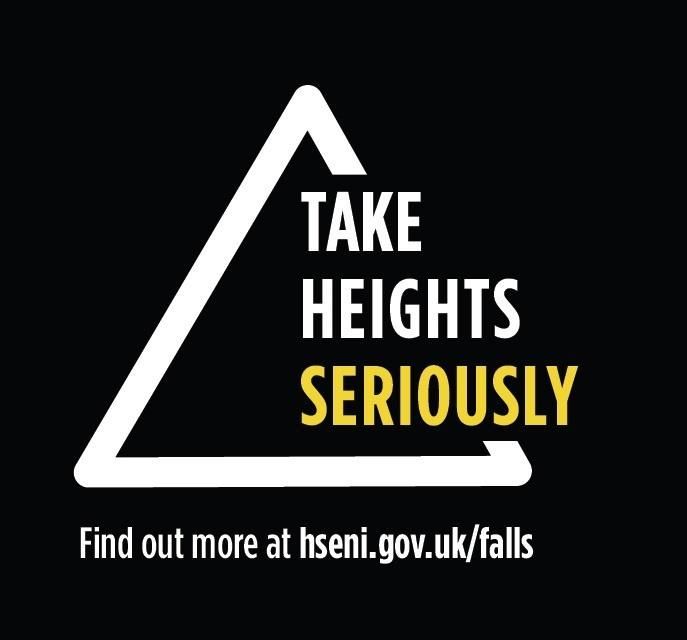
The current campaign led by the Health and Safety Executive for Northern Ireland (HSENI), in partnership with the Health and Safety Authority and the Construction Industry Federation, reinforces a simple but uncompromising message: falls are preventable.
Recent figures published by the Health and Safety Executive for Northern Ireland report 68 fatalities due to falls from height since 2016, including 16 in Northern Ireland alone. These figures reflect the wider construction and maintenance landscape and underscore why prevention remains a regulatory priority.
For organisations responsible for planning, supervising or commissioning work at height in Northern Ireland, the campaign is not merely an awareness initiative. It is a reminder that legal duties are established, expectations are clear, and enforcement remains active.
The Regulatory Framework for Work at Height in Northern Ireland
All duties relating to work at height in Northern Ireland derive from the Health and Safety at Work (Northern Ireland) Order 1978. This foundational legislation imposes a general obligation to ensure, so far as is reasonably practicable, the health and safety of employees and others affected by work activities.
More specific obligations are set out within the Work at Height Regulations (Northern Ireland) 2005. These Regulations require work at height to be properly planned, appropriately supervised and undertaken by competent persons using suitable work equipment.
Crucially, they embed the hierarchy of control. Duty holders must first consider whether work at height can be avoided altogether. Where avoidance is not reasonably practicable, measures that prevent a fall must take precedence over those that merely mitigate consequences.
The legal structure is clear and longstanding. Enforcement outcomes consistently demonstrate that failures arise not from uncertainty in legislation, but from inconsistent application.
Why Work at Height in Northern Ireland Still Results in Fatal Falls
Given the maturity of the regulatory framework, the persistence of fatal incidents demands scrutiny.
Inspection activity in Northern Ireland repeatedly identifies similar failings. Risk assessments may be generic rather than site-specific. Access methods are sometimes selected based on familiarity rather than proportionality. Supervision is assumed, yet not clearly defined in practice. Many serious incidents occur during tasks considered routine or short in duration. However, the severity of outcome associated with a fall remains unchanged regardless of task length.
Commercial pressures can also influence decision-making. Where scheduling constraints override structured planning, the hierarchy of control can be compromised. The campaign’s message that falls are preventable reflects this reality. Height safety failures are rarely unforeseeable; they are more often linked to gaps in planning, oversight or justified control selection.
Applying the Hierarchy of Control to Work at Height in Northern Ireland
The hierarchy of control is the structured approach used to manage work at height risk, prioritising the removal of exposure wherever possible before considering measures that simply reduce the consequences of a fall.
In the context of work at height in Northern Ireland, that hierarchy can be summarised as:
- Eliminate the need to work at height where reasonably practicable.
- Prevent a fall through collective protection measures such as guardrails, edge protection or properly designed access systems.
- Mitigate the consequences of a fall using personal fall protection systems, where higher-order controls are not feasible.
In practice, the most significant decisions are often made long before operatives arrive on site. Design-stage planning frequently determines whether elimination is possible, yet this opportunity can be missed where programmes are compressed or legacy methods are adopted without review.
Where exposure remains unavoidable, the focus shifts to collective prevention. Fixed guardrails, engineered edge protection and properly designed temporary works provide passive safeguards that do not rely on individual action once installed. These measures represent the strongest defensible position under regulatory scrutiny.
Mitigation measures, including personal fall arrest systems, play an important role where higher-order controls are not feasible. However, they depend on anchorage integrity, inspection regimes and competent use. Regulators will assess whether reliance on personal systems was justified or whether collective measures were reasonably practicable.
When applied consistently and proportionately, the hierarchy reduces both incident likelihood and enforcement exposure. When treated as a procedural formality, its protective value diminishes. Structured working at height awareness training can help supervisors and operational teams apply the hierarchy of control consistently across projects, particularly where exposure is intermittent or task-specific.
Access Method Selection for Work at Height in Northern Ireland: Including Rope Access
Selecting an access method is often the most consequential decision within a work at height project. Scaffolding may be appropriate for extended duration tasks or where multiple trades require simultaneous access. Mobile Elevating Work Platforms (MEWPs) offer flexibility but rely on stable conditions and trained operators, and often flat or even ground.
The proportionality of access selection remains central to defensible decision-making. As explored in Dangle Academy’s analysis of rope access versus scaffolding, the safest solution is rarely determined by tradition alone; it depends on task duration, structural constraints, exposure profile and supervision capability. A structured comparison supports compliance and commercial defensibility alike.
Rope access, when selected following suitable and sufficient risk assessment, can provide a controlled solution in complex environments where installing extensive temporary works would introduce additional hazards or disproportionate disruption.
Published safety data from IRATA International provides important context. The 2025 Work and Safety Analysis (WASA) report, compiled from data submitted by IRATA member companies worldwide and representing millions of recorded rope access working hours, identifies only a very small number of recorded falls from height incidents within IRATA-governed operations.
The 2025 WASA report details falls from height within member activities, illustrating the low frequency of such events relative to total exposure hours. This reflects the structured design embedded within IRATA standards, including dual-rope redundancy and mandatory Level 3 supervision.
Each access methodology must be justified within the hierarchy of control. Where rope access is selected proportionately and delivered within recognised standards, published data demonstrates consistent safety performance.
As an IRATA member company operating in Northern Ireland, Dangle delivers both rope access services and structured IRATA training programmes in accordance with IRATA International standards and applicable Northern Ireland legislation. Operational practice and training delivery are aligned with the requirements of the Work at Height Regulations (Northern Ireland) 2005, ensuring that competence development reflects real-world regulatory expectations rather than theoretical compliance.
Organisations seeking structured certification pathways can explore the full range of IRATA rope access courses delivered in Northern Ireland through Dangle Academy’s dedicated training centre.
Strengthening Prevention in Work at Height in Northern Ireland
Preventing falls from height is rarely about introducing new controls. More often, it requires disciplined application of established principles across planning, supervision and governance. Effective prevention begins before work commences. Design-stage review should challenge whether exposure to height can be eliminated entirely or reduced through sequencing and task redesign. Where exposure remains necessary, preventative measures must be embedded into the method of work rather than applied reactively.
Supervision must be structured rather than assumed. Clear allocation of responsibility, defined oversight and routine verification ensure that the hierarchy of control is maintained even under operational pressure. Without visible leadership and accountability, preventative measures can erode incrementally over time.
Access method selection must also be defensible. Whether scaffold, MEWP or rope access is chosen, the decision should reflect task duration, environmental conditions and exposure profile. Proportionality is central to both safety performance and regulatory compliance.
Competence development underpins all preventative effort. Organisations that invest in structured awareness training and recognised certification frameworks are better positioned to apply prevention principles consistently across projects.
The current campaign reinforces that falls are preventable not because risk is minor, but because effective controls are known and available. Where prevention is embedded into organisational culture and governance systems, both incident likelihood and enforcement exposure reduce materially.
The message behind the current campaign — that all falls are preventable — is not a slogan but a regulatory expectation. Preventability depends on structured planning, competent supervision and proportionate control selection. Organisations that embed these principles into everyday practice do more than comply; they actively contribute to reducing the statistics that prompted the campaign in the first place.
#fallsarepreventable
Governance and Enforcement Expectations for Work at Height in Northern Ireland
Height safety responsibilities extend beyond operational teams to those who commission and control work.
Under the Health and Safety at Work (Northern Ireland) Order 1978, directors and senior managers may be held accountable where offences occur with their consent, connivance or neglect. Procurement processes increasingly evaluate contractors based on methodology justification, competence frameworks and structured planning systems. Organisations able to demonstrate robust governance and recognised training pathways strengthen both regulatory and commercial standing.
Work at height in Northern Ireland remains an area of sustained regulatory attention. Organisations that can demonstrate structured planning, justified access method selection and visible leadership oversight are best positioned under inspection. Compliance is not driven by campaign visibility; it is defined by consistency.
FAQ's
What legislation governs work at height in Northern Ireland?
The Health and Safety at Work (Northern Ireland) Order 1978 establishes overarching duties. The Work at Height Regulations (Northern Ireland) 2005 define specific obligations relating to planning, supervision, competence and equipment selection.
What does the HSENI campaign signal for organisations managing work at height in Northern Ireland?
The campaign reinforces an active enforcement focus on planning, supervision and proportionate control measures. While the legal framework remains unchanged, the visibility of the campaign signals regulatory scrutiny. Organisations should treat it as confirmation that inspectors will expect demonstrable application of the hierarchy of control, not merely documented compliance.
Is rope access compliant with Northern Ireland Work at Height regulations?
Yes, when selected following suitable risk assessment and delivered in accordance with recognised standards such as those set by IRATA International. It must align with the hierarchy of control and include structured supervision.
What do inspectors typically assess during work at height inspections?
Inspectors examine whether planning reflects site reality, whether access method selection is justified and whether supervision and competence are demonstrable in practice.
Why Choose Dangle?
Dangle is Belfast’s only IRATA-accredited company, offering IRATA training and rope access services locally. That means clients in Belfast and across Northern Ireland can access verified IRATA standards without relying on providers mobilising from further afield.
We pride ourselves on offering a wide range of professional and comprehensive inspection, access, coatings, and composite (IACC) industrial services and training courses to cater to the needs of both the private and public sectors. Our dedication to providing high-quality work at height solutions and training has helped us establish a strong reputation in the industry.
With a team of highly skilled and experienced professionals, we are committed to delivering exceptional results that not only meet but exceed our clients' expectations. Our on-site working at height services are designed to minimise maintenance costs in the long and short-term, allowing our clients to save on valuable resources.
Located in Belfast, Northern Ireland, our headquarters serve as the centre of our operations across Northern Ireland and Ireland. However still ensuring that we can extend our services to a wider clientele across the United Kingdom. No matter where you are located, our team is always ready to assist you with your industrial maintenance or training needs.
If you would like to learn more about how our dedicated team can help you, we encourage you to
get in touch with us today. Our friendly and professional staff are always available to provide you with the information and support you require.
Contact Us
We'd Love a Share...
Recent Blog Posts