Rope Access Ultrasonic Thickness Testing: A Practical Guide
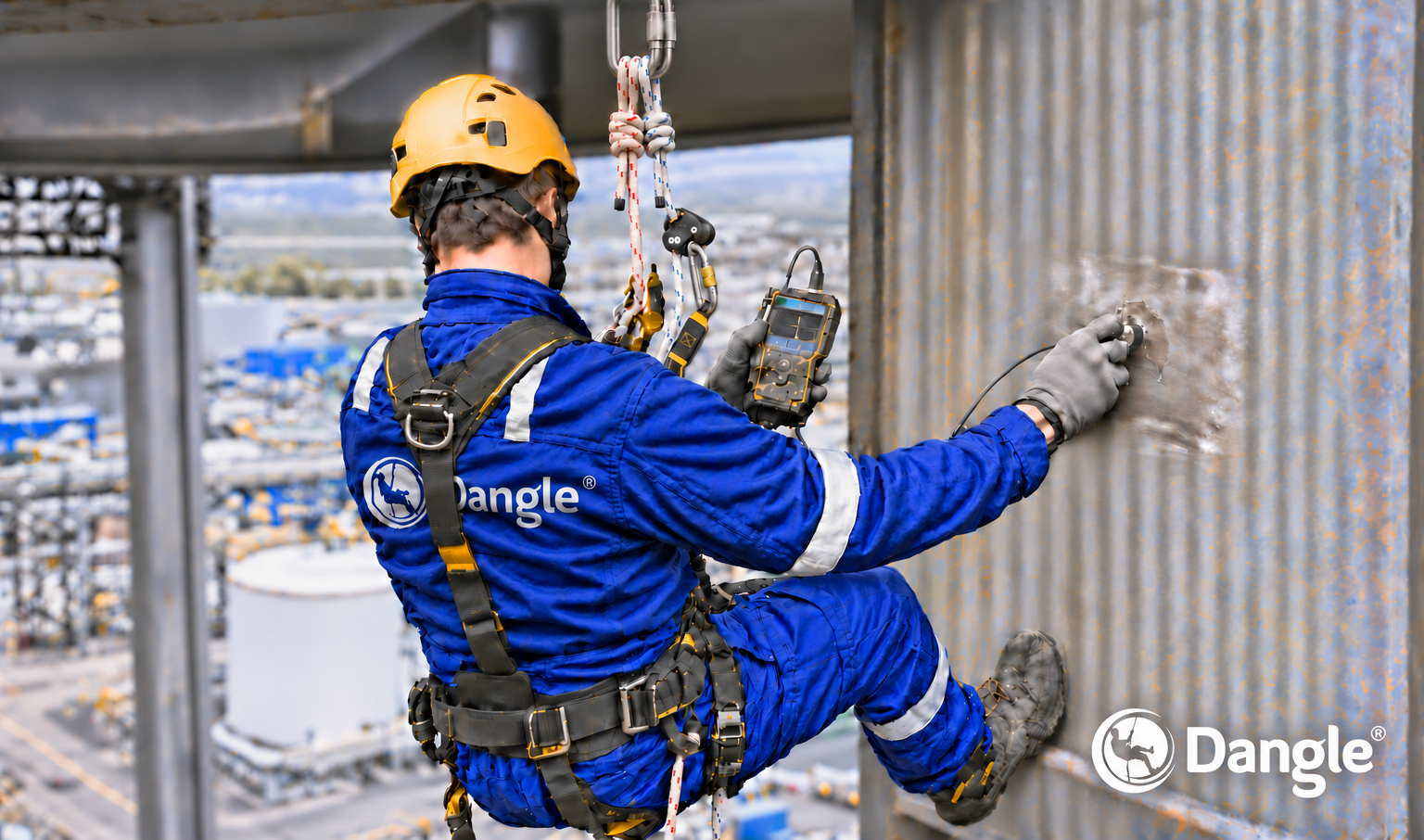
Reach difficult inspection points and gather thickness data your maintenance team can use. Rope access ultrasonic thickness testing combines specialist access with measurements at agreed locations on pipework, tanks and industrial steelwork.
For asset owners, the value is clearer evidence for maintenance planning: where readings were taken, what they show and which areas need further review. Where suitable, rope access can reduce the temporary access equipment needed for the inspection and help limit disruption around an operating site.
This guide focuses on ultrasonic thickness measurement, one application of ultrasonic testing. It does not cover every ultrasonic method or weld-flaw examination. Choosing the inspection method, procedure and competent personnel must follow the asset’s requirements.
What does ultrasonic thickness testing measure?
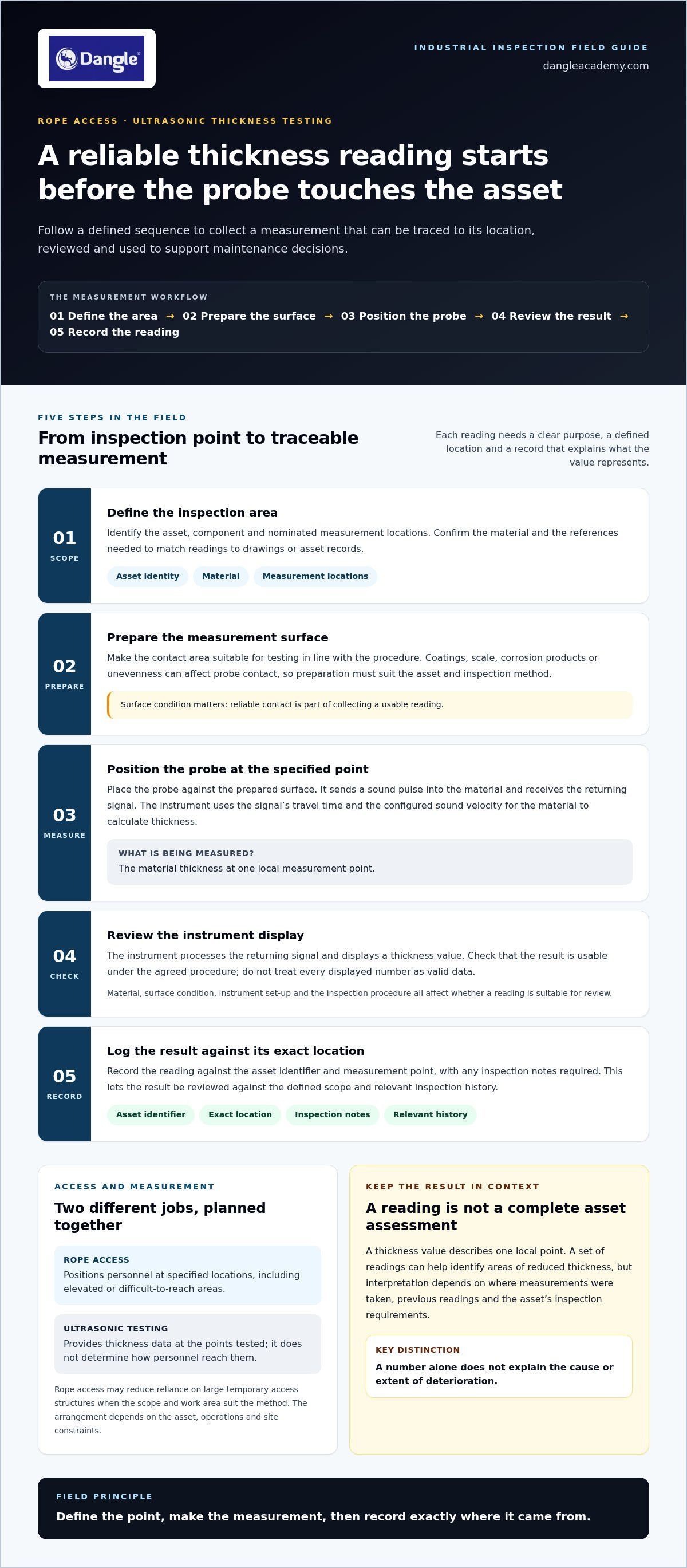
A suitable gauge measures the travel time of sound sent into a component and reflected back to the probe. Using the configured sound velocity, it calculates a thickness value. The instrument must be set up and calibrated for the material and application.
The reading relates to a local measurement point. A planned set of readings can help assess wall loss, but it does not establish the condition of every part of an asset or diagnose the cause of deterioration on its own.
Probe contact, surface condition, coatings, material and temperature can affect measurements. Couplant helps transmit sound between the probe and the surface. The procedure must address these factors and define how valid readings are obtained.
For the underlying principles, see instrument manufacturer Evident’s ultrasonic thickness measurement guide and factors affecting measurement accuracy.
Why combine thickness testing with rope access?
Inspection points may be high above ground, behind pipework or spread across a complex structure. Rope access can position technicians at suitable locations without installing a large access structure across the whole area.
- Target the required locations: plan access around the agreed measurement points.
- Support maintenance decisions: connect readings to asset identifiers, photographs and inspection history.
- Coordinate work around the site: assess access restrictions and nearby operations before mobilisation.
- Reduce avoidable repeat visits: define the required records and deliverables at the outset.
Rope access provides positioning; it does not determine testing competence or measurement accuracy. The work needs suitably competent inspection personnel, an appropriate procedure and a safe access and rescue plan.
How a reading becomes useful inspection evidence
- Define the scope: identify the asset, material, inspection purpose and measurement locations.
- Prepare and check: use the agreed surface preparation, instrument checks and testing procedure.
- Measure and record: log valid readings against identifiable locations, with relevant observations and limitations.
- Review in context: compare the findings with the asset history and project criteria through the responsible competent reviewer.
Clear location records make future comparisons more useful. An unexplained number labelled only “pipework” gives a maintenance team far less value than a reading tied to a mapped component and measurement point.
Choosing the right access arrangement
Consider the area to inspect, how long access is needed and how work will interact with the site. The comparison below highlights planning factors; the final choice depends on the task and risk assessment.
| May suit when | Planning considerations | |
|---|---|---|
| Rope access | Inspection points are elevated or difficult to reach, and the work can be completed from planned positions. | Consider anchor arrangements, positioning, rescue planning, site activity and whether the probe can be used effectively at each point. |
| Scaffold or work platform | Access is needed across a broader area, or a stable platform supports several tasks or extended work at the same location. | Consider the space required, installation and removal, interfaces with operations, and the scale of access needed for the inspection. |
| Other access arrangement | The site layout or asset geometry makes another method more suitable for reaching the nominated locations. | Assess reach, ground or support conditions, nearby activity, access restrictions and the planned response to an emergency. |
Match access to the inspection scope
Rope access may suit localised points on elevated pipework, tank exteriors, marine structures and industrial steelwork. The technician must be able to reach the nominated surface, maintain a suitable position and use the probe effectively.
Scaffolding or a work platform may be more suitable for extensive inspection, prolonged work or repeated access to the same area. Compare the full task, site constraints and access requirements before choosing a method.
Whatever the access arrangement, thickness readings need competent interpretation alongside the inspection scope and asset history. Local measurements support maintenance decisions; they are not a complete integrity assessment.
What to include in your inspection enquiry
A clear brief helps the team assess the work, identify missing information and prepare a useful quotation. Send what you have; flag unknowns rather than making assumptions.
- Site and asset: location, asset type, component identifiers, material details and photographs.
- Inspection purpose: the concern to investigate, nominated measurement points and any client specification.
- Existing evidence: drawings, previous readings, inspection reports and known areas of deterioration.
- Access conditions: approximate height, obstructions, operating restrictions and available access information.
- Programme and output: preferred dates, site coordination requirements, reporting format and who will review the findings.
Agree how inaccessible locations, uncertain readings and scope limitations will be recorded. This gives your team a clear picture of what was inspected and where further work may be needed.
Inspection reporting that supports the next decision
A useful report connects each reading to its location and the agreed scope. Depending on the project requirements, the record can include asset references, a measurement map, readings, relevant photographs, observations and limitations.
Assign a competent person to review the findings against the asset’s inspection criteria and history. Keep measured results separate from interpretation and any recommendation for further assessment. That makes the handover easier to use when planning maintenance, monitoring or additional investigation.
Why involve Dangle in difficult-access inspection planning?
Dangle connects inspection with the practical work needed to reach and maintain industrial assets. Our Belfast-based services business brings together Inspection, Access, Coatings and Composites (IACC), supporting projects across Northern Ireland and the Republic of Ireland, with wider UK work considered by scope.
That combination helps clients discuss access constraints, inspection requirements and related maintenance in one conversation. Our operational experience informs how work is coordinated around the asset, while each technical task remains subject to the required competence, procedure and project controls.
- Practical access planning: consider the measurement location and working position together.
- Clearer project preparation: identify the site information and scope needed before mobilisation.
- Useful handover: agree records that the responsible asset team can review and act on.
- A wider maintenance perspective: connect findings with discussions about inspection, access and coating requirements.
Dangle Academy is our training division; Dangle delivers field services. Learn more about our industrial rope access and inspection services.
Discuss your ultrasonic thickness inspection requirements
Send the site location, asset photographs, inspection scope and preferred programme. We can review the brief, clarify the required testing and access arrangements, and discuss the next steps for a quotation.
Ultrasonic Testing Frequently Asked Questions
What is rope access ultrasonic testing?
Rope access ultrasonic testing combines rope access with ultrasonic thickness inspection at difficult-to-reach locations. Define the inspection purpose before selecting measurement points. If the concern is possible wall loss around a pipe support, for example, the scope should identify the area of interest and the information needed for the next maintenance review. This keeps the inspection focused on a clear decision.
How does ultrasonic thickness testing measure material?
It uses a probe and instrument to obtain a thickness value at a selected point. Material information and measurement locations help inform the inspection procedure before fieldwork. This matters on assets containing different materials or components, since assumptions about the material can affect how results are assessed. Provide available asset records and identify uncertainties rather than treating every section as identical.
Is ultrasonic thickness testing non-destructive?
Yes. The thickness measurement does not require a section of the asset to be cut out for testing. This can be useful when the inspection objective is to assess wall thickness on installed equipment. However, “non-destructive” describes the test’s effect on the material, not the breadth of its findings. The scope still needs to state what question the test is intended to address and what further assessment may be needed.
Can ultrasonic testing be carried out using rope access?
Yes, rope access can be used to reach suitable inspection locations at height. Consider whether the technician can work in a stable position with adequate access to the specified surface, not simply whether the point can be reached. Site activity and the surrounding structure can affect positioning. Account for these factors alongside the inspection scope and the site’s arrangements for managing work at height.
What information should an ultrasonic thickness inspection report include?
A useful report makes clear what the results mean for the agreed inspection purpose. Alongside readings and observations, it can distinguish findings that meet the project’s review criteria from locations that may need follow-up. This gives maintenance teams a basis for assigning review actions. Establish criteria for the asset and inspection before using results to inform a maintenance decision.
Can ultrasonic thickness testing identify corrosion?
Thickness readings can help identify areas of material loss that may be consistent with corrosion, but a point measurement will not show the full surface pattern. Localised pitting between measurement points, for example, may require the scope to target the area more closely. The pattern and spacing of readings should reflect the concern being investigated. Interpret results alongside relevant asset knowledge rather than using one value to diagnose a corrosion mechanism.
Contact Us
We'd Love a Share...
Recent Blog Posts